

Native Americans in the USA and Serbs in Kosovo
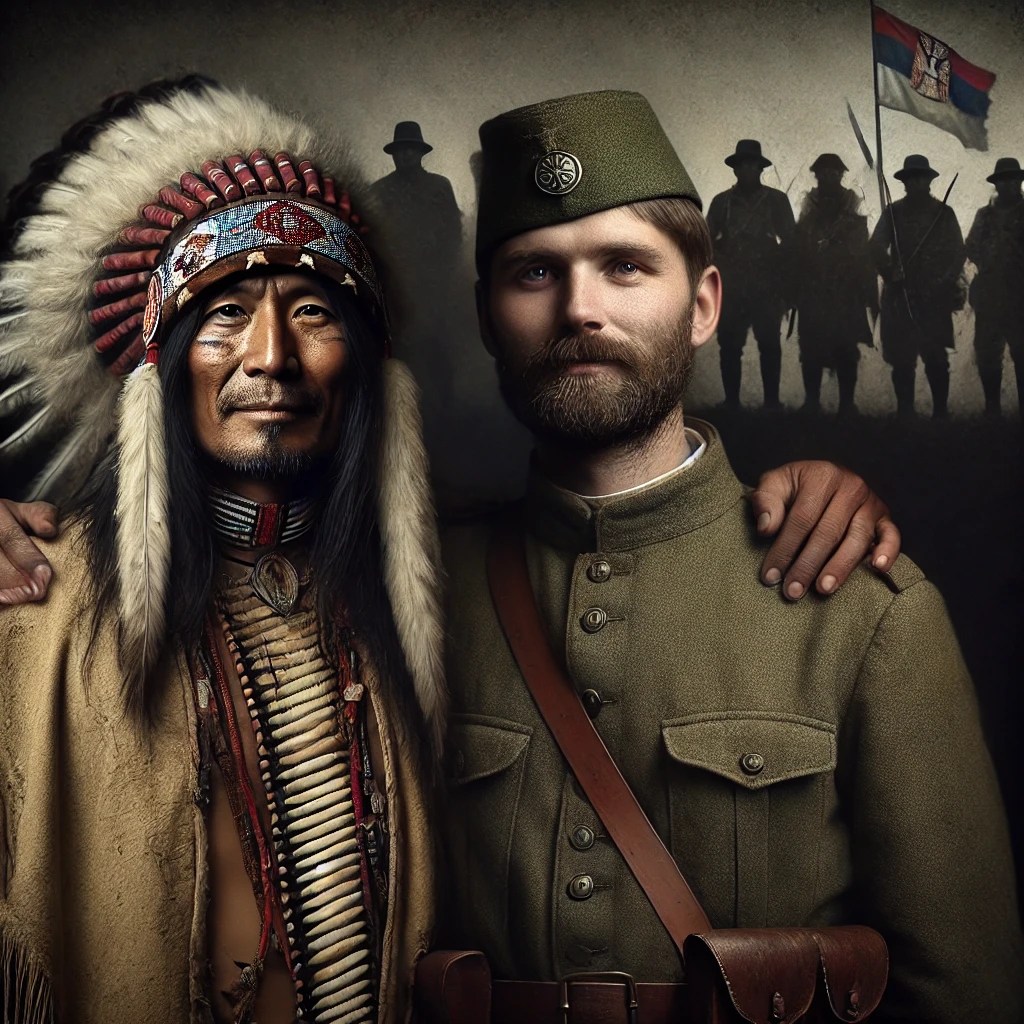
By Dejan Krstic
I asked my friend, the artificial intelligence ChatGPT, to help me with a chronic health problem. Namely, after repeated media bombardment from domestic and international TV channels, acute symptoms appear regularly, giving me no peace. I describe them in detail, and after about ten seconds, I get an answer: “Waterboarding is a form of torture that simulates drowning. This method induces extreme fear and a feeling of suffocation. The person physically cannot breathe but remains conscious and under the control of the torturer. Although it doesn’t leave lasting physical injuries, waterboarding creates intense feelings of panic, helplessness, and acute physical suffering.” Not to brag about my buddy, but he truly knows me to the core.
MEDIA PRIORITIES
Indeed, the media torturers waste no time. We learn that Donald Trump, after two failed assassination attempts, still spreads racist misinformation about how Haitian immigrants are chasing the pets of Springfield’s American hosts to consume them for Sunday lunch. It didn’t help that the mayor, governor, and senator denied the orange clown’s lies, as Trump’s followers aren’t listening and are taking “justice” into their own hands. Pressure began mounting on the immigrants of this small Ohio town. Racist outbursts and threats unsettled the unfortunate people from Haiti, who had legally immigrated to America, leaving them afraid to go to work or send their children to school. In the next segment of the news, flustered astronauts stranded in space during the Boeing Starliner mission tell us they will miss Christmas and New Year’s this year, but they’ll still fulfill their civic duty and vote in the elections!? Then comes the report on how American allies are “defending” Gaza to the last Palestinian, and for lighter topics, there’s the arrival of a panda at the California zoo and the price list at the restaurant “Adalina” in Chicago, where a glass of martini costs $13,000. Since there were no major sports events, before the weather forecast, a reporter from the Arizona desert tells us: “In the last ten years, the issue of missing and murdered Native Americans (a politically correct term for Indians), especially women and girls, has become a global problem requiring urgent action…” Besides journalists, not a single politician or human rights advocate has addressed this topic. Clearly, they’re more concerned with the price of that martini in Chicago. Annoyed by the thematic priorities of American TV stations, I decide to take a media trip back home, where only one man is on all channels. Angry, frowning, sad, worried… the president of Serbia emphatically presents seven points under the multilingual title “Return to ‘Status quo ante.’” The first demand concerns new local elections in North Kosovo, although the previous ones were repeatedly boycotted by Serbs at the urging of Belgrade. The second and third demands suggest the return of Serbs to the police and judiciary, which they again left of their own accord. The fourth relates to the withdrawal of Kosovo police forces from illegally built bases and checkpoints (but not the removal of those bases)! The fifth demand and the leitmotif of all the president’s addresses—the Community of Serb Municipalities, which can be summarized with an old Serbian saying: “It might happen, but then again, it might not!” The sixth demand is the release of prisoners, and the seventh is the re-enabling of payment transactions and postal services. After the president’s speech, one-sided panel discussions followed on the theme—“he really told them!”
Exhausted from the “dry waterboarding” of the media, I reluctantly resort to a nowadays despised activity—thinking. Is it just me, or do the fates of the Native Americans in the U.S. and the Serbs in Kosovo painfully resemble one another?
The number of missing and murdered members of indigenous peoples in North America is increasing year by year, and this phenomenon is more frequently referred to as an “epidemic.” According to the Canadian government, it is estimated that in the past decade, the number of missing indigenous women has exceeded four thousand. The situation in the U.S. is not much better, as according to FBI data, women from Native American tribes make up 0.8% of the American population but represent as much as 7% of reported missing person cases. One of the key problems is the inadequate response of authorities and police to reports of missing persons, which further fuels the feeling of discrimination and a deeply rooted mistrust in state institutions. The movement supporting the missing Native American women of North America doesn’t attract widespread public attention. Protests, performances, and artistic projects demanding justice for the missing and murdered have received no support from official institutions or indifferent fellow citizens outside the reservations. Through the symbolism of red dresses, the natives demand changes in the legal system and the government’s approach to handling these cases. At the same time, it’s not uncommon for protest participants to end up behind bars, as outside the reservations, the laws of the white people prevail.
For years now, the Serbian authorities have used Kosovo as the key theme of their political campaigns, and the Serbian minority as a symbol of resistance and the fight for national rights. Despite bombastic media appearances and quasi-patriotic rhetoric promising protection and support, the situation in northern Kosovo is getting worse. Faced with tragic reality, growing political and existential problems, Serbs in Kosovo feel forgotten, abandoned, and betrayed. Until recently, state media bombarded us with the pledge of the Serbian president that the homeland would never recognize Kosovo’s independence and that everything would be done to protect brothers and sisters on “holy Serbian soil.” Since the (un)signed Ohrid Agreement, Serbs living in northern Kosovo can only see a better life on television, as they remain victims of Kurti’s regime. On the one hand, there are empty promises from Belgrade, with appeals to remain steadfast and dignified, while on the other, legal, political, and social pressures from Pristina intensify. The result is complete confusion in the Serbian enclaves in northern Kosovo, where, as a minority without real support, they see no way out of the vicious circle of hopelessness. It leads to the conclusion that Belgrade’s insincere rhetoric is merely a media mask covering the fact that Serbs in Kosovo are essentially abandoned.
HISTORICAL SIMILARITIES
If we are to believe history, Native Americans and Kosovo Serbs have lived on their territories since at least the 14th century. Both lived in accordance with their faith, upheld traditions, nurtured customs, and minded their own business. Everything was fine until some idle, curious, and above all aggressive people decided to attack their “tribes” in search of a better life. When they found what they were looking for, the wild ones decided to chase away the tame ones.
In North America, the conquerors arrived from Europe. Hungry for land, gold, and domination, they responded to the natives’ hospitality with violence. Systematic enslavement of the indigenous people, of the land that would soon be called America, began. The modern “pilgrims” brought with them weapons, whiskey, infectious diseases, and terror for the natives. In the new state, the land of the Indian tribes became the subject of discord, deception, and wars. The natives resisted for a while, but as the years went by, the sovereignty of their tribes crumbled. The surviving natives were driven from the territory of their ancestors and placed in reservations where they still live today.
In Kosovo, it’s the same story, just different actors. The Ottoman Empire expanded westward, bringing Islam, taxes, and the devshirme (blood tax). Kosovo was part of a larger entity that was always seen as a strategically important route between east and west. Here, Serbs, like the Native Americans, lived for centuries, and the Kosovo plain was a symbol of culture, faith, and statehood. After the defeat at Kosovo Polje in 1389, the centuries-long struggle began, which, in its way, continues today. The Turks conquered it, Tito and Fadilj Hodža repopulated it, Clinton bombed it, and Milošević and Vučić “defended” it. When you sum it all up, it’s hard to judge who brought the greatest harm to the Serbs in Kosovo.
The strategy changed over time, but the motives remained the same. In North America, Indian land was taken either by force or deception because treaties were always signed to the detriment of the natives. After placing most Native Americans in reservations, the U.S. authorities provided them with lifetime social assistance to discourage them from education, creation, and advancement. Cigarettes, alcohol, recreational drugs, and unhealthy food are sold at dirt-cheap prices in the reservations, and the average life expectancy of Native Americans in North America is 48 years for men and 52 for women. A staggering 25% of this population are alcoholics, and 20.6% suffer from diabetes.
Today, there are barely four million Native Americans in the U.S., while there are just about 100,000 Serbs left in Kosovo. The first quarter of the 21st century is nearing its end, and the problems of the indigenous peoples of North America and Kosovo grow larger by the day. It’s no longer just about the legacy of the past, but also about the tacit consent of the surroundings that the slow disappearance of the natives is a natural process that should not be stopped. The world, like the Palestinians in Gaza, has completely forgotten them. Burdened by their own struggle for survival, some count likes on social media and discuss the fate of pets in Springfield, while others worry about astronauts and the panda from the beginning of our story. Life goes on…
“I told myself, my God, how much demagoguery systematically arranged in artillery salvos.
How many stolen thoughts that stand for nothing but hatred, vanity, power…?
And how much corruption must spill before our feet?
And how thoroughly the essence of deception has been brought to unrecognizability…?”
Branimir Štulić: “When Pheasants Fly”
 STORY TELLER
Leave a comment