

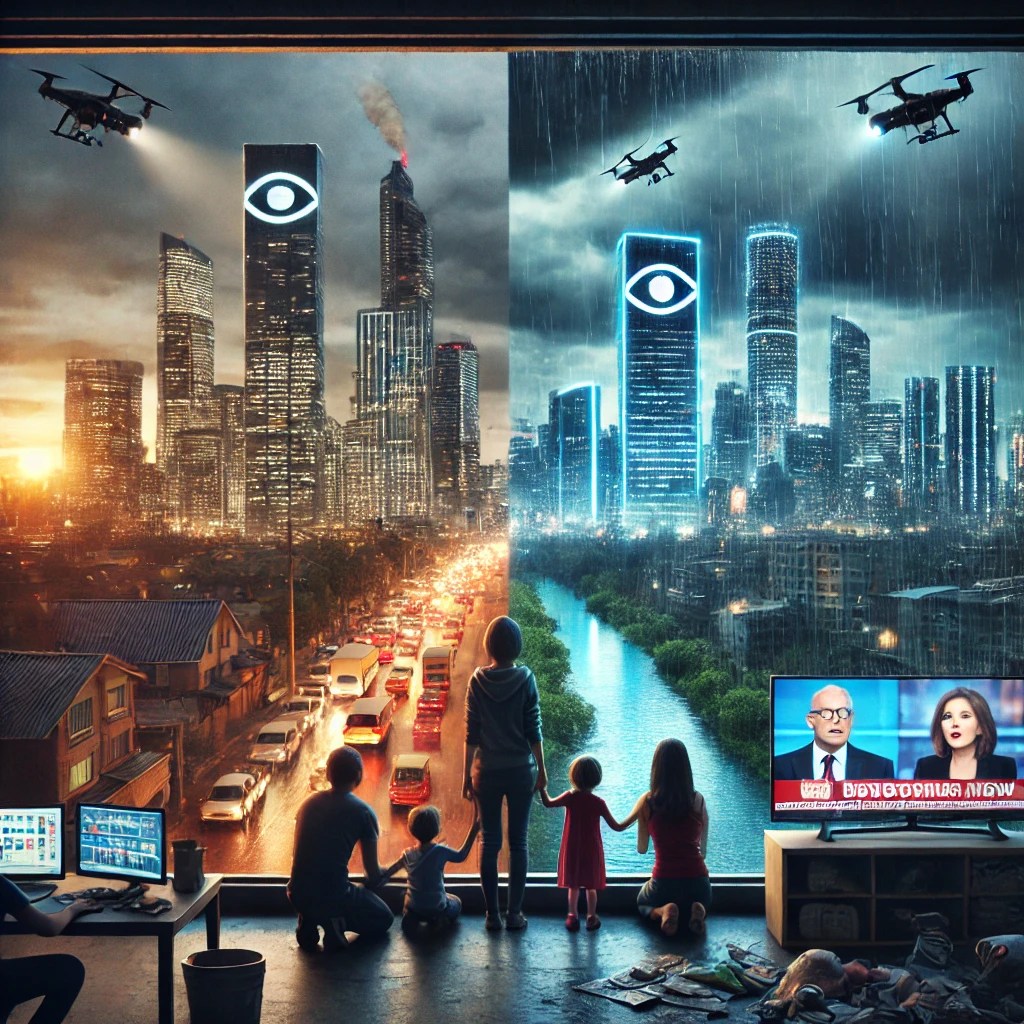
We were once taught to seek the truth in newspapers, on the radio, and on television, and to develop our imagination through literature, theater, and film. But experience tells us that reality is quite the opposite: truth is elusive, and the world is upside down. Today, the media feed us fairy tales and shiny lies, while art carves a path to the truth, decodes and exposes reality, and often even predicts the future. Artists have sensitive radars; they see what others miss, often long before anyone else. Writers are neither oracles nor prophets. They simply observe what unfolds before them with great attention, because art is not a mirror of the future — it is a scanner of the present.
One might think that in the age of the internet and global digitalization, being intuitive and visionary would be easy. And yet, few people see beyond their own noses. Twitter is more appealing than National Geographic, and Instagram seems more important than the digital content of all the world’s libraries. Literature, on the other hand, offers incredible examples of foresight, often in works created in times when even a light bulb above pen and paper was considered a luxury. Exactly one hundred years ago, Yevgeny Zamyatin’s novel We predicted totalitarian surveillance, people without names identified by numbers (just like Elon Musk’s children), and the erasure of individuality for the sake of “collective happiness.” His vision marks the first modern dystopia, warning us about the loss of freedom and identity. Zamyatin inspired George Orwell, who didn’t know what exactly would happen in 1984, but clearly saw the post-WWII world’s trajectory: propaganda, mind control, repressive systems, mass surveillance, manipulation of information and history, and perpetual wars as instruments of internal control. In Brave New World, Aldous Huxley, back in 1932, “predicted” genetic engineering and embryo selection, a society rooted in hedonism and consumerism, widespread use of calming drugs, and a uniform world devoid of identity and spirituality. Huxley claimed people would love their servitude because the system would give them everything — except the freedom to think. In Serbia, the novel Rabies by Borislav Pekic, structured as a thriller, reads today like a simulation of a pandemic crisis. The book depicts an epidemic used for manipulation and control, bioterrorism, and dubious medical experiments. Chaos ensues as fear, disinformation, mistrust in healthcare, and political interference in science overwhelm the system. The corrupt establishment exploits the crisis to strengthen its grip on power. That novel was published forty years before COVID.
WHAT JUST HAPPENED?
These days, while the authorities in both of my homelands conduct a silent implanting of full-scale idiocy into the minds of their subjects, I decided to rewatch the 2019 British series Years and Years. It’s a dystopian drama charting humanity’s rapid downfall from 2000 to the mid-2030s. The series portrays how society gradually slips into authoritarianism, technological dependency, and collective anxiety. Through the everyday life of one British family, we witness the systematic collapse of humanity across all aspects of modern society. Charismatic leaders gain popularity with shocking and populist statements, only to introduce repressive measures that most harm their own voters. Numbed by harsh reality, obedient citizens wake up too late — only to realize the devil has long since played his cruel joke on them. Truth is meaningless, justice is relativized, and hypocrisy becomes official currency. Information is filtered through algorithms, and people withdraw into their media bubbles. Unnamed viruses, quarantines, and mass panic serve as catalysts for new repressive measures and a redefinition of the individual-state relationship. Mass migration due to war, climate change, and economic collapse meets bureaucratic walls, unseen repression, and brutality. Young people strive to escape bodily limitations and dissolve into digital identities. Artificial intelligence becomes a more acceptable form of existence as the real world turns into hell. By 2025, the world no longer resembles what it was two decades earlier. Horror becomes the new normal. Stability is an illusion; common sense, a rarity. Technology doesn’t solve problems — it complicates them. Society becomes emotionally and economically shredded. And since the show’s creators have predicted nearly everything so far, we’re left wondering: what’s next? Nothing good. After 2025, things get darker. Nations become fortresses. Borders close. “Undesirables” vanish from the system. Regime critics are silenced via advanced mechanisms of digital control. Mind uploading becomes reality — not as scientific progress, but as a desperate escape from an unbearable world. The economy becomes fully centralized. Cash disappears. Every transaction is monitored. Without system access, a person essentially ceases to exist. People comply not out of belief, but out of helplessness. In the end, the series doesn’t offer salvation — just a question: What happened to us while we were minding our business, silently observing, and philosophizing on social media instead of fighting back?
For the past hundred years, both conservative and liberal media have presented us with the “absolute truth” — allegedly based on verified facts, scientific knowledge, and logical reasoning. Some support Russia, others Ukraine; most justify Israeli brutality in Gaza, while a minority expresses empathy toward Palestinian civilians. Locking down the world for a virus was “scientifically justified” and the global use of a newly developed vaccine deemed perfectly logical. Individuals who don’t believe this carefully curated propaganda are labeled as conspiracy theorists or, in simpler terms — lunatics. According to this logic, the world’s greatest conspiracy theorists are Zamyatin, Orwell, Pekic, Huxley, Bradbury, Paul Auster, and Russell T Davies, creator of the aforementioned series. Meanwhile, politicians, CNN, FOX News… are the keepers of the truth.
COINCIDENCE OR CONSPIRACY?
Some events repeat far too often to be dismissed as mere coincidence. It’s reasonable to ask: is it really all coincidence, or is someone, watching from the shadows, pulling the strings of our destiny? In the gap between official narratives and common sense emerges what we call a “conspiracy theory.” Coincidences become suspicious when they recur regularly. If certain elites always profit during pandemics, wars, and market crashes, if the same people rotate through positions of power regardless of ideology, if information is always “accidentally” censored in one direction — then something is clearly off.
Healthy skepticism is the foundation of a free mind. The term “conspiracy theory” is often a label used to discredit politically inconvenient truths. When truth seriously threatens an official narrative, it rarely gets debunked — it gets mocked. Ask about the overlap of political and corporate interests, and you’re instantly branded a conspiracy theorist, even if your question is perfectly legitimate. In practice, the “conspiracy” label works as a tool for discourse control. On one hand, we’re told not to fall for misinformation, while on the other, reality reminds us daily that “coincidence” has become a pattern. Yesterday’s “insane” ideas become today’s headlines. And art, literature, and satire, meant to amuse or scare us, more often sound like a warning of what lies ahead.
When we hear the word “conspiracy,” many imagine secret societies in dark rooms performing strange rituals. Reality is less mystical — and far more dangerous. Key players simply act according to their interests, and the system rewards their (mis)deeds. There’s no need for secret meetings — the system is built to function “automatically.” That’s why it often seems like “someone planned it all,” when in fact, everyone is just playing by rules designed so that the same people always win. If we say that powerful actors exploit crises they themselves caused to strengthen their position — that’s not conspiracy, that’s political realism. The difference lies only in tone, nuance, and openness to facts.
Many ideas that started as satire, science fiction, or dystopian fantasy have gradually become political platforms. Digital identification, mandatory vaccination, social credit scoring, banning cash transactions… All of these seemed paranoid just a few years ago. Today, they’re part of serious policy proposals. If the public reacts strongly, the plan gets shelved. If the public is indifferent, it moves forward. There’s no need for a conspiracy to steer society toward total control. All it takes is gradual normalization. Art plays a key role in testing the boundaries of acceptability. What was shocking yesterday is today a tweet, meme, or TikTok story. Tomorrow — a law.
In modern societies, there are no forbidden topics — only fear of the answers. The line between conspiracy theory and political reality is not fixed — it depends on how willing we are to question what’s presented as “truth.” We must defend the right to doubt — not out of paranoia, but out of recognition that every form of power always demands more power, and that systems don’t become corrupt by accident. In this global “mastercrafting,” art and media are not just mirrors — they are instruments.
So, whenever something “really important” happens, and the same people emerge even richer and more powerful, it’s worth asking:
Is this really just another coincidence? Or is it time we stop pretending that coincidence is the only explanation?
 STORY TELLER
Leave a comment