

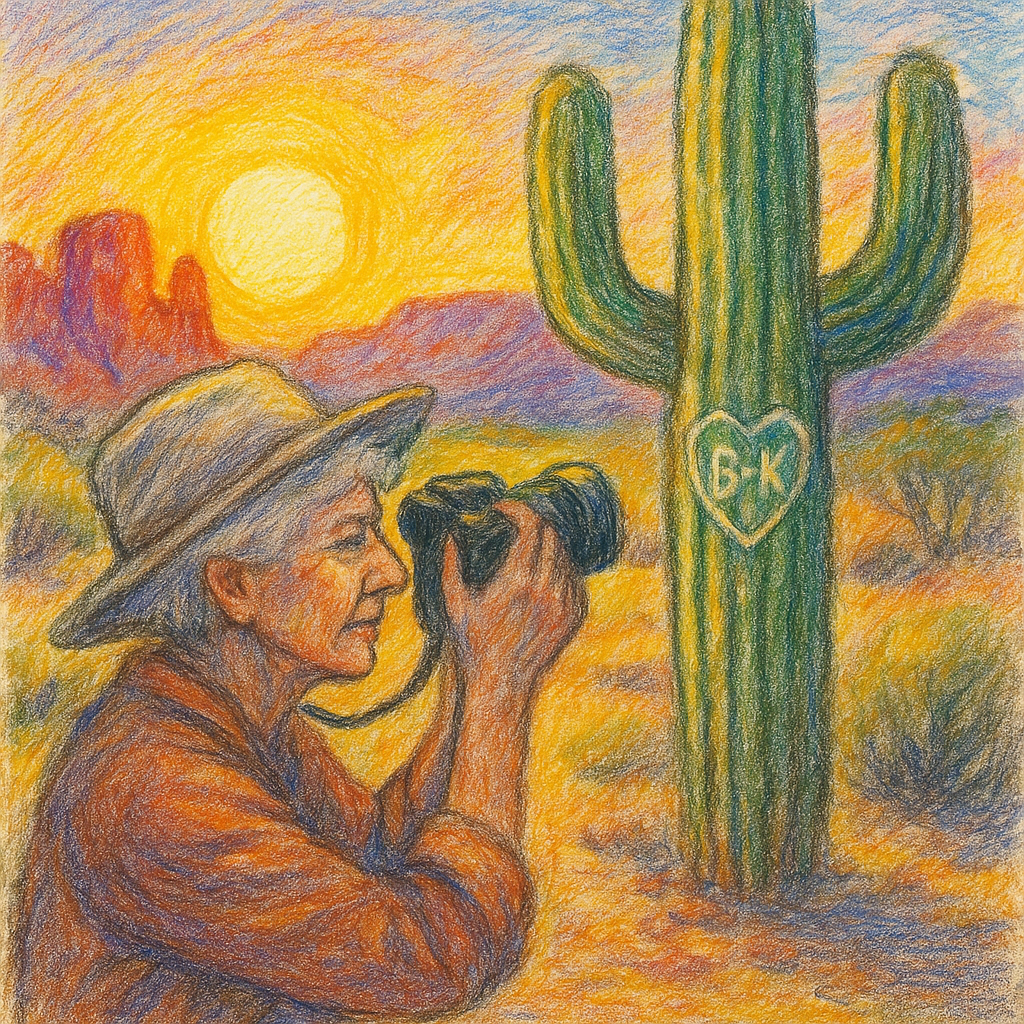
The Desert Silhouettes profile had just gained its milestone follower. Exactly ten thousand people on Instagram were enjoying Lena’s artistic photographs. Red rocks, canyons, open skies, and desert serenity—her eternal inspiration—were now capturing the attention of other lovers of landscape. The beauty of nature had long since crossed all borders, bringing joy alike to a Chinese farmer in Sichuan who had never heard of the internet and to a Silicon Valley hacker who had only seen landscapes through Instagram filters.
It had been about ten years since Elena Novak moved to what she called the most beautiful town in Arizona. A lady of Czech origin, she had once walked modestly through the marble corridors of the U.S. Embassy in Prague, following every rule to the letter. It was there she met a divorced American diplomat who fell in love with her at first sight. They married and, after his posting ended, moved to Washington, D.C. They loved each other deeply, and lived a joyful life together.
When retirement came, they moved across the country to Sedona, buying a house on the same street where Walt Disney once owned a weekend home. Lena had hoped the desert’s energy vortexes and the positive charge of the Red Rocks would heal the man she loved—her companion and best friend. But she lost him far too quickly.
She was left alone in a house full of sunlight, beautiful memories, and haunting absences. The deep emptiness in her soul gave her no peace, but she fought bravely. She could have returned to either capital—Prague or Washington—or moved elsewhere. Still, the desert’s beauty quickly took hold of her heart, and the pastel landscapes claimed her spirit.
In moments of solitude and longing, she would return to the photos she and her husband had taken during countless travels. Throughout the year, they traveled for work—and in summer, for the soul. She’d flip through an album where her husband smiled from the cover, and inside: the world in miniature—strolling through Montmartre, skating in Moscow, pyramids in Bugojno, safari in Kenya, the Yellow Mountains of Huangshan in China…
In youth, photography was a hobby; in maturity, a passion. Since settling in the heart of Arizona, the search for perfect light and composition had become Lena’s obsession and way of life. The encouragement she received online only deepened her desire to experiment—with abstract forms and desert shadows.
It was Saturday. The day began quietly, with no great plans. A mild migraine pulsed above her eyebrow—her familiar weak spot that dulled life’s beauty. She got up, made coffee, and sat on the patio. Gazing into the distance, she tugged the rubber bracelet on her right wrist with her left hand, letting it snap against her skin. She did it unconsciously, rhythmically…
The bracelet was thin, dark blue, with a barely visible motif—a gift from her husband, bought in Thailand more than twenty years earlier. In a small temple on Ko Lipe island, an old man had tied the bracelets to their wrists, saying: “Love is like this rubber band—it adapts, but it mustn’t be stretched too far, or it will snap. So take care of it, and it will last forever.”
Back then, Lena hadn’t thought much of the symbolism, but since she’d been alone, she often recalled that moment, the wise man, the bracelet… She hadn’t taken it off since. Whenever sadness crept in, she’d tug it a few times—it was her reminder of eternal love, her shield against sorrow.
She edited a few photos—a portrait of a desert rabbit and some shots taken above Cathedral Rock. She posted them in a new album titled “Traces of Wind.” Lena dressed in a tunic, hicking shoes, and a hat. After checking her camera and phone batteries, she slung her backpack over her shoulder and paused at the door. She tugged the bracelet one more time—hard—and set off down the street, then uphill toward the Red Rocks.
The afternoon was clear, not too hot for early July. The wind carried a fresh scent of dried pine. Lena walked her favorite winding trail, through stone sculptures carved by nature. The sun was lowering toward the horizon, painting the rocks in deeper shades of red.
She jumped a ditch, leapt from one large rock to another, and emerged into a clearing. And that’s when she saw it—a tall cactus with crooked arms, and the sun slowly sinking behind the rocky ridge. “Saguaro at sunset! Perfect frame,” she whispered to herself.
She clicked a few times, then again, and again… Wide shots, then details… She circled the cactus, seeking the perfect angle. She didn’t check the images right away, but she felt a special kind of satisfaction—that deep fulfillment every artist knows after good work.
As the sun disappeared behind the rocks, Lena returned to town. At The Secret Garden café, she ordered a double espresso—no milk, no sugar. Strong coffee in the late afternoon—a European habit that always puzzled Americans. She ignored the comments, sometimes replying that she slept well because she had a clear conscience—and caffeine couldn’t touch that!
On the café terrace, as the wind hummed mystically, she decided to review her latest shots. By the eighth photo, she zoomed in—something on the cactus had caught her eye. Two carved letters with a curvy mark in between. She zoomed further. At the base of the cactus were the initials: B + K, framed in a simple, awkwardly drawn heart.
Carved initials. A heart. Romance. Memory. Permanence.
“This is a cactus that remembers,” she thought, satisfied.
She posted the photo on Instagram with the caption: “Some plants never forget great love. Does anyone know the story of B + K who once loved each other here?”
At that very moment, walking past the café garden was Frank Begay—a local naturalist, wise Navajo elder, Lena’s friend and guide in her search for untouched desert landscapes. As one of Sedona’s oldest residents, Frank was known as a flawless chronicler of local history. He waved from across the street, and just as he was about to cross, Lena called out:
“Frank! Please, come here! I’d like to ask you something,” she said, immediately ordering two Southern Comforts—his favorite whiskey.
Frank turned, nodded, and headed toward The Secret Garden. He shook her hand, sat beside her, and the drinks arrived. They toasted, and Lena showed him the photo. Frank focused on the faded markings at the bottom. After enlarging and applying a filter, they saw hints of numbers…
They peered from all angles, until Frank’s still-sharp eyes spotted part of a date.
“The year is clear. And part of the month… I can’t make out the day. But the epitaph was carved in September of 1986.”
Lena didn’t stop there—she flooded him with questions: Did he remember any couples from that time? What stood out to him about the autumn of 1986? Could he help her solve the photo mystery?
Frank promised to ask around and check his journal, which he had kept faithfully since youth. After they finished their drinks, the local chronicler bid farewell and walked toward the reservation.
Night had already fallen when Lena packed her things and returned home. She printed several of the best photographs, poured herself a glass of wine, and once more studied the image of the saguaro cactus and the initials that wouldn’t leave her mind.
She dozed off in the living room and moved to bed just before dawn. She didn’t sleep long—around seven, a knock at the door woke her. It was Frank Begay.
“Put the coffee on. Double strength… The cactus story is far more interesting than I first thought. I’ve written everything down in my journal.”
Lena served honey with the coffee and squeezed fresh lemon. They sat on the terrace overlooking the Red Rocks. Frank lit a cigarette and began recalling events from four decades earlier.
The aging Navajo drew a long breath of smoke, wanting to organize the images in his mind before turning them into words. He flipped through a worn, weathered notebook. Halfway through, his finger paused.
“August… and here’s the start of September!”
As if reading his mind, Lena brought out a bottle of whiskey and two glasses.
“Somewhere in the world, evening is falling,” she said, justifying the morning toast.
Frank’s face lit up, and after the first sip, he returned to the journal.
“That year, I was working as a desert guide. People came from all over the world, and I was learning trails I hadn’t even known as a child. It says here—autumn 1986—I met a young couple from California. Betty and Karl. She was a painter. He recorded the desert’s voices, patiently waiting for the perfect sound—whispers, trickles, silence. They were in love with each other, with nature, with people, firewater, and the herb of laughter and silence.
Betty spent hours painting the Red Rocks from different angles, while Karl roamed with a giant reel-to-reel recorder—it looked like he was carrying an entire radio station on his back. He told me he was searching for something special—the sound of silence, or silence that sounds.”
Frank licked his finger, turned the page, and gazed at the painted sky, recalling that distant time.
“One morning, just after sunrise, they were walking near the cactus when Betty hurt her leg. They sat down and carved their initials. Later, Karl carried her on his back to my reservation, where the shaman wrapped her ankle and gave her healing herbs. The next day, a storm was coming…”
He lit another cigarette. With a slow match strike and deliberate inhale, he continued.
“Karl told me that rain and wind create the best resonance behind the Red Rocks—and that the storm was his chance to finally capture the sound. That one, unrepeatable sound you can only hear in Sedona. I tried to stop him. I felt something bad coming. Betty begged him not to go. But he wouldn’t listen.”
Lena poured them another drink and waited in silence.
“He never returned. We searched for days. My tribesmen joined in, along with the police and locals. Eventually, we found the broken recorder and tapes scattered by the wind. Then, by pure chance, Betty spotted a cassette. ‘He always carried a dictaphone—just in case,’ she explained. His body was never found.
When we got back to town, we played the cassette. We heard incredible sounds—strange whispering, unreal voices. And at the very end, Karl’s voice: ‘My love! Forgive me for leaving you forever—for chasing obsession and being selfish.’”
Just then, Lena’s laptop chimed. It sat beside the bottle of whiskey, gently “pinging,” begging for her attention. She opened it—an Instagram DM from user Beti Art:
“That was our saguaro. Betty + Karl. Forever. Thank you for finding it and reviving the memory of the cactus and of Karl.”
Two days later, Lena and Frank walked the familiar trail in silence. Instead of her camera, Lena carried a bouquet of flowers and a thin rubber bracelet. Dark, simple, engraved with the memory of eternal love. The cactus stood in its place, proudly bearing the heart with initials B + K carved into its skin.
Frank stood a few steps behind. Lena approached, knelt down. She stretched the bracelet one last time, let it snap gently against her wrist—one final time—then slipped it off and laid it at the cactus’s root.
The air smelled of sage and red earth. The wind rustled softly through the cactus’s spiny arms, spreading the song of love.
 STORY TELLER
Leave a comment