

At the far south of Arizona, Mount Lemmon and the Santa Catalina range formed a natural wall, reminiscent of an ancient time when people moved freely, loved openly, and lived together. All was peaceful until the day some gringo decided to draw a border with a ruler. North of the mountains lies Tucson, and to the south – times when no one asked for a passport. In the largest town in the American part of the Sonoran Desert, summer is not just a season, but a “torture chamber” for schoolchildren and students alike. The authorities, in their wisdom, decided the school year should begin in late July – when temperatures don’t drop below 110°F even in the shade. And people, as people do, long for shade.
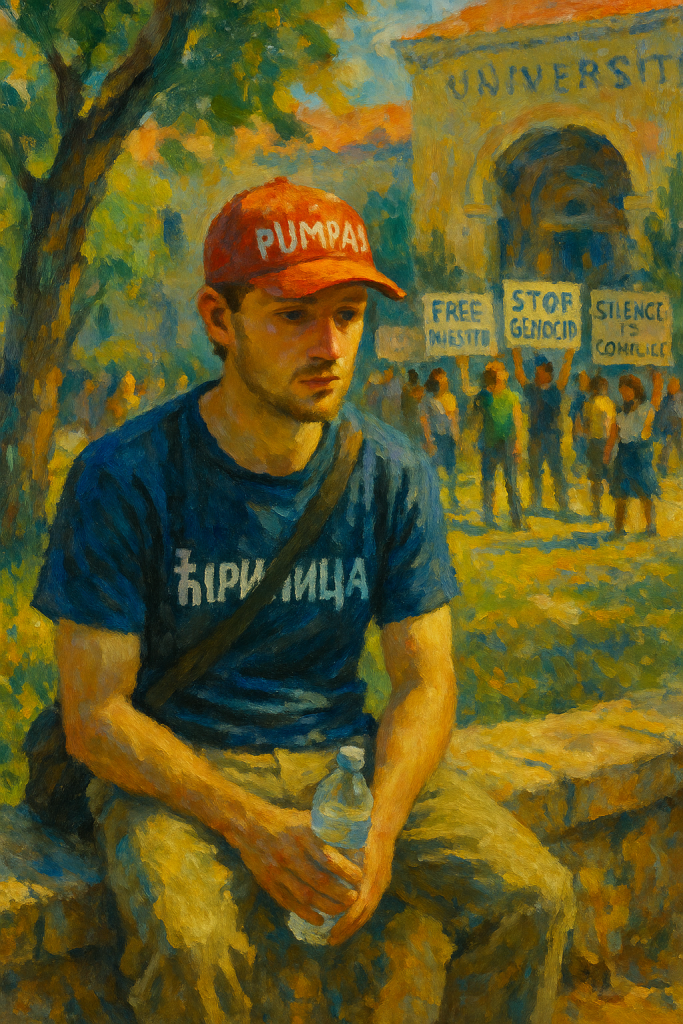
It’s noon. The hot air clings to the skin, the streets are deserted, and the sidewalk shadows are as short as the patience of Tucson’s residents. In the middle of the desert, the Arizona State University campus rises like an oasis of knowledge, free thinking, and tolerance – but there are fewer and fewer who thirst for truth. Students move slowly, disinterestedly. On the walls: slogans – “Freedom for Palestinians in Gaza,” “Stop the Genocide,” “Silence = Approval!” Between lectures, on the yellowing lawn in front of the library, about twenty students protest. Despite their cries against atrocities, the atmosphere is subdued – lukewarm in contrast to the blistering desert heat.
Bane, a student from Serbia, arrived in the U.S. last month. Today was his first day of professional development. He sat on a low stone wall beside the path to the library, beneath a scraggly pine whose needles barely offered shade. In his hand, a plastic water bottle. He sipped from it now and then – not out of thirst, but to give his hands something to do. He watched the students walk by, slow and lifeless, like wind-up dolls. Posters, slogans on T-shirts… All of it evoked tragedies taking place far from this campus, far from Tucson, and even further from the American mind. The whole protest seemed limp – as if done out of obligation, not out of the desire to expose truth.
He tried to feel a sense of belonging, to believe in the values these young people claimed to uphold – at least on paper. He walked with his peers toward amphitheater A-117. A massive lecture hall at the end of the corridor – dark and perfectly air-conditioned. Professor Michael Greenberg stood before the board, mentally preparing for his first lecture to the freshman class. A short man in his late fifties, he wore a gray blazer. Wisps of thinning hair fell across his collar, dandruff clinging to the lapels. Fatigue weighed down his hunched shoulders. On the board, in rushed handwriting, was scrawled a quote by Aristotle:
“Where the law does not rule, there is no constitution. The law should be supreme, and even the rulers must be its servants. For if justice is equality, then all must be subject to the same rules.”
The students took their seats – some scrolling through phones, others scoping out their classmates. Bane sat next to a stunning Black woman and two guys he couldn’t quite place – either Arab or Latino. Back home, friends had predicted this: at first, he’d obsess over ethnicity, trying to decipher people’s bloodlines. But eventually, he’d stop counting red and white blood cells. In America, people from all over the world live side by side – racial math is a dead end. At least until Trump and his kind change the equation. And by the looks of it…
The professor sipped from a bottle, then closed it. As the noise faded, he began:
“Dear colleagues, future philosophers, let’s not waste time on introductions. Let’s dive right in. Who wants to comment on the quote on the board?”
A few students offered textbook platitudes – about law as the foundation of society, justice as a gradual conquest, nothing being absolute. The professor nodded along, encouraging further thought. Then a short-haired guy wearing a T-shirt with Cyrillic letters and a crossbody bag, raised his hand.
“Yes, go ahead.”
Bane hesitated for a moment, then responded with a question:
“Professor, were you at the protest out front today?”
Silence blanketed the room. As if on cue, every eye turned toward the accented student with a shirt that read – Pumpaj!
Greenberg slowly lowered his water bottle and leaned against the wall by the board.
“It’s expected of faculty to remain neutral. Our role is to teach, not take sides. If each of us shared our political opinions publicly, we’d stop being professors and start being propaganda.”
Bane’s neighbor by the door didn’t wait for permission – he shouted:
“The propaganda is already taken care of – by state-run and, frankly, most other media. If you intellectuals stay silent, what can we expect from some uneducated American getting all their info from Facebook?”
Though he agreed, Bane disliked being interrupted. He picked up where he left off:
“Aristotle says: A citizen is one who takes part in deliberation and in governance. If you remain silent, Professor, you’re not a citizen – you’re just a spectator. Academic neutrality becomes complicity the moment power turns into autocracy and you do nothing.”
A voice from across the amphitheater rang out:
“Exactly! Silence isn’t a defense – not when it comes to genocide in Gaza or fascism in America.”
Greenberg hesitated. Good pay, great benefits, funding for research… But hard to trample everything he’d learned about humanism, civilization, ethics…
“That’s a strong, though somewhat simplistic, interpretation of Aristotle.”
From the back row, a girl with messy curls and Israeli flags painted on her sleeves stood up:
“What about October 7th, 2023? What they did to us -was that justice? Should we just stay quiet and wait for terrorists to strike again?”
“Evil doesn’t stop by multiplying it,” Bane shot back. “An eye for an eye blinds both the victim and the aggressor – even when their roles reverse.”
A group of silent students in the far-right corner shifted. One heavyset guy wore a hoodie with an American flag. On the back: a semi-automatic rifle and the words: AR-15 for Trump.
“Easy for you to preach, foreigner. You weren’t here when our people died on 9/11. If you don’t like it, go back where you came from.”
“Yeah,” said his pale, ratty sidekick. “Trump’s guard is happy to escort you out.”
The professor wondered whether the debate had gone too far. He let it roll a bit longer.
Then a tall guy with a Pancho Villa mustache stood up. His shirt read: On stolen land, everyone’s an illegal. He looked directly at Greenberg:
“If you’re neutral about genocide in Gaza, how come you’re not upset when your President locks migrants in cages?”
The professor stayed quiet. But a new punch came from the far right – literally. A red-faced blondie in a MAGA hat jumped up:
“All you foreigners are the same. You come here, use our benefits, take our jobs, and then preach to us. We don’t care what Mexicans, Arabs, or people with weird alphabets think. Where’s this punk from anyway?”
“That alphabet’s called Cyrillic, you MAGA philosopher,” Bane snapped.
The professor tried to keep control:
“Everyone is free to speak here.”
“Yeah, and we’re free to say we’ve had enough of America-haters!”
Bane ignored him and locked eyes with Greenberg.
“Plato says: In democracy, people live as they please. Freedom is exalted above all, but when it becomes excessive, discipline erodes, laws are ignored, and democracy slides into tyranny.”
“See! Even Plato says we need order,” the MAGA crowd snickered.
But Bane kept going, quoting the philosopher:
“Plato also says: Democracy gives power to those with neither wisdom nor responsibility. And so, the state ends up in the hands of people unfit to lead.”
Silence.
Professor Greenberg used the pause to outline the semester syllabus. But “ceasefire” didn’t last long. A soft voice spoke up – from a girl with no slogans, no flags, wearing jeans, a white shirt, and loose black hair.
“Excuse me, Professor, but it’s not fair to interrupt someone in the middle of a debate. The guy in the Cyrillic shirt hasn’t finished.”
Swallowing hard, Greenberg turned to Bane.
“Please, go on.”
The student from Serbia rose slowly, looked at the young faces around him, and spoke plainly:
“I’m not here to lecture you. Or to win you over. I came to see what it’s like to live in a free country with functioning democracy. But I found fear – on the faces of people who have everything, except the guts to speak up. You ask why I care? Because silence equals complicity. If you mind your own business, you’re no different from those who disagree – and you’re helping your oppressors. I know how it feels to keep your head down to survive. I know how tear gas burns. How police batons sting. And the kind of silence you don’t choose – it’s imposed. You say: ‘Go home.’ Where, exactly? Back to where the government swings a stick and the people pretend not to see? Even there, students speak up. Even there, I don’t stay silent. Freedom isn’t American, Palestinian, or Serbian. It has no passport, no flag – but it has a price. You chose silence. I chose resistance. It may feel easier now – but one day, guilt will catch up to you. At least, for those who still have a conscience.”
The professor used the break to wrap up the lecture. Others stayed quiet. Some stared at the floor, some at their phones. Most just wanted out.
Outside, the sun was still scorching, the heat working overtime. At the edge of campus, Bane stopped and looked up at the mountains.
“In the land of the ‘free,’ telling the truth is the hardest thing,” he thought.
 STORY TELLER
Leave a comment