

It was Saturday, early morning, when customers discovered that Slava’s barbershop was closed. Next to the sign with working hours stood a short, bilingual message: “This Saturday, due to marital obligations, I will not be working!”
No, no—it’s not what you think, mischievous reader. This Arizona barber is an honest Serb with permanent residency in the U.S., who keeps intimacy behind closed doors. This was actually about tourism.
The last time Slava took his Stana on vacation was in 2012, through her union in Serbia. After that, they went a few times to the “Pumpkin Days” festival in Kikinda, where the biggest pumpkin is chosen, but since coming to Arizona—vacationing was forgotten. This weekend, they decided to visit the northern part of their new desert “homeland.”
After drinking his coffee, packing the trunk, and starting the Buick to cool the inside, Slava paced nervously down the hallway, waiting for his lifelong companion.
“Just five more minutes!” Stana called from the bathroom.
“Come on, woman, we’re going to the mountains—who’s going to look at you there? Your five minutes last as long as two Trump terms!”
As soon as they sat in the car, the barber adjusted the mirrors and hit the highway. Stana carefully typed the destination into her phone app, but Slava didn’t trust GPS.
“Some woman from a phone isn’t going to tell me where to turn. The best navigation system is a wise male head—and if you’ve got a map, even better…”
“But Slava, this ‘woman’ knows where Flagstaff is. Last time, you ended up toward Nogales when we wanted to go north.”
“That wasn’t a mistake—it was… an alternative route.”
He popped in a CD with the Yugonostalgic hits of his youth, they reached Ash Fork, where they joined the famous Route 66.
“On this road, my dear, Peter Fonda and Dennis Hopper rode their motorcycles in Easy Rider!” he sighed wistfully.
“Don’t be biased—Thelma and Louise drove here too!” Stana snapped back.
After an hour and a half, they stopped for breakfast at the Monte Vista Hotel, famous for its mystical happenings and paranormal events. They stepped into a restaurant filled with the smell of bacon, coffee, and the Wild West. Everything was authentic, including staff that could scare any normal child. They sat at a table near the entrance, with a clear view of the reception desk where old Billy, a hundred years strong, dozed off.
Their waitress could have passed for a witch—messy hair, black makeup, and a tattoo of an evil spirit on her forearm.
“Good morning, what can I get you?”
Stana ordered a pastry with white coffee, Slava went for a full omelet and extra bacon—or, as the menu called it:
“One ‘Morning Apparition in a Vampire’s White Cloak’ and ‘The Sheriff’s Last Stand,’” the waitress summarized.
“I thought I was ordering breakfast, not a horror-western. But fine, I’ll take it before they change the genre and bring sushi!”
As Slava poured his third coffee, he thought he saw the bellboy and porter vanish through the western wall, where there were no doors or windows.
“Watch out for the Lady in White,” the waitress teased. “Sometimes she shows up after the third coffee.”
She confided in them that at a corner table often sat a pale man with long white hair, who came in every day, drank a bottle of red wine, and when the bill came—simply disappeared. They checked security cameras, but no trace of him until the next day. It had been like that for years.
“This place reminds me of the in-laws—you’re never alone, and you always end up paying for their drinks.”
“They say once a guest reported his chair dancing around the room,” Stana added.
“And when my customers steal newspapers, you all say Slava exaggerates!”
After breakfast, they continued to Sunset Crater, the volcano whose terrain resembles the surface of the Moon.
“See, Slava, Armstrong and the other astronauts trained here before flying to the Moon,” said Stana.
“So, they practiced walking on the Moon… in Arizona?”
“Yes, the terrain is similar.”
“Then I can claim I was in Egypt, because I walked on sand in Kikinda.”
“Hopeless case.”
“If they went to the Moon, then I fought in the Battle of Kosovo!”
That evening, they visited Lowell Observatory. The curator explained that Pluto had been discovered right there.
“So, little Johnny from Flagstaff peeks into a telescope and bam—a new planet. Like guessing the right rakija in a tavern—pure luck.”
When he heard Pluto was no longer a planet, Slava shrugged: “My buddy retired too, but we still call him Tika the Postman.”
They spent the night in a modest motel, free of mysteries. The next morning, as Stana was getting ready, Slava impatiently tapped his feet by the window:
“If you’re not ready in five minutes, we’ll get to Bisbee after the third mining shift is over.”
“There are no mines anymore, Slava.”
“That’s why we’re leaving early—to see what’s left.”
As they drove south, the landscape changed: pine trees gave way to rocks and desert, until finally the hills of Bisbee. The town’s entrance looked like an old postcard—brick facades, winding streets, and ruins where the copper mine once stood.
Their first stop was the Serbian Orthodox Church of St. Stefan Nemanja. An elderly man in a black cassock greeted them.
“Father Radovan,” the barber said warmly, “when I was a kid, I heard my great-grandfather—my namesake—worked as a miner in America. I’m curious if it was here in Bisbee.”
“We have a donor book from 1877, so if he was a man of faith…”
“But the church was founded only in 1956?” Stana asked.
“Among the miners, there was always a man of God, or a priest’s son. Services were held in homes. Here, look—there’s a Slavoljub, last name Števin?” Father Radovan said, leafing through the old book.
“That’s him! My namesake and distant ancestor, a tambura player. They say he sang in the mine when times were hard. He made it far by ship, and I barely dragged myself here by plane.”
They bought a few souvenirs, lit candles for the late grandfather Slava and for the health of his descendants, then headed downtown. When the mine closed in the late 1970s, the town was soon filled with bohemians and artists, and later with members of the LGBT community—then frowned upon in much of America. Stana wanted to see the galleries lined up one after another.
The first was “55 Main Gallery.” The walls were covered with paintings, jewelry, and bent metal shapes Slava couldn’t describe even under a polygraph.
“Look at this, Stana… someone bent a spoon and glued it to a wooden board. And that’s art?”
“That’s conceptualism, Slava.”
“I conceptually wanted to clean out the garage, but never got around to it. Imagine how many ‘artworks’ could be found there!”
Next stop: the Artemizia gallery. Walls full of graffiti, Warhol, Kusama, and in the corner the famous “Banksy rat.”
“You know who’d like this? That bald Šumadijanac who used to be a journalist, now a banker. He claims to understand these modern tricks. When I see this critter on the wall, my first thought is to call pest control.”
Among the exhibits was a sculpture of seashells, a bicycle, and a tennis racket.
“Is this art or did someone forget their stuff?” Slava asked a young artist with purple hair.
“It’s the journey of the soul.”
“Hmm, no wonder it looked familiar.”
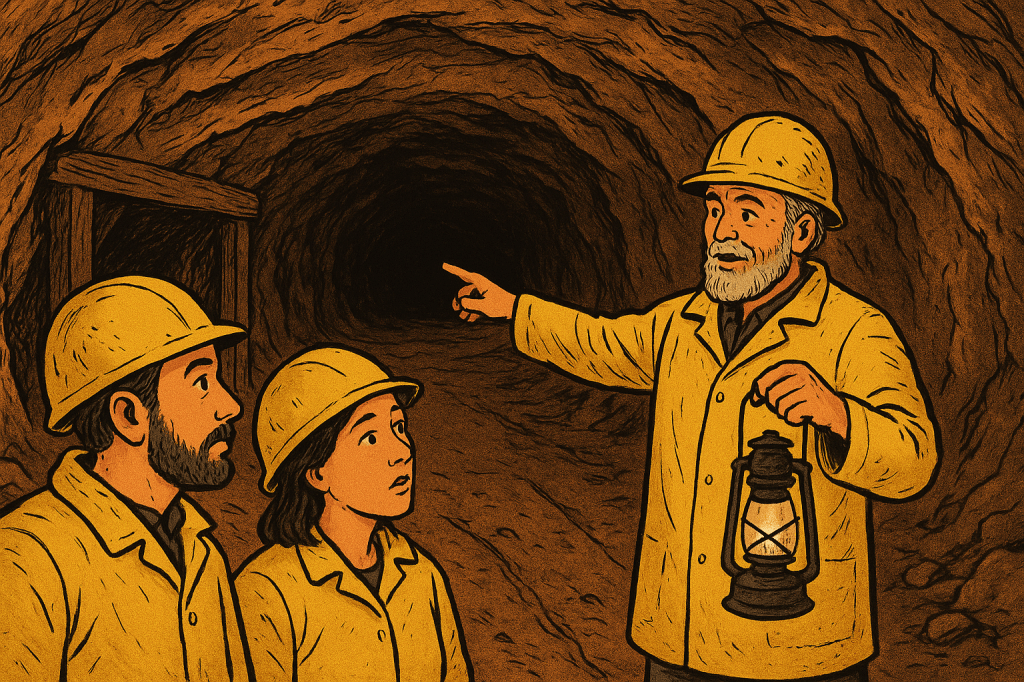
After fulfilling his wife’s artistic wish, the barber finally got his turn: the Lavender Pit mine. After viewing the open pit, they put on yellow raincoats and helmets and descended into the tunnel by a small mining train. The guide, an old man with Popeye’s arms, spoke calmly, as if counting minutes to the end of his shift.
“People worked here twelve hours a day, deep underground. No air conditioning, no cell phones… just sweat, dust, and copper.”
Slava cut in: “So what did they do when they got bored?”
“Worked harder, so they wouldn’t get fired.”
“My great-grandfather dug here too. They say he played tambura and sang.”
The guide smiled and pointed to a niche in the wall:
“Maybe he stood right here, where the air was a little warmer. I know some used to sing, to make the shift go faster.”
The guide continued: “The mine ran for nearly a hundred years, until it closed in 1975 when copper prices fell. Today, when we tell tourists how life was, many think we exaggerate.”
Slava waved it off: “I believe you, my friend. I know what it’s like to be stuck twelve hours under the lamp—on pensioner days in my barbershop, I shave and cut until my arms fall off.”
At dusk, they stopped at a restaurant. Slava ordered “Desert Winds Beans” and got beans with coconut milk.
“Is this beans or perfume?”
*“Vegan fusion,” the waiter replied.
“Listen, pal, I’ve eaten beans with ribs, with sausage, even plain beans—but never with coconut!”
Stana picked at her arugula salad, blushing at her husband’s complaints:
“Stop grumbling. A man should try something new.”
“Every time I tried, I regretted it!”
After finishing this so-called dinner, they drove back through the desert. The night sky was dark, only the cacti outlined by the moonlight. Slava was silent for a few minutes, then couldn’t resist:
“You know, Stana… I’m not sure about walking on the Moon, but today I went underground, saw where my great-grandfather worked, toured an artists’ town… and survived beans with coconut. Isn’t that enough?”
Stana laughed:
“You deserve a medal! Whether from Trump or Vučić, we’ll see!”
“A medal? Nonsense…” he waved her off. “That’s just barber talk—with a little salt, to make it sound like I opened the mine myself.”
The car sped toward Phoenix, Leo Martin singing from the back seat. Slava pressed the gas and kissed his wife:
“See? Even without the sea, we had a lovely mini-vacation. Next year we’ll stay a whole week. Since when was Slava a cheapskate?”
 STORY TELLER
Leave a comment