

On the Brioni islands, in the summer of 1978, Josip Broz showed U.S. President Jimmy Carter an ancient olive grove that had outlived invaders, regimes, and systems. The seasoned statesman told his younger colleague: “Trees endure for centuries, politicians only until the end of their term.” Malicious tongues would add that it’s easy for Tito to preach about the transience of power when he was elected lifetime president of the SFRY. The most famous peanut farmer from the state of Georgia soon felt for himself the difference between the people’s permanence and power’s impermanence. Three decades later, in Prague, there was another meeting between a “leader of the free world” and a president from the Balkans. Obama and Tadić didn’t discuss gardening, but they did touch on basketball. “Our players are getting close in quality to the NBA pros!” Boris boasted. “And imagine what kind of basketball power you’d have if you hadn’t broken up Yugoslavia!” Barack shot back, side-eyeing Angela Merkel. “Summits” also marked the reigns of later Serbian presidents, but more on them another time in the column “Comedy, Misery, Disgrace!”
“IF YOU’RE A PORK CHOP, YOU’RE NOT FOR SAUSAGES”
Although at first glance they seemed to have done a decent job, history was harsh to the politicians just mentioned. While he was alive, Broz was exalted to the stars, only to become overnight the whipping boy for all the frustrations of Joža’s heirs. Carter, Obama, and Tadić became hated, not so much for personal failures as for the fact that they came to symbolize citizens’ disappointment in their own unrealistic expectations. Carter was criticized for lacking courage and decisiveness—even though he pioneered putting human rights at the center of U.S. policy. Obama was blamed for everything under the sun—though he led America out of one of the greatest economic crises in its history. The hatred of the first “colored” president has little to do with policy and much to do with the personal complexes of no small number of racists in the U.S. Boris Tadić was attacked from both left and right, though during his term Serbia was closest to Europe, and civil liberties and living standards were at their highest since the days when Serbs said a resounding “no” to Ante Marković’s policies. It should also be said that each of the above presidents was mentally stable, with no visible personality disorders. Unfortunately, back in vogue came those quickest to pounce when the doors of the world’s madhouse swung ajar and when democracy, living standards, and basic normalcy disappeared from most citizens’ list of priorities. Thus, in America, “normal” politicians were replaced by Republicans Reagan and Trump; in Serbia, by Radicals Nikolić and Vučić.
In search of a strong hand, both Americans and Serbs turned their backs on those who respected the constitution and advocated compromise and dialogue. Both got, alas, the most extreme version of the politics they voted for—only to find themselves in a deep democratic crisis. Civil liberties are slowly vanishing, institutions have lost their strength, and “firm-handed” leaders are ushering in autocracy. People quickly forgot the Brioni olive trees and the casual basketball banter from Prague, and “between two evils” they voted for dread and horror. By mid-2025, citizens of the U.S. and Serbia were feeling, intensely, the consequences of their own choices—choices that led to radicalization and the erosion of basic democratic standards. What used to be a debate over shades of difference has become a conflict marching toward the abolition of freedom and human rights.
After many years, America is now feeling on its own skin what it has lectured others about for decades. Summer days passed under the sign of protests against the deportation of thousands of immigrants. Images of police repression in the streets of Los Angeles, San Francisco, New York, and Chicago read like the sad chronicle of a country where nothing is normal anymore: blocked streets, tear gas in the air, zip-ties on protesters’ wrists. Instead of dialogue, President Donald Trump sent military reservists first to California, then to the capital, where he deployed the National Guard around the Capitol. American media are still flailing in a net of imposed unanimity from on high, but Donald doesn’t worry: between The New York Times and The Washington Post, a Trump voter will opt for Instagram and TikTok.
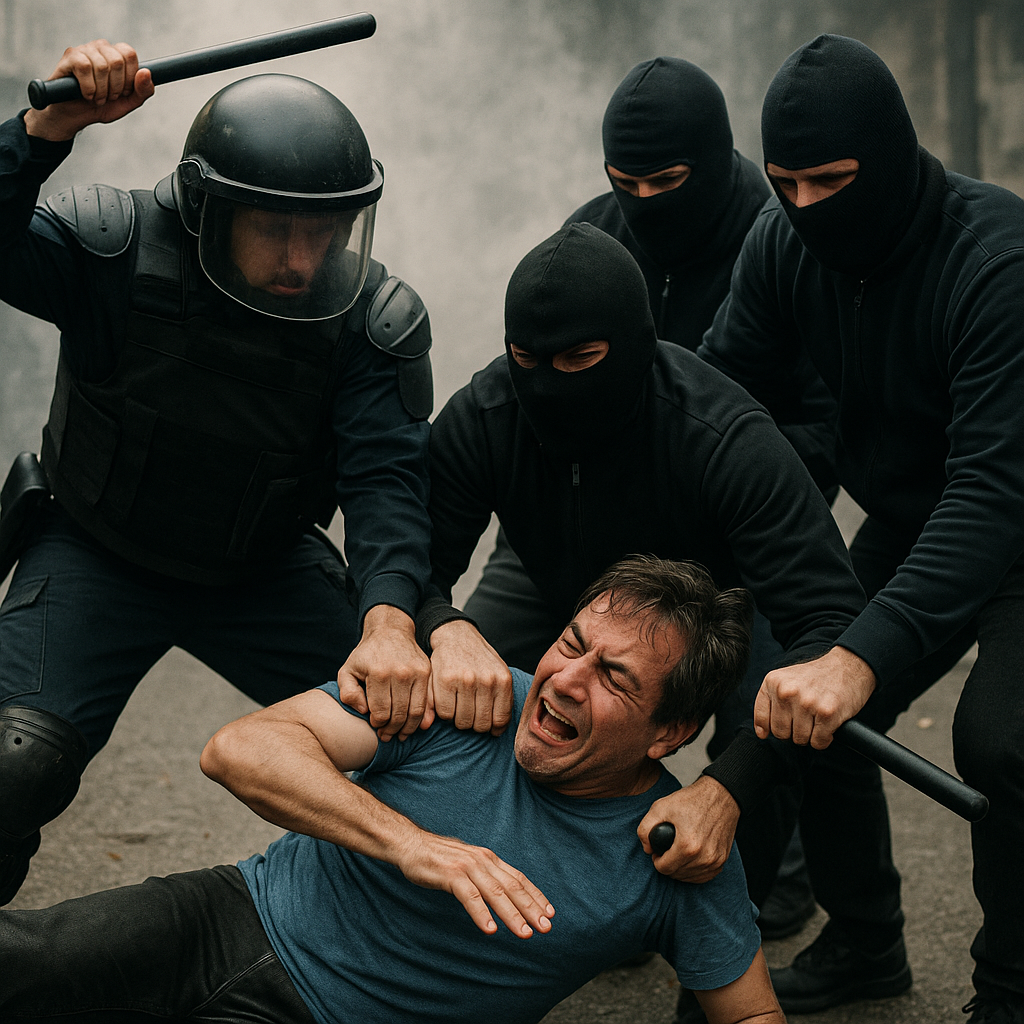
The totalitarian rule of a single man has lasted far longer in Serbia, and its citizens have endured the consequences of their neutrality and “blank ballots” for thirteen years. When you shake popular champagne that long, it doesn’t take much for the cork to blast out of the bottle. In Serbia, however, something truly horrific happened: because of corruption and lawlessness, 16 innocent people lost their lives. After the tragedy in Novi Sad, an explosion of emotion and common sense sent people into the streets. Students and citizens demanded accountability, respect for the law, and functioning institutions. Instead of meeting those demands, Vučić leafed through the memoirs of his idols and forged a new tactic. In fascist Spain and later in Latin America, dictators were the first to understand that uniformed police often weren’t enough to crush popular revolt. So they hired civilian enforcers to intimidate, beat, and kill opponents. Under Franco they were called Falangists; Somoza in Nicaragua had his esbirros; Pinochet his brigadistas; Perón the Triple A. Many years later, in the heart of Europe, Vučić formed his “loyalists.” Men in black—most with criminal records—who, under the pretext of guarding party offices, pelt unarmed demonstrators with stun grenades, stones, frozen water bottles, and eggs. Meanwhile the police protect the criminals and arrest those who react to the thugs’ provocations.
PARDON ME, MR. PRESIDENT
If a lost Norwegian visiting Belgrade Waterfront or the Freedom Fair were to ask how it’s possible, in democratic countries, for criminals to attack unarmed citizens with iron rods and walk away unpunished, he’d get a simple answer: presidential pardon! In July and August 2025, Aleksandar Vučić pardoned several of his protégés accused of violence against students. Instead of defending the victims, the state sided with the perpetrators, erasing the line between justice and loyalty.
Donald Trump went a step further and, on Inauguration Day, issued mass pardons to participants in the January 6, 2021 attack on the Capitol. Sentences for members of extremist groups were drastically reduced, while thousands of other participants received permanent clemency for serious crimes. Thus ended the judicial epilogue to one of the fiercest assaults on American democracy: responsibility erased with a rubber, violence legitimated as part and parcel of political struggle by the privileged and the president’s bullies. At the moment, the president is reportedly toying with pardons for convicted pedophiles as well—but that’s another story.
In the play Balkan Spy, Danica Čvorović says at one point: “If they betrayed their wives, why wouldn’t they betray their country?” Applied to political mimicry in the U.S. and Serbia, we might freely say: whoever lies to their own citizens—no wonder they cheat their allies. Here begins the double game on Ukraine and the tragedy in Gaza. The “governorate” of Aca the Serb from Red Star’s north stand presents itself as a country with an independent foreign policy. Weapons and ammunition produced in Serbian factories end up in the hands of Ukrainian soldiers, while President Vučić insists Serbia will never impose sanctions on fraternal Russia. Public friendship with Moscow; secret trade with Kyiv; and the final paradox—Serbia profits from a war it officially condemns.
America, for its part, openly backs Ukraine with billions in military aid. Yet while telling the home front it stands in solidarity with embattled Ukrainians, behind closed doors it negotiates with Moscow—without its “protégé,” Zelensky, at the table. In mid-August, Vladimir Putin visited the United States. Donald played the clown as usual; Volodya’s knees buckled—not from fear, but from arthritis. They discussed a “peace plan” in which Ukrainian resources and territory served as bargaining chips for two great powers. Thus the word peace was, and remains, a diplomatic screen for a redistribution of interests.
The same story applies to the war in Gaza, where slogans about ceasefires and humanitarian aid scatter under the weight of weapons delivered to the aggressor. In the first six months of 2025, Serbia exported arms to Israel worth €55.5 million. Only when a UN special rapporteur publicly warned that international law was being violated did Serbia’s leadership react. The president announced a supposed halt in exports—only to, as usual, break his promise.
The U.S. went many steps further: in February it scrapped the law barring the use of American weapons where international humanitarian law would be violated—paving the way for arms shipments worth billions. According to the Stockholm International Peace Research Institute, America accounts for over 70 percent of global arms exports to Israel.
At the end of this masquerade, Serbia and America stand before the same mirror: preaching peace while exporting weapons; invoking democracy while crushing protests; promising a bright future while dragging citizens backward. Democracy wasn’t killed with one thunderous volley, but with a thousand small bullets of lies, backroom deals, and pardons for political thugs. If once great ideas and principles led nations forward, today we’re left with petty haggling over interests and the weighing of power. Serbia increasingly resembles Franco’s Spain; America, Mussolini’s Italy—while the citizens of both countries teeter between hope and despair.
The crisis of democracy is no longer an external threat; it’s becoming an internal metastasis. The question is no longer whether democracy will survive, but whether citizens will fight to win it back—someday.
 STORY TELLER
Leave a comment