

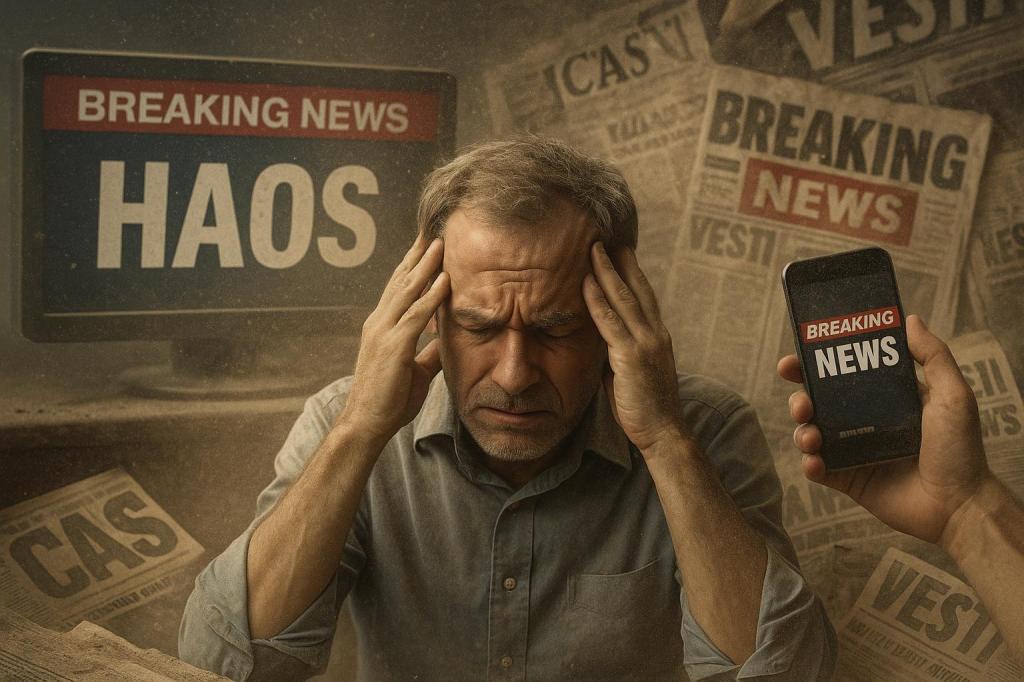
FROM BROKEN EGGS TO GLOBAL CATASTROPHE
During a guest appearance on a morning talk show, a well-known psychologist shared a story: one of his patients said, “Doctor, I read the news ten hours a day and I feel like the world is ending tomorrow. Is that normal?”
The doctor replied: “It’s not normal to read the news ten hours a day — but it is normal to feel like the world is ending.”
Never in history have we been exposed to as much information pressure as today. If the old saying once held that “you can’t have too much knowledge,” it now turns out that too much information can shake both body and mind.
In an ideal world, every reader, viewer, or listener would process, analyze, and shelf every piece of content into their personal experience. But in reality, the day is too short, and the avalanche of data is relentless. News stories cascade one after another. When a new topic hits, the old ones don’t disappear — they recycle and pile up in our consciousness. Like grime on a window we can no longer see through.
Every outlet invents a new drama, offers a bigger threat, creates more panic. In our effort to stay informed, we become prisoners of our own curiosity. Inner peace vanishes, replaced by a constant state of alertness: war is about to erupt, and global catastrophe seems inevitable.
We interrupt this program — reason and logic have gone missing!
Journalism has changed. Once a pillar of public interest, a tool in the pursuit of truth, a foundation of an informed society — today, it has become its own opposite: an attention industry. News is no longer grounded in verified truth, but in screen time and click counts.
Ratings matter more than credibility. Speed trumps accuracy. Sensation beats context.
Objectivity has faded, and analytical journalism has been reduced to the work of a few brave, systematically sidelined investigative reporters.
And the audience? Far from innocent — devouring every sensational headline the tabloids serve. If there’s no blood, fire, tears, or victims — the story goes unnoticed. “Breaking News!” is every newsroom’s daily prayer.
In Serbia, headlines read:
“Grandpa stabbed over broken eggs.”
“A mother’s boundless love: ‘I want my son to die before I do’ — tabloids in tears, son in shock!”
In the U.S.:
“Sunflower allegedly looks like the president – mystery shakes midwest farm!”
“Wall Street panic: Analyst forgets password — stocks plummet!”
“White House insider claims president dozed off during online NATO meeting!”
Globally:
“Exclusive: Putin seen feeding pigeons – what does this mean for global stability?”
“Drivers shocked as giant penis-shaped sign reappears at roundabout!”
“Panda refuses bamboo – Asian diplomacy in crisis!”
Everything is urgent. Everything matters. No one asks: is it true?
Half of these headlines are real. The other half are made up.
Can you tell which is which?
After multiple propaganda “climaxes,” timed perfectly for prime time, comes a short break — a false peace — before news therapists reload the next round of informational ammunition.
If we switch metaphors — from sex to war — we could compare it to artillery: the barrage briefly stops, the barrels cool, and then it all starts again. In that silence, there’s no reflection, no real analysis — just a pause to recharge for the next wave of fear.
Propaganda First, Then the Bombs
Wars have always been fertile ground for sensationalism. Every bullet is preceded by a barrage of weaponized words. First comes propaganda — turning people into obedient herds — followed by media shepherds, leading them “down the right path.”
On one channel, Ukraine is a symbol of freedom. On another, Zelensky is a Western puppet.
One says Israel is a victim. Another calls it a genocidal regime.
In both cases, truth is buried under a mountain of bias, algorithms, and political interests.
When objectivity disappears, everyone picks the version of reality that suits them best:
“My facts.” “My source.” “My truth.”
Disoriented and distrustful, the public flees to social media — only to get lost in an even denser jungle: conspiracy theories, half-truths, fake news that spreads faster than it can ever be fact-checked.
And so, in this whirlwind of disinformation, people retreat into their own mental refugee camps — spaces where no one is trusted anymore.
Media Inflation
Psychologists already have a term for it: doomscrolling.
Endless, compulsive scrolling through destructive content. The digital equivalent of picking at a wound — you know it hurts, but you can’t stop.
The brain craves the next dose of anxiety. Fear is the cheapest drug of the digital age.
The cycle continues: stress triggers a search for news, and news creates more stress.
People wake up tired, go to work fractured, and fall asleep depressed.
Insomnia turns into anxiety. Focus becomes fragmented.
Social media algorithms shatter attention spans and herd us into echo chambers.
In these tribes, truth is irrelevant — only confirmation of our biases matters. Each tribe has its own borders, sources, prophets, and slogans.
Instead of dialogue: tribal war in the comments section.
And so we have digital “brotherhoods,” whose members, miles apart, fight endless battles from behind their keyboards — convinced they’re defending justice, unaware they’re only feeding algorithms that make someone else rich.
This well-oiled mechanism produces digital saturation with imagined truths.
The human brain, bombarded by lies and half-truths, loses the ability to tell important from trivial.
Child killings and celebrity breakups appear side-by-side.
Climate change and reality TV — equally weighted.
In this noise of nonsense, truth becomes irrelevant, and the audience unknowingly helps maintain the media circus.
Sensation Is the New Standard
In today’s media madhouse, even the murder of a previously unknown man — who suddenly became a conservative influencer — can dominate global headlines.
“Charlie Kirk’s murder sets the world on fire!”
“Tragic death of conservative hero sparks wave of violence in U.S.!”
“U.S. revokes visas for those who didn’t mourn Charlie Kirk!”
The headlines never stop.
TV channels interrupt programming.
Online debates erupt.
Flags are lowered. Commemorations held. Presidents express condolences — as if a statesman of historic importance had fallen, not just an influencer riding the wave of algorithmic fame.
This single, irrational act of violence gets more media attention than the escalation of war in Gaza, mass protests across Europe, or even the death of Robert Redford.
Logic collapses. One inflated name outshines events of real, far-reaching consequence.
The world no longer measures the weight of news by its impact — but by its virality.
Tragedy becomes spectacle.
And spectacle is the most stable currency in public discourse.
What’s Left for the Ordinary Person?
What can the average person — the news consumer, the reader, the viewer — do?
Perhaps the simplest thing. But also the hardest:
Turn away from the screen.
Go for a walk.
Read a book.
Have coffee with a friend. Listen when they talk.
Do whatever reminds you that reality is still here — firm, living, and waiting for us to return.
That doesn’t mean abandoning the world of information. It means practicing selective intake.
Just as we don’t eat everything we’re served, we shouldn’t swallow every headline tossed at us.
The first step to healing is an informational diet.
After that comes context — and truth never lives in the headline. It demands patience, deep analysis, investigative reporting, documentaries, books.
Things that require time — not just a click.
And finally, we must accept that we can’t change most of today’s headlines.
Instead of panicking, we must protect our mental health.
Not by closing our eyes to reality — but by refusing to let it destroy us.
We Only Have One Life
Because life, as the poet said, is just this one — there’s nothing beyond it.
If we spend it endlessly scrolling through the latest “breaking news,” we’ll waste it in a tunnel of media deception, blinded by the glow of fake spotlights.
So maybe the wisest move is the most obvious:
Don’t read more. Don’t read less.
Read smarter.
Learn to spot the difference between news and propaganda, between information and manipulation, between what matters and what doesn’t.
If we can do that, maybe we’ll regain what this media madness has stolen —
clarity of thought and peace of mind.
A decade ago, anyone glued to the news all day would be diagnosed with an anxiety disorder and prescribed medication. Today? That’s just the statistical average.
Humanity has turned into one giant therapy group, where we all say in unison:
“Just one more headline… one more news panel… one more reality show… one more staff meeting… and then I’ll stop!”
In a world where thinking the world might end tomorrow feels normal —
maybe the only real act of sanity is this: to stay calm, stay human, and keep smiling.
And when the world does finally collapse — rest assured —
the tabloids will break the story first.
Prime time.
Exclusive.
Just for you.
 STORY TELLER
Leave a comment