

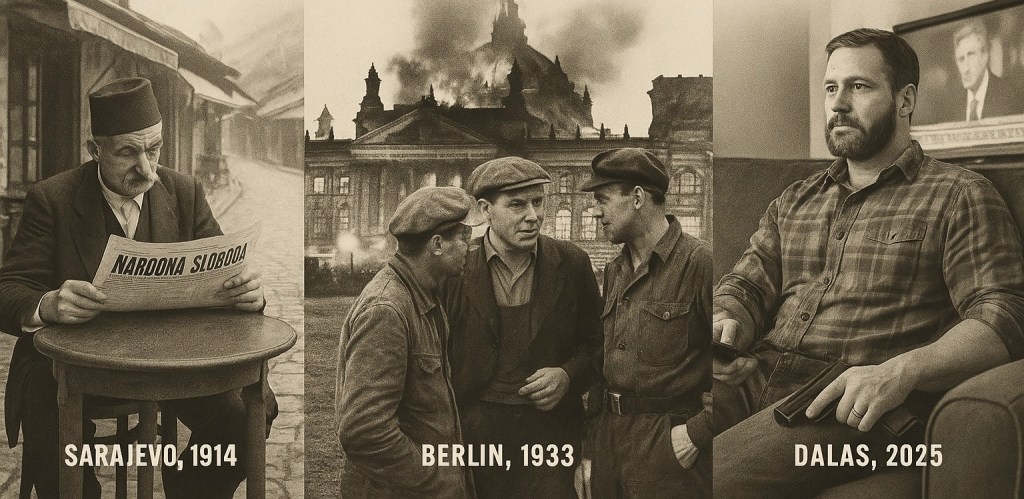
Sarajevo, January 1914.
Vukašin, a merchant in Baščaršija, sat with his morning coffe and leafed through the papers. On the front page: news of the Balkan Wars, a new model of French airplane, the British kingdom and industrial strikes. Near the bottom—strained relations between Austria-Hungary and Serbia. Vukašin read, sighed, and said aloud:
“War? Ah, no one’s that crazy.”
That afternoon he received a shipment of new goods and scolded his assistant for mixing up the stock. In the evening he ate sarma with his family. On Wednesday he sat with neighbors in the tavern; on Thursday he delivered groceries to Mrs. Wagner…
On June 28, 1914, he went to the market. He heard gunshots. Someone said, “They’ve killed Franz Ferdinand.” He shrugged and thought, “Surely there won’t be another slaughter over one man…”
A month later, Austria-Hungary declared war on Serbia—as if someone had merely been waiting for a pretext and everything else had long been ready. And Vukašin, like millions of others, had no inkling that the shot that morning had awakened the beast. Until then, everyone had lived their small lives in peace—planning, working, waiting. No one wanted war. No one asked for it. And when it came—they were astonished.
Gavrilo Princip pulled the trigger and the rest was a chain reaction. Vienna wanted revenge, Berlin gave support, Petrograd muttered, “Don’t touch our brothers.” Paris stood by its allies, and Europe stepped to the edge and jumped into the abyss. One bullet in Sarajevo, then a month of ominous silence while armies mobilized and ultimatums were drafted… Propaganda at the time was less subtle, but present, brutal, and effective. Patriotism, hatred of the enemy, faith in king or state were its main lines. On the posters, the enemy was a beast and our soldier a hero. Censorship was used in all countries to prevent defeatism and the spread of “unsuitable” information. Churches, schools, and military institutions took the lead in shaping the public narrative.
The world plunged headlong into war. Everyone believed they’d be home by Christmas. No one imagined four years of hell, the likes of which had never been seen.
Berlin, February 1933.
Otto, a tool-factory worker, took off his greasy apron and ate a half-empty sandwich in the back of the shop. With his colleagues he talked about everything and nothing: the price of milk, class differences, army maneuvers… They concluded it couldn’t go on like this. One said the communists should take matters in hand. Another waved him off: “You’d be happy about that, would you?” Otto kept quiet. He believed neither side. What mattered most was to be left alone and peacefully await the next paycheck.
The next morning the Reichstag burned. The Nazis blamed the communists. A state of emergency was declared and civil rights suspended. Many rejoiced: “At last there’ll be order.” Otto wondered how everything could change overnight. He kept quiet, didn’t make waves. He drew many more paychecks—and then came the uniform, training, oath… War.
How did the world breathe before it suffocated? On the surface—calm and normal. In Paris they spoke of fashion, exhibitions, and scandals. In Belgrade—taxes, harvests, and how the king was too hard-line. In London—markets, colonies, a convoy bound for India. In New York—the new Ford plant, the price of tobacco, yet another ship of immigrants docking. Everything followed its course. Trains flew by, telegraphs chirped, industry clattered without pause. People made plans and bought their first summer clothes. Wrote love letters, prepared weddings, bought cradles… Beneath the veneer of normality, pressure built. Factories saw strikes. Parliaments broke their lances deciding which side to lean toward. In the villages, people mostly kept silent—they knew nothing good comes when the German gets riled.
In Vienna the elite feared disintegration. In Berlin the generals studied maps and drew borders. In Moscow the communists discovered that ruling isn’t easy—you have to feed the people—so they found salvation in an external enemy. In Paris, conformism beat every other “-ism.” The French weren’t much in the mood for war. From London came the message that the new division of the world was, in fact, a matter of honor. In Serbia—pride, stubbornness, and a wound still bleeding from the Balkan Wars. Workers made policy, peasants worked, students dreamed of revolution. Markets haggled, taverns drank, theaters laughed, factories sweated. And no one—absolutely no one—suspected that in a month the whole world would look like an open wound without a bandage. The world walked on ice already cracking. It only took someone to stomp harder, one army to move and shout: “Charge!”
War propaganda became a science. In Germany, a Ministry of Public Enlightenment and Propaganda was formed. The goal wasn’t to inform but to shape. People ignored the persecution of Jews—not for lack of warning signs, but because no one wished to see them. Camps already existed and violence had gone public. Kristallnacht (1938) unfolded before the people’s eyes. Yet the world looked away, calling it “Germany’s internal affair.” The problem wasn’t a lack of information, but a surplus of propaganda, false optimism, selective attention, and collective fatigue.
In 1938 Hitler swallowed Austria. The world was silent. September: the Munich Agreement dismembered Czechoslovakia. Otto was sent to the border. “You know,” he told a comrade in the trench, “I can’t say I support war—but someone’s got to defend the nation.”
Dallas, 2025.
Tyler is 38. Drives a Ford, carries a handgun, believes the state shouldn’t meddle in his life. He dislikes taxes and “woke culture.” He supports Trump: “Not perfect, but at least I know where he stands.” He doesn’t trust liberal media; he follows conservative podcasts, Twitter, and listens to Joe Rogan. The war in Ukraine? “Not our problem.” Gaza? “They asked for it.” Inflation, the Chinese, migrants—all symptoms of American decline. Then, an assassination: Charlie Kirk is killed at a public event. The internet is ablaze. Theories. Counter-theories. The right calls for civil war. The left demands gun-control laws. TV programs critical of the authorities are banned. One by one, U.S. states teeter on the edge of emergency rule. Tyler tells his wife: “This doesn’t smell good.” Remote in hand, FOX News on the screen, he looks out the window. The street is calm. For now.
Over the last hundred years the world has turned on its head, but human naiveté, the greed of the powerful, and our urge toward self-destruction remain constants. In the first quarter of the first tenth of the twenty-first century, we enjoy the sweet idleness of the internet, bicker on social media, and play with artificial intelligence. Technology is everywhere. In Western Europe and America, wars are waged via keyboard; in Ukraine with drones; in Gaza with all means available to meet the daily quota of death.
Tyler has bought a semi-automatic rifle.
Everything Has Changed—and Everyone Has Swapped Places
In the First and Second World Wars reality was stark and the aggressors had names—Germany, Austria, Italy, Japan… The defenders of the world rallied under the banners of the Soviet Union, America, and Great Britain. Millions of civilians perished, and the victims were recognizable—above all the Jews, the most persecuted people. It was believed that after 1945 the world had learned its lesson and that the lines between good and evil were at least somewhat clearer. We hoped the chapters on camps, city bombings, expulsions, and racial hatred would never be reopened. But today the deck is completely reshuffled, and the world seems to have forgotten the recent past and its own blueprint.
Germany, Austria, Italy, Japan—countries that once shoved the world into war—are now among the most prudent powers. Their militaries are modest; their foreign policies measured. Germany is bound to the EU, Italy minds its own house, and Japan, though strong, rarely raises its voice. Maybe it’s guilt, maybe fear… Whatever the reason, one thing is certain: the aggressors of two world wars now play a relatively decent role in a planetary tragedy of wailing and gunfire.
At the same time, yesterday’s “good guys,” the protectors of the free world in the first half of the last century, have become engines of chaos. The U.S. and Russia, once united against fascism, are now in constant conflict—mostly with others, often with themselves. Russia, in “self-defense,” attacked Ukraine, borrowing the rhetoric of 1939. Under the threadbare banner of human rights, America left ruins wherever it wished to “help.” Guided by democratic principles, twentieth-century wars were waged against tyranny; today they serve as cover for invasions, coups, and the foulest colonial grabs.
No great power sits for a moral exam anymore; each calculates instead: how profitable is aggression, how valuable an ally, how long the public’s attention will last. While today’s empires negotiate feebly (and act far more lethally), yesterday’s victims have too easily accepted the role of executioner. Petty bullies in the Middle East, backed by big brothers in the West, are carrying out an unprecedented slaughter in the Gaza Strip. The Jewish people—symbol of twentieth-century suffering—through the policy of the Israeli state are conducting the ethnic cleansing of the Palestinian people. In Gaza’s daily abuse of civilians, it isn’t only Hamas who die—children, refugee camps, schools—an entire enclave of sacrificial civilians is destroyed. The “democratic” world that once screamed “Genocide—never again!” now whispers “It’s complicated,” and does nothing to stop further war crimes. This is no longer a mere moral dilemma; it is the moment when historical roles have been fully reversed. Recent aggressors are disciplined, quiet, restrained. Former defenders have lost their compass and wage endless wars. Yesterday’s victims surpass their former persecutors. We believed that after 1945 we could tell black from white. Today there are only sides—ours and theirs—though neither is just. Law has become relative, morality overnight a luxury, and politics a small coin for settling the accounts of insecure, senescent men.
Leadership is no longer grounded in truth but in interest. If you have power—you’re right. And vice versa. And so today’s world irresistibly recalls 1939: marches in Washington, Moscow, even New Belgrade. But it also looks like 1914: a heap of local crises, armies at borders, politicians shaking poisonous draughts while citizens are convinced “there’s still time.” Everyone assumes someone else will pull the brake. And the runaway train thunders toward the ravine.
World War III may not break out this year, or the next—perhaps never. But if it comes, it won’t arrive as a surprise; it will be the consequence of what we’re living through now. When we one day look back from some trench, we won’t be able to say we didn’t know. We knew—but didn’t want to face the truth.
Ah well—leave it be. May we live and be well.
 STORY TELLER
Leave a comment