

At different ages, people dream of different things.
Teenagers, for instance, dream of sex and that elusive freedom of libido slipping out the window of the classroom or the bedroom. Men in their thirties dream of cars, motorcycles, speed—and most often of the busty neighbor on the third floor.
Some dream of weapons, power, self-assertion. The “softer” ones dream of art, of literature or music that—if only it were a little louder—might save the world from various plagues. Later, approaching fifty, dreams grow practical: work, higher pay, children, loans… Dreams then resemble not metaphysical clouds but Excel sheets with deadlines, interest rates, and dividends. After sixty, most people stop dreaming and start philosophizing, arguing with invisible interlocutors—about the meaning of life, about politics, about God and about death.
On that seesaw between sleep and waking, I discovered Stephen LaBerge’s book: Exploring the World of Lucid Dreaming. This scientific study teaches techniques that help you, before bed, simply “order” the dreams you will “live” through the night. The idea of becoming, while asleep, the author of my own reality was too seductive to ignore. After all, we spend a third of life with our eyes closed; it can’t hurt to use at least some of that time.
I thought: “If I can’t change reality while awake, I’ll try in my dreams! And since the people who run the planet are untouchable, I’ll try with the wise ones who attempted to explain this crazy world!”
I went to sleep firmly resolved to summon Dostoevsky and Camus into my dream to answer—why is this world so absurd? I had other questions ready: Is man a being in search of truth, or just an excuse? Can there be forgiveness without repentance? Is there freedom without responsibility? Can evil be eradicated, or only kept under control?
In the evening I rehearsed, imagining the answers of men who passed through the hell of their epochs without losing hope. I go to bed early and repeat to myself: “This is your dream. You will be conscious of every moment, of your questions and their answers.”
I imagined studio lights, the hush before recording, name placards, a cameraman unenthused by the choice of guests, and a producer biting his nails, afraid of the “authorities’” reaction. I sit at the desk, and there they are across from me—pensive, in the clothes of their time, with wisdom reaching across centuries. Everything is ready.
I open my eyes. The studio lights come up. Desk, microphone, questions in my hand. I glance at the monitor—shock, disbelief, a quiet chill and fever. Instead of Fyodor and Albert, in walk Donald and Aleksandar. In that instant I understand I am not dreaming the way I planned, but the way I was fated. The red tally light above the camera glows—on air. The camera glides toward me though I haven’t recovered from the shock.
“Dear viewers,” I rasp, “there’s been a small change of program, so instead of celebrated writers from the past, we’ll speak with our contemporaries. Our guests are the presidents of the USA and Serbia—Donald Trump and Aleksandar Vučić!”
Trump lounged back, arms crossed over his belly, face the color of a carrot, his gaze smug and dominant. He looked like a man saving the world while, in his spare time, discovering a cure for cancer. Vučić, by contrast, nervous, meek, and sweaty—like a student arriving to take an exam before his own idol.
“Gentlemen, since you’re here, let’s begin,” I said. “Mr. Trump, how do you see today’s Serbian-American relations?”
Donald looked up at the lights, scratched his orange tuft, and with a grin ear to ear said:
“Serbia… yes, I’ve heard of that country! Where was it again? Europe, right? Great country, wonderful people, everybody says so! My friend Rod Blagojevich, you know him, he’s from there. I pardoned him—great guy, beautiful hair—though not as good as mine. Believe me, nobody has better hair than me.”
Vučić bowed as if before Šešelj:
“Dear Donald, it is an honor to speak with you. Serbia and the U.S. have traditionally good relations, and I hope your administration will understand our situation and help lift sanctions on the energy company NIS.”
Trump looked at him, surprised:
“Sanctions? You didn’t impose sanctions on the Russians? Can’t do that, friend! There has to be order, for God’s sake! No sanctions—no talks! They say Putin sandbagged me over Ukraine. Small guy, but toxic! That’s fake news, everyone tries to trick me. No chance.”
Vučić smiled, red as a poppy:
“We’re trying, but our capabilities are limited… Vladimir Vladimirovich has his hand on the gas valve, and the people expect heating… We must balance…”
Trump cut him off, index finger raised:
“Wait, wait… you’re the one who tried to sneak into Mar-a-Lago in disguise, right? Wanted a selfie with Melania, and security almost deported you! Everyone told me about you! You were the butt of jokes for days. Ha-ha-ha!”
Vučić laughed, but his eyes darted to the floor, brimming with tears:
“No, no, Mr. Trump. People make up all sorts of things. That’s untrue.”
“Fake news, huh?” Trump said, smiling.
I tried to save the moment with the next question:
“Gentlemen, America has a problem with illegal migrants, and Serbia with a shortage of labor. Have you considered a population exchange? Specialists from Serbia working in the U.S., and part of your labor force coming to Serbia—to build highways, EXPO facilities, and factories?”
Trump straightened and gestured energetically:
“Great idea! But no need for an exchange! I’ll give them to you! Take them all, for free! It’ll be the best donation ever. They work day and night, don’t complain, don’t eat much, but they grind fantastically! Believe me, it’ll be genius!”
Vučić nodded enthusiastically:
“Your generosity is fascinating! Serbia will welcome these people with open arms. They’ll get three hundred euros salary, citizenship, and the right to vote!”
Trump looked at him like a salesman who can’t believe someone actually bought his product:
“Three hundred euros? That’s great! You’re not dumb—you know business! You’re my guy! You can’t compare to me, but you’ve got potential!”
Vučić bowed:
“I strive to learn from the best.”
Trump spread his arms:
“Of course—you’re looking at him.”
I tried to change the tone, but both were already in full swing.
“Alright,” I asked, “both of you are in power for a second time. What do you plan after this term?”
Trump smiled contentedly:
“After a second term comes a third! We’ll extend! Why not? America loves me, I’m the best president in history! No one had a better economy, nobody! Everybody says so. If the people want a third term—I’ll give it to them! Maybe a fourth. Believe me, it’ll be great!”
Vučić, flushed and breathless, nodded:
“That’s an excellent idea! The people beg me to stay because I fight and never give up. If the people want it—I’ll stay too.”
“Don’t they chant ‘Vučić, go away’?” Donald asked, curious.
“Oh no—that’s how love is expressed in our country!” Aleksandar lied without blinking.
Trump patted him on the shoulder:
“Wise words, Aleksandar. You’ve got the spirit of a winner. But if the people do kick you out, come to America. You speak English, and boast you worked in a London ironmongery.”
Vučić nodded, visibly honored.
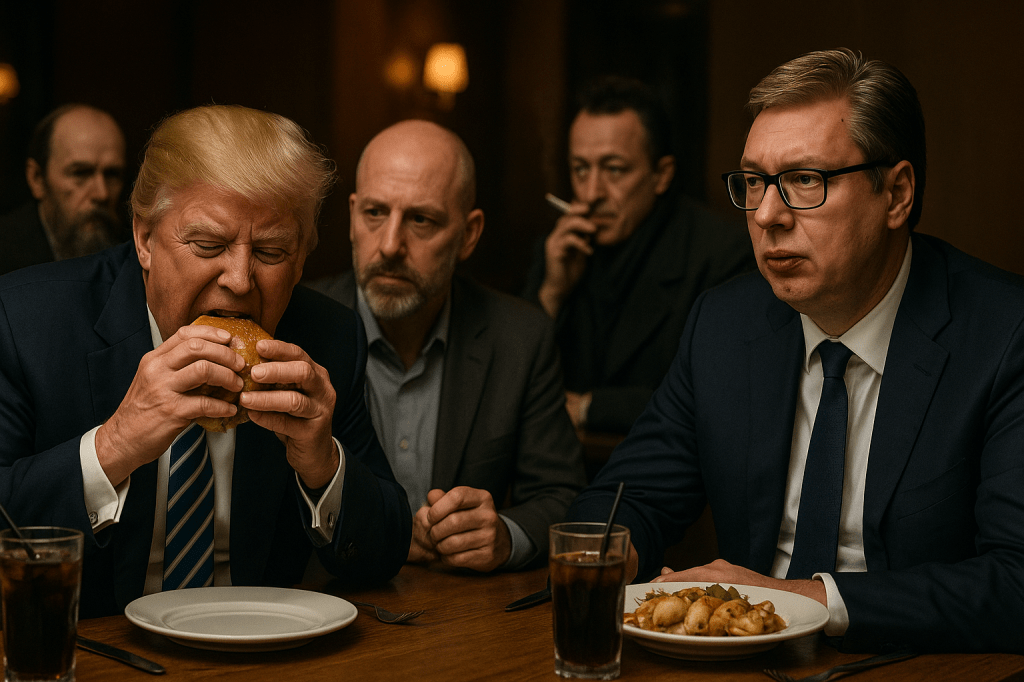
At that moment, the camera cut, and the two kept chatting—one bragging, the other thanking. The walls vanished, and the scene shifted to a luxurious restaurant.
They sat facing each other. Trump talked about golden elevators, Vučić about highways.
Donald boasted about renovations in the White House, Aleksandar about high-speed rail.
And both, at some point, uttered the same sentence: “No one, no one like me!”
Trump ate a cheeseburger with bacon, while Vučić, across from him, sighed over a plate of stuffed squid that kept slipping off his fork, as if unwilling to be part of the story. “No one makes squid like my mother,” he thought. Both drank Coke Zero.
Donald, mouth full, managed to say:
“See, this is real food. The hamburger is a symbol of freedom. Everyone loves it, but nobody eats it better than me.”
Vučić quickly affirmed:
“We in Serbia also like American food. It’s proof of friendship between our nations.”
“That’s right,” Trump replied, wiping his hands on the tablecloth, “you are a small nation, but with potential. I like small nations—they’re easy to maintain.”
Vučić smiled vaguely, as a man unsure whether he was being mocked or praised. Just then their gaze drifted to a corner table where two men were seated. One was gaunt, with sparse hair and a long beard; the other had a cigarette in his mouth.
Trump noticed me staring.
“Who are they?” he half-whispered. “The shaggy one looks like he just got out of prison, and the other smokes like a steel mill in Pennsylvania.”
Vučić leaned in conspiratorially:
“Maybe they’re journalists. I’m used to them. They film, provoke. Always asking something.”
I cleared my throat and explained quietly:
“They’re writers—Fyodor Mikhailovich Dostoevsky and Albert Camus.”
Trump pondered, chewed, and asked:
“Don’t know them. Are they from TV?”
“No,” I said, “they’re from the past. One wrote about guilt and redemption; the other about absurdity and freedom.”
“Interesting,” Trump said. “Freedom and guilt—that sounds like my campaign! Bring them over so I can explain how real democracy works.”
Vučić waved to his assistant:
“Invite the gentlemen. President Trump would like to speak with them.”
Dostoevsky and Camus approached the table. Trump stood, offering the confident grip of a man who doesn’t know when to stop.
“I’m Donald Trump, the best president in history, everybody says so. And you are… the shaggy one and the smoker?”
Camus returned a cool smile:
“I’m a smoker who thinks the world is meaningless, and you are living proof I was right.”
Dostoevsky looked at him with pity and said:
“To believe oneself the best at anything is the greatest punishment. A man who feels no shame cannot govern himself, much less a nation, for sin governs him.”
Silence. Trump paused, not understanding, then insisted:
“Punishment? Sin? No, no, those are complicated words. In my campaign we only use insults. People love that. Vulgarity beats everything. Believe me.”
Camus exhaled and shrugged:
“Absurdity is when a man eats a hamburger and talks about spirituality.”
Trump raised his eyebrows, then smiled, childishly, a little offended:
“Okay, okay… enough philosophy. I like practical people. They write books, I write history. Huge, great history. That’s the difference.”
Camus looked at him, almost gently:
“True enough—you really are writing the history of the absurd.”
Dostoevsky grumbled:
“I see that even in this century man has not learned to distinguish greatness from hubris. And that is the beginning of all evil.”
They glanced at each other and left—quietly, decisively, without goodbyes. Suddenly the lights went out.
The restaurant vanished. Food, drink, cigarette smoke… everything dissolved into fog.
“Hey, journalist, enough sleeping—go do something useful!” Trump barked. “And you, Aco the Serb, let me hear how things stand with demolishing the General Staff building?”
I woke up—sweaty, bewildered, alone. On the table beside the bed lay the notebook of questions I’d prepared for the writers. At the bottom of the page someone had added:
“See you tomorrow night—if you learn to choose better company.
Greetings, Fyodor and Albert.”
 STORY TELLER
Leave a comment