

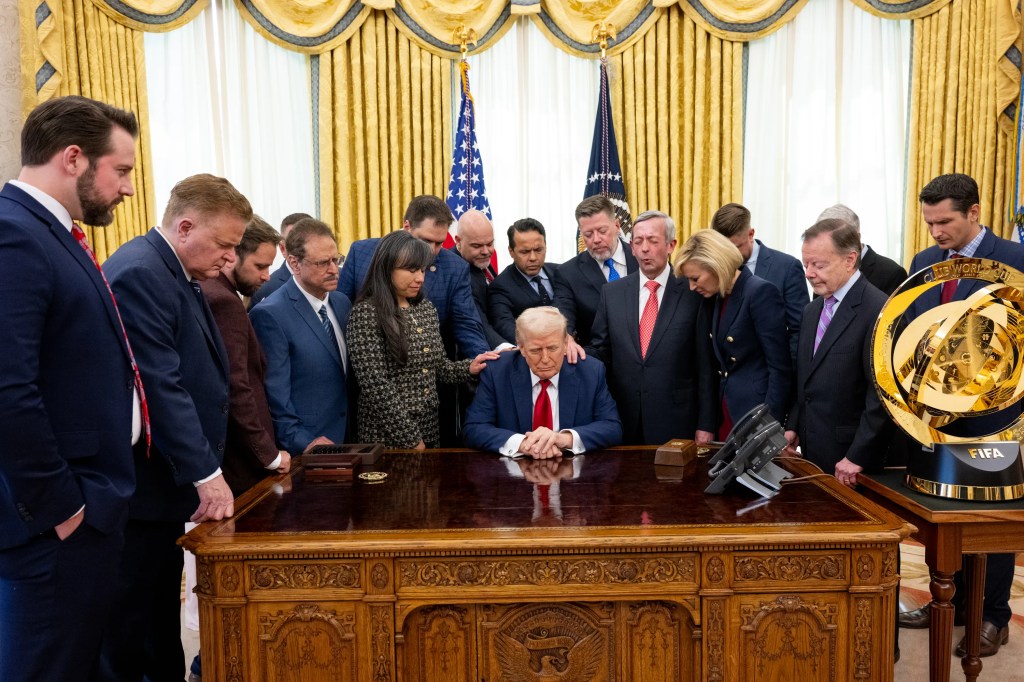
The Oval Office in Washington, a symbol of U.S. state power, has been the stage for all kinds of sordid affairs later covered up by wars. From that very place, in early March this year, a bizarre photograph was sent out into the world: President Trump surrounded by leaders of conservative Christian communities. The host in the White House stood encircled by influential Protestant pastors who had placed their hands on his shoulders and tousled hair. Together, they offered a prayer for Donald’s health, wisdom, and protection during military operations in Iran. The blessing came from leaders of the American evangelical movement, who for years have served as a bridge between conservative religious doctrine and political influence in Washington.
NOT MORAL, BUT FUNCTIONAL
This image gains additional weight when one considers that Protestants are the largest Christian community in the United States—over 140 million according to 2025 data, of whom more than 80 million belong to evangelical circles. By comparison, there are slightly fewer than seventy million Catholics and around three million Orthodox Christians. Beyond sheer numbers, the key to their strength lies in their level of organization and political mobilization: evangelical voters are typically more disciplined at the polls than other social groups and vote within a clearly defined ideological framework.
For evangelical circles, Trump was never an ideal candidate in moral terms. His private life, rhetoric, and public appearances often stood in direct contradiction to the values they nominally promote. However, in this case, personal integrity was not decisive—functionality was. Trump was recognized as an effective instrument—someone willing to unreservedly support key elements of their agenda: unwavering support for Israel, an aggressive policy toward Iran, the appointment of conservative judges, and the strengthening of religious discourse in the public sphere. His political value was measured by tasks accomplished, not personal virtues.
Hence the narrative that accompanies him within this religious community: not as a role model, but as the “chosen one.” He is a political figure who, despite his flaws, fulfills an important historical role. Such an interpretation allows obvious contradictions to be explained as part of a broader logic in which God acts through imperfect people.
To understand the strength of this powerful alliance between religion and politics, one must explain the belief system that underpins it—Christian Zionism. This is a doctrine that reads contemporary geopolitics through the prism of biblical prophecy. According to this interpretation, history is not a series of unpredictable events but a pre-structured process moving toward its final act. At the center of this path stands the State of Israel—not merely as a political entity, but as a focal point in a biblical end-times scenario.
For millions of believers, the very existence and strengthening of Israel confirm that prophecies are being fulfilled. Conflicts in the Middle East, including the war with Iran, are seen as necessary stages in that process. In this context, support for Israel ceases to be a matter of foreign policy and becomes a matter of faith. The scene from the Oval Office—with pastors praying over the president—is therefore not an isolated episode of political theater. It is a visible expression of a deeper alliance between religious conviction and state power, in which political decisions gain theological justification, and religious beliefs produce concrete political consequences.
Christian Zionism is not an abstract belief—it is a very concrete scenario involving physical, political, and ritual steps.
FROM THE EUPHRATES TO THE NILE
At the heart of this vision lies the idea of rebuilding the Third Temple in Jerusalem. According to this interpretation, in order to fulfill Old Testament prophecies, a new sanctuary must be built on the site where Solomon’s Temple and the Second Temple once stood, restoring ancient sacrificial practices. The problem is that the Al-Aqsa Mosque—one of Islam’s holiest sites—now stands on that same location. That is precisely why, within this theological framework, the idea of rebuilding the Temple appears as an inevitable step, with potentially catastrophic geopolitical consequences.
The second element of this system concerns ritual purity and the restoration of Old Testament sacrificial practices. Here we encounter the strange story of the so-called red heifer—an animal that, according to the Book of Numbers, must be perfectly pure so that its ashes can be used in purification rituals. Without this ritual, the rebuilding of the Temple would not be possible. For this reason, in recent years certain organizations—primarily in Israel, but also in the United States—have launched projects to breed such an animal. Reports have surfaced of attempts to achieve the “ideal” specimen through selective breeding and even modern biotechnological methods, further illustrating the extent to which theological concepts are translated into concrete projects.
The third element is the creation of political conditions: continuous support for Israel, opposition to territorial compromise, and the maintenance or even encouragement of tensions in the region—because peace merely delays the fulfillment of prophecy.
Everything began during the Protestant Reformation in England, when new interpretations of the Bible emerged. Theologians believed that the Jews would one day return to Palestine and that this would be part of God’s plan for the end of history. The Puritans who migrated to North America believed they had a special mission. They saw America as a new promised land, themselves as a new Israel, and their state as part of God’s plan. From these ideas emerged the ideology of America as a “chosen nation.”
In the 19th century, a theological current emerged that strongly influenced modern Christian Zionism. Its most important representative was John Darby, who introduced the idea of the rapture of believers and the ultimate return of Jesus. In this narrative, Israel and Jerusalem play a central role in the events leading up to the end of the world.
The establishment of the State of Israel in 1948 was seen by many evangelical Christians as the fulfillment of biblical prophecy, dramatically increasing support for Israel among American Christians. After the Six-Day War in 1967, Israel took control of East Jerusalem, and for many Christian Zionists, this was further proof that biblical prophecies were unfolding rapidly.
Today, Christian Zionism is highly influential in American evangelical politics, in some African churches, in Brazil and Latin America, and in parts of Europe. For its followers, support for Israel is not merely political—it is a religious duty.
These ideas do not represent the official policy of any state, nor the views of the majority of believers, but they exert significant influence through financial networks of clerical-political organizations and lobbying efforts. Under their influence, stories about the Temple, rituals, and “signs of the times” cease to be marginal religious speculation and become part of a broader narrative linking faith and geopolitics. This is a worldview in which the future is not open, but already written and predetermined.
In its simplest form, Christian Zionism is the belief that the modern State of Israel plays a central role in the divine plan of history.
It is important to emphasize that this idea is not universally accepted even among Protestants, and even less so within Catholic and Orthodox traditions. On the contrary, it is a specific evangelical theological current whose popularity owes as much to media, televangelists, and political movements as to the church itself. During the 20th century—especially in the United States—this doctrine moved beyond theological debate and became part of mass culture. Books, television programs, and sermons spread the idea that the modern world is the stage for the final act of biblical history.
In that context, the connection between the evangelical movement and the State of Israel ceases to be symbolic. It becomes organized and politically assertive through lobbying, financial support, public campaigns, and direct influence on decision-makers.
At the same time, some preachers go even further, interpreting even the most tragic events of the 20th century as part of God’s plan—claiming that even the Holocaust played a role in the creation of the State of Israel. In such an environment, the boundary between belief and everyday reality becomes almost invisible.
IS THERE A PILOT ON THE PLANE?
Some companies in the United States have even offered services guaranteeing care for pets in the event of their owners’ “rapture”—on the assumption that believers will disappear, while those who do not share their beliefs will remain to take responsibility. A similar logic appears in certain professional circles, such as aviation, where believers raise suggestive questions—what would happen if part of a flight crew “disappeared” mid-flight?
At the same time, for some believers, the geography of the Middle East is no longer merely a place of historical events, but a map of the future. Trips to Jerusalem become encounters with locations from which, soon, live broadcasts of the final events in human history will be watched.
On a practical level, these beliefs shape everyday life. The children of some believers grow up in constant fear of sudden “rapture,” in which their parents might vanish from the face of the earth. This motif sometimes appears even in the form of bizarre “jokes,” suggesting to them that they have been left behind—turning apocalyptic expectations into childhood anxiety from an early age.
In the political sphere, events such as the National Prayer Breakfast stand out—religious gatherings that also function as informal channels of political networking, where domestic and foreign actors meet outside institutional frameworks.
Taken together, these phenomena show that Christian Zionism is a complex system operating simultaneously through culture, everyday life, and political practice.
Within such a worldview, conflicts in the Middle East confirm that prophecies are being fulfilled. The greater the tensions, the closer history moves toward its goal—and the world toward its final end. In that context, support for Israel takes on an entirely different character. It is based on strategic interests and alliances, but also on the belief that Israel’s survival and territorial expansion are part of divine will. Some spokespeople go even further, invoking biblical imagery of a “Greater Israel,” stretching, according to their interpretation, “from the Nile to the Euphrates.”
Thus, Christian Zionism is not merely a theological doctrine, but a framework through which religious belief is translated into political action. In this view, modern, bloody conflicts—such as those in Gaza and Iran—are not military operations, genocide, or even historical events. They are simply phases in a preordained end of history.
 STORY TELLER
Leave a comment