

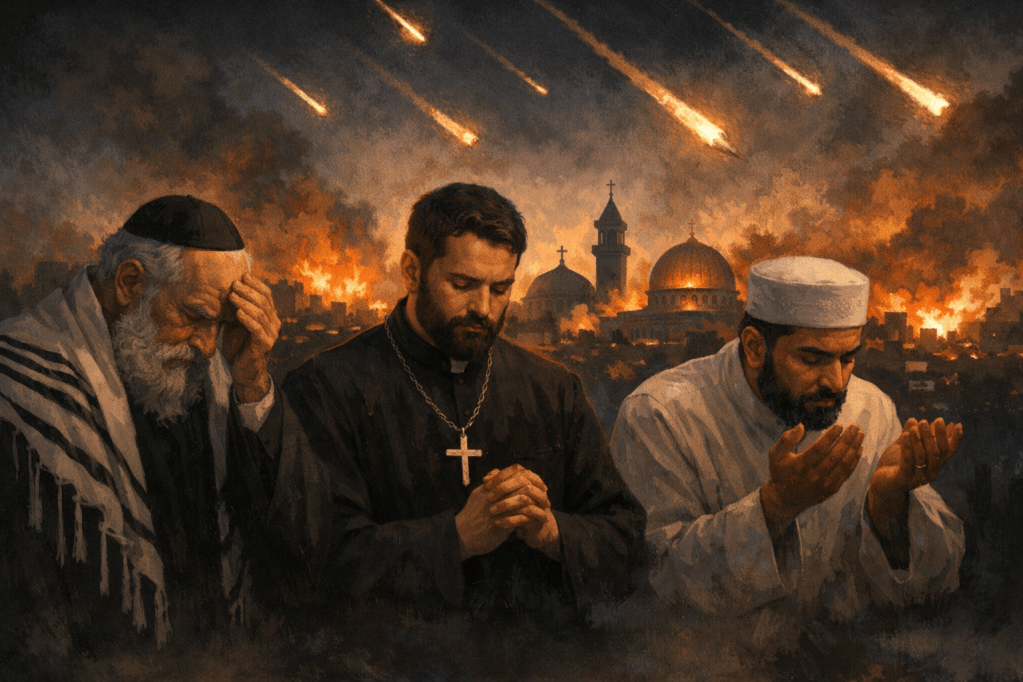
At this moment, the three oldest religious traditions on the planet are marking their holiest days. Jews are celebrating Purim – a holiday of survival and divine deliverance. Muslims are observing Ramadan – a month of fasting, prayer, and inner purification. Christians are going through Lent – a period of abstinence, self-examination, and preparation for Easter. Three faiths. Three of the most influential communities. Three parallel worldly languages through which a person turns to heaven when there is no one left to confide in on earth.
And while, in accordance with their customs, they light candles, make the sign of the cross, bow in prayer, or pray, rockets fly over the Middle East. As bombs fall, public gatherings in Israel are banned, and mosques, churches, and synagogues are closed—on the very land that all three religions call holy. As if holiness itself has turned into a security risk, and worship has become too dangerous even where, according to their own claims, it began.
Everyone continues to pray, believing that God is on their side, while the realities of war clearly do not care whose God is the “true” one.
THE TRAGIC TRIO
Thinkers close to an atheistic worldview have long argued that religion is not just one of the sources of hatred, but its most fertile form, because it gives hatred meaning, justification, and—through a higher power—a sense of purpose. In March 2026, we may be witnessing the clearest illustration of this claim. Before our eyes, and in real time, everything unfolds smoothly—without pause, reason, or moral resolution: three religions at once, one war zone, and a silence from heaven that lasts longer than any sermon.
Let us first consider the circumstances in which all this is happening, because they make the picture even more devastating.
Purim is one of the most joyful holidays in the Jewish calendar. It tells the story of Esther—a young Jewish woman in ancient Persia who married the king and concealed her identity. She lived “underground” until the moment a plot to destroy her people was uncovered. According to tradition, that is when the turning point occurs. Thanks to Esther’s courage, fate turns against those who planned the destruction of the Jews: the villain falls, and the victim survives. It is a story of exalted intervention, of a God who changes the course of events, and of survival against all odds.
The holiday is marked by celebrations, feasts, and the public reading of the Book of Esther. One of its commandments emphasizes unconditional tolerance, blurring the line between hero and tyrant. It is the happiest day of the year—or at least it should be. But in 2026, the situation is entirely different.
Ancient Persia, where the story of Purim takes place, is today Iran—against which Israel has, yet again, launched another bloody military campaign. On the day of the first airstrikes on Tehran, the Chief Rabbi of the United Kingdom, Ephraim Mirvis, stood before the gathered faithful and called on them to pray together for a repetition of the miracle of Purim. He said that just as circumstances turned in ancient Persia and the Jews prevailed, so too today, in modern Persia, a swift victory should be achieved—in other words, the complete destruction of Iran. A religious leader in 2026 uses a 2,500-year-old story to justify a contemporary military operation. He does not pray for peace, diplomacy, or forgiveness, but uses a biblical narrative to bless killing.
Religion here is not merely the “background” of the conflict—it is its moral seal. Politics can give orders, the military can carry them out, but religion can do something more powerful than military doctrine: it turns violence into duty and killing into a form of virtue. When war begins to speak the language of religion, it ceases to be about interests and becomes a confession of faith.
At the beginning of March, alongside the new Middle Eastern war, more than a billion Muslims were already observing Ramadan. It is the holiest month in the Islamic calendar: fasting from dawn to sunset, without food, water, or bodily pleasures during the day. Its purpose is discipline, compassion for the poor, closeness to God, and connection with the community. Ramadan is meant to be a month of peace and inner purification, when a person restrains the ego and briefly stops living as if everything in the world belongs to them.
For Muslims in Gaza, in parts of the Middle East, and in war zones across the region, Ramadan 2026 is not a month of peace but of great suffering. Mosques are closed, and families who would normally break their fast together now gather in shelters. People fast while their neighborhoods are shelled, pray while walls tremble, and ask God for protection—which they do not receive. In such moments, prayer often becomes a substitute for real protection, a moral alibi, a final word that binds no one. Human helplessness turns into piety, and divine helplessness into collateral damage.
And of course, there are the Christians. Hundreds of millions around the world are observing Lent. It is a forty-day period preceding Easter, symbolizing the time when Jesus, after being baptized in the Jordan River, withdrew into the desert where he remained for forty days and nights in fasting and prayer. He spent this time in solitude and spiritual reflection before beginning his public ministry. These are days of renunciation, repentance, and preparation of the soul for the Resurrection.
But in the Holy Land—where, as Christians believe, Jesus walked, preached, was crucified, and rose again—public gatherings in churches are banned. Christian communities in the Middle East have for decades been caught in the crossfire between Jewish and Muslim forces. As a religious minority in the region, whenever bombs begin to fall, Christians suffer alongside everyone else. Their prayers are, as a rule, drowned out by devastating explosions.
ROCKET PRAYER
And so we return to the beginning: March 2026. Three faiths. One war zone. Everyone is praying—and the silence from heaven continues.
In complex moral debates, it is often argued that religion is not the sole cause of war. That is true. There is also greed, the struggle for territory and resources, fear, revenge, the rise and fall of empires, propaganda… Religion does not have to create conflict to make it more dangerous. It is enough that it removes the exit and turns compromise into betrayal.
In politics, compromise is both necessary and possible. In religion, it becomes a theological problem. One can negotiate borders, but not the “promised land.” One can bargain over natural resources, but not divine commandments. When conflict is elevated to the level of the sacred, it ceases to be negotiable and becomes a matter of identity—something that cannot be split in half. Identity is defended to the last breath, which is why religious conflicts often last for decades or even centuries.
These days in the Middle East, synagogues, mosques, and churches are not receiving worshippers. A state founded on a religious narrative of a promised land cannot allow any of the three religions that consider that land holy to freely practice worship. A land that should be sacred has become a space that cannot tolerate sanctity.
A similar pattern repeats throughout history: the Crusades, the Thirty Years’ War in Europe, the partition of India in 1947, conflicts in Northern Ireland, Rwanda, the Balkans, Sudan, Nigeria… In each of these conflicts, people prayed before and after killing. They prayed for victory, sometimes for forgiveness—but always with the conviction that “our” prayer is closer to God than “theirs.” Religion, unfortunately, instead of preventing wars, often morally reinforces them, gives them an eternal dimension, and thus prolongs them.
Secular conflicts often have a natural end: people grow tired, resources are exhausted, generations change. With religious conflicts, this is not the case, because the stake is no longer territory or money—but eternity. For anyone who believes God has commanded them to fight, surrender is not a political defeat—it is a betrayal of faith. If dying for the “right cause” leads to heaven, death is no longer an obstacle—it becomes a motivation. When one believes that the other side is not merely mistaken but an enemy of God, compromise and diplomacy become heresy. Religion does not resolve conflict—it removes the possibility of agreement.
A GOD-PLEASING “LIKE”
When we open social media, we see Jewish messages of hope during Purim, Muslim calls for patience and mercy during Ramadan, Christian odes to sacrifice and love during Lent. Many of these messages are sincere. Ordinary people truly believe that their Almighty is a God of justice and compassion, and that His desire for peace, meaning, and protection awakens the most delicate religious feelings in people.
The tragedy is that religion ties these humanistic impulses to mutually opposing claims. The focus shifts to a past that does not overlap, prayers that do not align, and “truths” that directly contradict one another.
A Jew, a Muslim, and a Christian pray for peace and essentially want the same thing—but their religions often do not allow them to reach that peace together. Each religion insists that its framework is final, that its version of God, history, and justice has the last word. The end of war becomes a conditional offer: peace—but on our terms; forgiveness—but with an admission of guilt; harmony—but under clerical hierarchy.
Ordinary people rightly distrust politics because they expect dirt and hypocrisy from it. They are used to politicians lying, states pursuing their own interests, and morality being used as decoration. We view politics as a technique of power, so even when it disappoints us, that disappointment is expected.
From religion, we expect the opposite. It should be an oasis of peace, forgiveness, and unity—above all, a corrective to power, not its reflection. A place where boundaries dissolve, not deepen. Where the enemy is not sought in another person, but within one’s own arrogance, fear, and violence.
The moment sacred words are used to justify conflict is far more serious than mere misuse. At that point, religion ceases to be a path to reconciliation and becomes part of the problem. When human conflicts are presented as divine will, the space for reconciliation disappears, because we are no longer speaking with people, but with eternal truths that each side believes it possesses.
When religion ceases to be the greatest source of comfort and hope and begins to speak the language of conflict, it loses its moral strength entirely. If even what we call sacred begins to divide people, then the question is no longer who is right, but how far we are from what we believed faith should be.
If the three most powerful religions in the world are all praying for peace at the same time—and none of them receives it—what does that tell us?
Are they all praying incorrectly, or does prayer simply not work? Is the God they pray to powerless, uninterested, or nonexistent?
Until humanity is ready to accept one of these three possibilities and begin solving its problems through reason, evidence, and human empathy—instead of using ancient texts as political weapons—bombs will continue to fall. Not because humanity has stopped believing, but because it has stopped thinking.
 STORY TELLER
Leave a comment