

Order in the Chaos of Routine
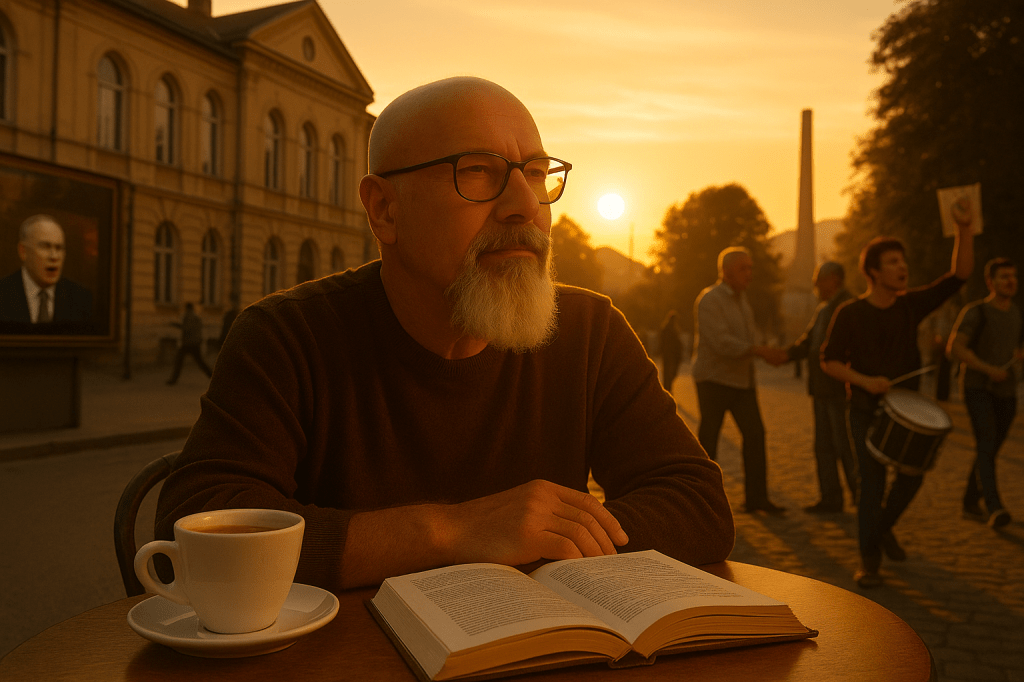
There comes a moment in life when a person realizes they no longer wish to change their habits, because those habits long ago ceased to be small rituals and have turned into the structure of their everyday life. After sixty, it’s no longer the adrenaline of new beginnings that moves us, but the serenity of a familiar rhythm. What we once did on a whim, by chance or out of impulse, now becomes an essential part of the day. Habits are like architecture: they build walls that make us feel safe and open windows through which we already know what we will see. With age, rituals stop being charming little quirks and become our mental compass—or, as the younger would say, our GPS. It’s the best way to cope with a world growing more chaotic by the day.
And so, every time I land in Serbia, everything unfolds in the same order. I unpack my suitcase and push it under the bed in a room that hasn’t been mine for years but still smells like childhood. No matter how often I promise myself to “improvise a little this time,” I end up doing exactly the same.
Bakery, tavern, bookstore…
First—the bakery. Not just any, but the one where pastries are still measured by sight, not by scale, and where the rolls are so good that only the French ones come close. That’s where the first conversations with strangers begin—about the weather, politics, rising prices. In that brief ritual, while waiting in line, every year of distance between me and the city disappears as if it never existed.
Next comes Stara Srbija, the tavern that looks exactly as it did twenty years ago: the same stain on the wall, the same smell of cooked meals, smoke, and alcohol. There I meet old colleagues I haven’t seen since my last visit. The conversations are the same but no less dear—grandchildren, sports, nostalgia, who won the NIN Award this year. After two hours, I haven’t learned anything new, but I’ve recharged with familiar warmth.
The next stop is the Laguna bookstore. I browse the shelves, leaf through the books, and buy a few titles I’ll, as always, not read until I’m back in Arizona. I don’t know why, but in American silence, it feels best to read what I brought from Serbia.
And then, when the city quiets down and retreats into its evening routine, when the lights go out and I return home, begins that time of day reserved for old books. On the shelf in the living room, about fifty titles await me—survivors of all the moves, renovations, and “rational decluttering.” I always pick one at random, and it becomes my companion throughout my brief stay in my hometown. This time I “grabbed” Tolstoy’s Notes of a Madman. I read it slowly, a few pages each night, the way one drinks Turkish coffee—with relish, unhurried, savoring every sense. While the TV hums in the background about “historic speeches” and “decisive negotiations,” I stumble upon lines like this:
“Today they took me to the provincial office for observation, and opinions were divided. They decided I was not insane, only because I tried my best not to give myself away. I didn’t, because I fear the asylum; I fear they’ll prevent me there from pursuing my mad work. They concluded I’m prone to emotions and something of the sort, but otherwise of sound mind.”
The next day—my walk. First through the park, the same one where more than half a century ago I chased a ball. Now I walk slowly, stopping by the same benches and trees. I always meet someone there: a schoolmate, a former colleague, a cousin who’s aged faster than I have. The conversations are short and always alike—health, children, America.
My path almost always leads me farther, to Šumarice, where history and silence touch. As I walk through the woods, time itself seems to move slower. In the evening, I wander aimlessly through the city center, recognizing faces in my imagination as if we had grown up together. Taxi drivers argue about politics, a chestnut vendor and a pensioner debate world affairs as if they were headed to a UN Security Council meeting the next morning. I shrug, return home, pick up the book, and turn the page:
“Until I was thirty-five, I lived like everyone else, and nothing peculiar could be noticed about me. Such things happened to me only in early childhood, up to the age of ten, and even then only in fits, not constantly as now.”
Meetings with friends are usually short and on weekdays. Everyone has their own life, family, and weekend plans. Our encounters are brief, spontaneous, and sincere. We meet, talk about everything and nothing. No one tries to sound profound—we leave that to those sitting in TV studios explaining the world. And Tolstoy, after all, still has the final word:
“I remember, once I was getting ready for bed, I was five or six. My nurse, Yevpraksia—a tall, thin woman in a brown dress, with a cap on her head and loose skin under her chin—undressed me and put me in bed. ‘I’ll do it myself,’ I said, climbing over the railing. ‘Come now, Feodyenka, see how good Mitya is—he’s already asleep,’ she said, nodding toward my brother. I jumped into bed, still holding her hand. Then I let go, kicked my legs under the blanket, and tucked myself in. It felt so wonderful.”
Photographs, drums, optimism…
One afternoon, instead of following my usual route, I stopped by the city gallery for an exhibition dedicated to student protests. The place was packed: high-schoolers with backpacks, professors with serious faces, parents of the “children” in the photos. I watched a couple, holding hands, moving from photo to photo, searching for their son’s face. “He’s here somewhere, I’m sure he is,” the woman kept saying, pausing before every frame. They didn’t find him in the pictures, but they did in a student message pinned to the wall:
“For those who can’t be with us—thank you for teaching us to believe that we can.”
The rhythm of drums coming from the corner filled the room, along with a quiet sense of optimism. At home, on the nightstand, my book awaited:
“Like all mentally sound boys of my time, I went to grammar school, then to university, where I graduated from law.”
One morning, while I sat on a park bench, an old schoolmate approached. We hadn’t seen each other in years. “You know I lost my house?” he said immediately. “A fast-track bailiff decision. Sold it over an unpaid electricity bill—seventy-four thousand dinars.”
He paused, then added, “You know, Serbia must be the only country in the world where you can’t be sure you’ll live if you fall ill, work if you’re honest, or reach retirement if you’re diligent. But one thing is certain—you will pay your bill!”
When I got home, I opened my book where I had stopped the night before. I read aloud, as if trying to understand a world where someone loses a home over a bill, while others still strive to ‘wisely increase their wealth’:
“My wife and I had saved money from her inheritance and my convictions about redemption and decided to buy an estate. I was unusually interested in increasing our property—as one should be—and particularly in doing so wisely, better than others…”
Days passed. Instead of walking the same paths, I spent most afternoons at a café in front of my old high school. That’s where I meet friends from youth. Someone always drops by—a history teacher counting days to retirement, a classmate who says nothing has changed except that we now wear glasses and talk softer. In that mix of planned meetings and accidental encounters, there’s a kind of comfort. In a world teetering on the edge of a nervous breakdown, my little routines still feel like proof that sanity hasn’t completely vanished.
And then inevitably, it’s time to return to America. I pack my habits and rituals along with my belongings, carefully placing them between souvenirs and the books from Laguna that, as always, wait their turn to be opened on the other side of the ocean.
On the plane—an unexpected scene. A few rows ahead sits a group of Belgrade high-school seniors. Twenty or so boys and girls, bright-faced, polite, well-mannered. At first, I thought they were athletes—but no, they were invited to visit the United Nations. Some are flying for the first time, some leaving Serbia for the first time, but all speak of the trip with a seriousness and respect rarely seen today. One girl said she wanted to become a diplomat “to represent Serbia the right way.”
Watching them, I realized that this generation carries within it something we older ones may have long lost: the belief that the world is not only a place to survive, but a place to improve. And right there, between clouds and the ocean, I asked myself: does Serbia deserve such a generation—decent, curious, ready to listen and understand even those they disagree with? And, perhaps even more—do the United Nations deserve such visitors, young people who still believe that once-prestigious institution can be something more than a stage for endless speeches and diplomatic clichés?
I arrive home, where the woman of my life awaits—with a new layout. She’s moved the plates in the kitchen, rearranged the wardrobes in the bedroom, and the shelves in the bathroom. It will take me at least a week to find my way again—maybe a month. Because old habits, after all, are not easily abandoned.
MAY WE LIVE AND BE WELL
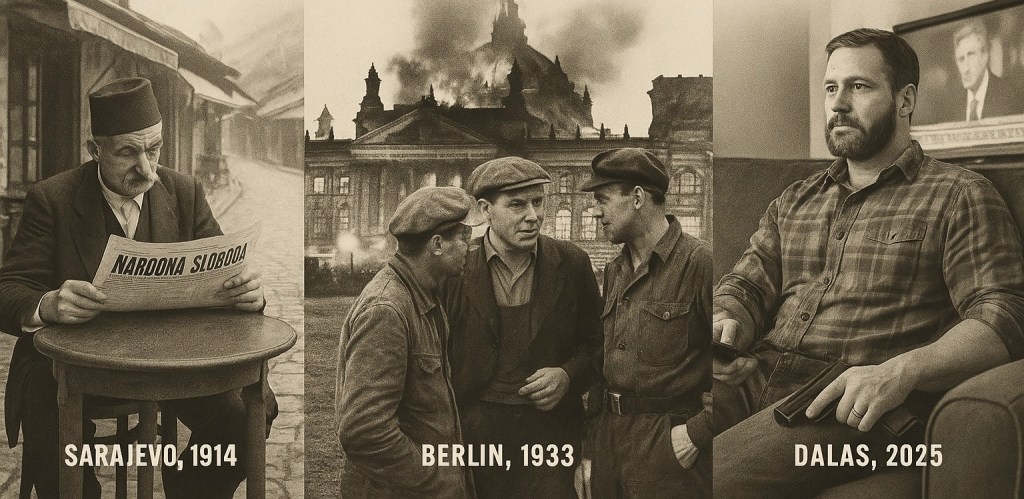
Sarajevo, January 1914.
Vukašin, a merchant in Baščaršija, sat with his morning coffe and leafed through the papers. On the front page: news of the Balkan Wars, a new model of French airplane, the British kingdom and industrial strikes. Near the bottom—strained relations between Austria-Hungary and Serbia. Vukašin read, sighed, and said aloud:
“War? Ah, no one’s that crazy.”
That afternoon he received a shipment of new goods and scolded his assistant for mixing up the stock. In the evening he ate sarma with his family. On Wednesday he sat with neighbors in the tavern; on Thursday he delivered groceries to Mrs. Wagner…
On June 28, 1914, he went to the market. He heard gunshots. Someone said, “They’ve killed Franz Ferdinand.” He shrugged and thought, “Surely there won’t be another slaughter over one man…”
A month later, Austria-Hungary declared war on Serbia—as if someone had merely been waiting for a pretext and everything else had long been ready. And Vukašin, like millions of others, had no inkling that the shot that morning had awakened the beast. Until then, everyone had lived their small lives in peace—planning, working, waiting. No one wanted war. No one asked for it. And when it came—they were astonished.
Gavrilo Princip pulled the trigger and the rest was a chain reaction. Vienna wanted revenge, Berlin gave support, Petrograd muttered, “Don’t touch our brothers.” Paris stood by its allies, and Europe stepped to the edge and jumped into the abyss. One bullet in Sarajevo, then a month of ominous silence while armies mobilized and ultimatums were drafted… Propaganda at the time was less subtle, but present, brutal, and effective. Patriotism, hatred of the enemy, faith in king or state were its main lines. On the posters, the enemy was a beast and our soldier a hero. Censorship was used in all countries to prevent defeatism and the spread of “unsuitable” information. Churches, schools, and military institutions took the lead in shaping the public narrative.
The world plunged headlong into war. Everyone believed they’d be home by Christmas. No one imagined four years of hell, the likes of which had never been seen.
Berlin, February 1933.
Otto, a tool-factory worker, took off his greasy apron and ate a half-empty sandwich in the back of the shop. With his colleagues he talked about everything and nothing: the price of milk, class differences, army maneuvers… They concluded it couldn’t go on like this. One said the communists should take matters in hand. Another waved him off: “You’d be happy about that, would you?” Otto kept quiet. He believed neither side. What mattered most was to be left alone and peacefully await the next paycheck.
The next morning the Reichstag burned. The Nazis blamed the communists. A state of emergency was declared and civil rights suspended. Many rejoiced: “At last there’ll be order.” Otto wondered how everything could change overnight. He kept quiet, didn’t make waves. He drew many more paychecks—and then came the uniform, training, oath… War.
How did the world breathe before it suffocated? On the surface—calm and normal. In Paris they spoke of fashion, exhibitions, and scandals. In Belgrade—taxes, harvests, and how the king was too hard-line. In London—markets, colonies, a convoy bound for India. In New York—the new Ford plant, the price of tobacco, yet another ship of immigrants docking. Everything followed its course. Trains flew by, telegraphs chirped, industry clattered without pause. People made plans and bought their first summer clothes. Wrote love letters, prepared weddings, bought cradles… Beneath the veneer of normality, pressure built. Factories saw strikes. Parliaments broke their lances deciding which side to lean toward. In the villages, people mostly kept silent—they knew nothing good comes when the German gets riled.
In Vienna the elite feared disintegration. In Berlin the generals studied maps and drew borders. In Moscow the communists discovered that ruling isn’t easy—you have to feed the people—so they found salvation in an external enemy. In Paris, conformism beat every other “-ism.” The French weren’t much in the mood for war. From London came the message that the new division of the world was, in fact, a matter of honor. In Serbia—pride, stubbornness, and a wound still bleeding from the Balkan Wars. Workers made policy, peasants worked, students dreamed of revolution. Markets haggled, taverns drank, theaters laughed, factories sweated. And no one—absolutely no one—suspected that in a month the whole world would look like an open wound without a bandage. The world walked on ice already cracking. It only took someone to stomp harder, one army to move and shout: “Charge!”
War propaganda became a science. In Germany, a Ministry of Public Enlightenment and Propaganda was formed. The goal wasn’t to inform but to shape. People ignored the persecution of Jews—not for lack of warning signs, but because no one wished to see them. Camps already existed and violence had gone public. Kristallnacht (1938) unfolded before the people’s eyes. Yet the world looked away, calling it “Germany’s internal affair.” The problem wasn’t a lack of information, but a surplus of propaganda, false optimism, selective attention, and collective fatigue.
In 1938 Hitler swallowed Austria. The world was silent. September: the Munich Agreement dismembered Czechoslovakia. Otto was sent to the border. “You know,” he told a comrade in the trench, “I can’t say I support war—but someone’s got to defend the nation.”
Dallas, 2025.
Tyler is 38. Drives a Ford, carries a handgun, believes the state shouldn’t meddle in his life. He dislikes taxes and “woke culture.” He supports Trump: “Not perfect, but at least I know where he stands.” He doesn’t trust liberal media; he follows conservative podcasts, Twitter, and listens to Joe Rogan. The war in Ukraine? “Not our problem.” Gaza? “They asked for it.” Inflation, the Chinese, migrants—all symptoms of American decline. Then, an assassination: Charlie Kirk is killed at a public event. The internet is ablaze. Theories. Counter-theories. The right calls for civil war. The left demands gun-control laws. TV programs critical of the authorities are banned. One by one, U.S. states teeter on the edge of emergency rule. Tyler tells his wife: “This doesn’t smell good.” Remote in hand, FOX News on the screen, he looks out the window. The street is calm. For now.
Over the last hundred years the world has turned on its head, but human naiveté, the greed of the powerful, and our urge toward self-destruction remain constants. In the first quarter of the first tenth of the twenty-first century, we enjoy the sweet idleness of the internet, bicker on social media, and play with artificial intelligence. Technology is everywhere. In Western Europe and America, wars are waged via keyboard; in Ukraine with drones; in Gaza with all means available to meet the daily quota of death.
Tyler has bought a semi-automatic rifle.
Everything Has Changed—and Everyone Has Swapped Places
In the First and Second World Wars reality was stark and the aggressors had names—Germany, Austria, Italy, Japan… The defenders of the world rallied under the banners of the Soviet Union, America, and Great Britain. Millions of civilians perished, and the victims were recognizable—above all the Jews, the most persecuted people. It was believed that after 1945 the world had learned its lesson and that the lines between good and evil were at least somewhat clearer. We hoped the chapters on camps, city bombings, expulsions, and racial hatred would never be reopened. But today the deck is completely reshuffled, and the world seems to have forgotten the recent past and its own blueprint.
Germany, Austria, Italy, Japan—countries that once shoved the world into war—are now among the most prudent powers. Their militaries are modest; their foreign policies measured. Germany is bound to the EU, Italy minds its own house, and Japan, though strong, rarely raises its voice. Maybe it’s guilt, maybe fear… Whatever the reason, one thing is certain: the aggressors of two world wars now play a relatively decent role in a planetary tragedy of wailing and gunfire.
At the same time, yesterday’s “good guys,” the protectors of the free world in the first half of the last century, have become engines of chaos. The U.S. and Russia, once united against fascism, are now in constant conflict—mostly with others, often with themselves. Russia, in “self-defense,” attacked Ukraine, borrowing the rhetoric of 1939. Under the threadbare banner of human rights, America left ruins wherever it wished to “help.” Guided by democratic principles, twentieth-century wars were waged against tyranny; today they serve as cover for invasions, coups, and the foulest colonial grabs.
No great power sits for a moral exam anymore; each calculates instead: how profitable is aggression, how valuable an ally, how long the public’s attention will last. While today’s empires negotiate feebly (and act far more lethally), yesterday’s victims have too easily accepted the role of executioner. Petty bullies in the Middle East, backed by big brothers in the West, are carrying out an unprecedented slaughter in the Gaza Strip. The Jewish people—symbol of twentieth-century suffering—through the policy of the Israeli state are conducting the ethnic cleansing of the Palestinian people. In Gaza’s daily abuse of civilians, it isn’t only Hamas who die—children, refugee camps, schools—an entire enclave of sacrificial civilians is destroyed. The “democratic” world that once screamed “Genocide—never again!” now whispers “It’s complicated,” and does nothing to stop further war crimes. This is no longer a mere moral dilemma; it is the moment when historical roles have been fully reversed. Recent aggressors are disciplined, quiet, restrained. Former defenders have lost their compass and wage endless wars. Yesterday’s victims surpass their former persecutors. We believed that after 1945 we could tell black from white. Today there are only sides—ours and theirs—though neither is just. Law has become relative, morality overnight a luxury, and politics a small coin for settling the accounts of insecure, senescent men.
Leadership is no longer grounded in truth but in interest. If you have power—you’re right. And vice versa. And so today’s world irresistibly recalls 1939: marches in Washington, Moscow, even New Belgrade. But it also looks like 1914: a heap of local crises, armies at borders, politicians shaking poisonous draughts while citizens are convinced “there’s still time.” Everyone assumes someone else will pull the brake. And the runaway train thunders toward the ravine.
World War III may not break out this year, or the next—perhaps never. But if it comes, it won’t arrive as a surprise; it will be the consequence of what we’re living through now. When we one day look back from some trench, we won’t be able to say we didn’t know. We knew—but didn’t want to face the truth.
Ah well—leave it be. May we live and be well.
THE ANATOMY OF MEDIA PROPAGANDA
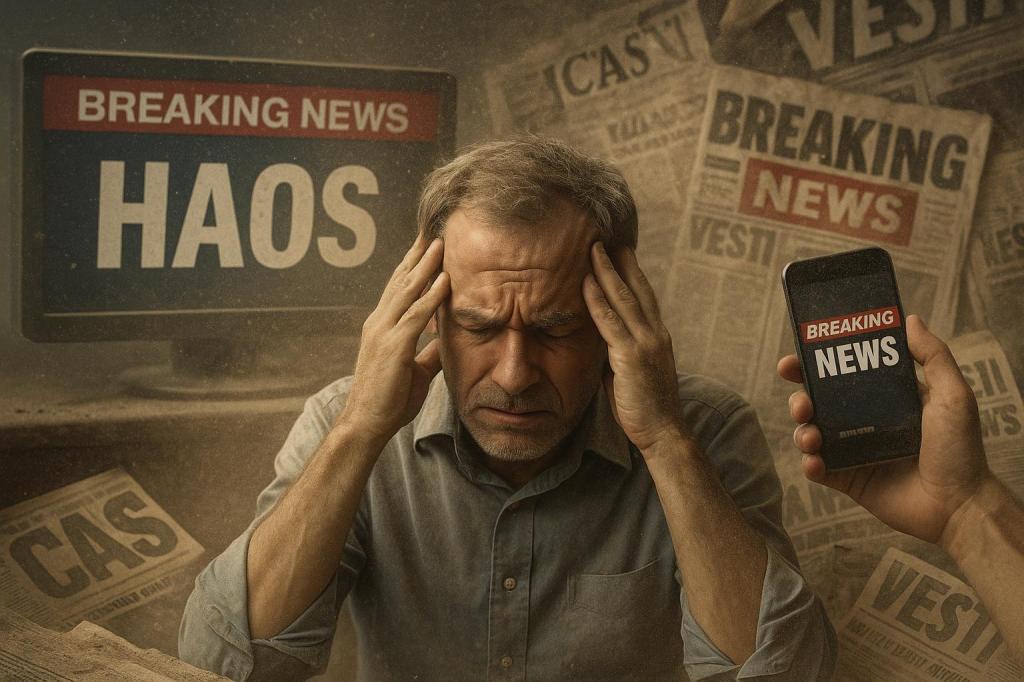
FROM BROKEN EGGS TO GLOBAL CATASTROPHE
During a guest appearance on a morning talk show, a well-known psychologist shared a story: one of his patients said, “Doctor, I read the news ten hours a day and I feel like the world is ending tomorrow. Is that normal?”
The doctor replied: “It’s not normal to read the news ten hours a day — but it is normal to feel like the world is ending.”
Never in history have we been exposed to as much information pressure as today. If the old saying once held that “you can’t have too much knowledge,” it now turns out that too much information can shake both body and mind.
In an ideal world, every reader, viewer, or listener would process, analyze, and shelf every piece of content into their personal experience. But in reality, the day is too short, and the avalanche of data is relentless. News stories cascade one after another. When a new topic hits, the old ones don’t disappear — they recycle and pile up in our consciousness. Like grime on a window we can no longer see through.
Every outlet invents a new drama, offers a bigger threat, creates more panic. In our effort to stay informed, we become prisoners of our own curiosity. Inner peace vanishes, replaced by a constant state of alertness: war is about to erupt, and global catastrophe seems inevitable.
We interrupt this program — reason and logic have gone missing!
Journalism has changed. Once a pillar of public interest, a tool in the pursuit of truth, a foundation of an informed society — today, it has become its own opposite: an attention industry. News is no longer grounded in verified truth, but in screen time and click counts.
Ratings matter more than credibility. Speed trumps accuracy. Sensation beats context.
Objectivity has faded, and analytical journalism has been reduced to the work of a few brave, systematically sidelined investigative reporters.
And the audience? Far from innocent — devouring every sensational headline the tabloids serve. If there’s no blood, fire, tears, or victims — the story goes unnoticed. “Breaking News!” is every newsroom’s daily prayer.
In Serbia, headlines read:
“Grandpa stabbed over broken eggs.”
“A mother’s boundless love: ‘I want my son to die before I do’ — tabloids in tears, son in shock!”
In the U.S.:
“Sunflower allegedly looks like the president – mystery shakes midwest farm!”
“Wall Street panic: Analyst forgets password — stocks plummet!”
“White House insider claims president dozed off during online NATO meeting!”
Globally:
“Exclusive: Putin seen feeding pigeons – what does this mean for global stability?”
“Drivers shocked as giant penis-shaped sign reappears at roundabout!”
“Panda refuses bamboo – Asian diplomacy in crisis!”
Everything is urgent. Everything matters. No one asks: is it true?
Half of these headlines are real. The other half are made up.
Can you tell which is which?
After multiple propaganda “climaxes,” timed perfectly for prime time, comes a short break — a false peace — before news therapists reload the next round of informational ammunition.
If we switch metaphors — from sex to war — we could compare it to artillery: the barrage briefly stops, the barrels cool, and then it all starts again. In that silence, there’s no reflection, no real analysis — just a pause to recharge for the next wave of fear.
Propaganda First, Then the Bombs
Wars have always been fertile ground for sensationalism. Every bullet is preceded by a barrage of weaponized words. First comes propaganda — turning people into obedient herds — followed by media shepherds, leading them “down the right path.”
On one channel, Ukraine is a symbol of freedom. On another, Zelensky is a Western puppet.
One says Israel is a victim. Another calls it a genocidal regime.
In both cases, truth is buried under a mountain of bias, algorithms, and political interests.
When objectivity disappears, everyone picks the version of reality that suits them best:
“My facts.” “My source.” “My truth.”
Disoriented and distrustful, the public flees to social media — only to get lost in an even denser jungle: conspiracy theories, half-truths, fake news that spreads faster than it can ever be fact-checked.
And so, in this whirlwind of disinformation, people retreat into their own mental refugee camps — spaces where no one is trusted anymore.
Media Inflation
Psychologists already have a term for it: doomscrolling.
Endless, compulsive scrolling through destructive content. The digital equivalent of picking at a wound — you know it hurts, but you can’t stop.
The brain craves the next dose of anxiety. Fear is the cheapest drug of the digital age.
The cycle continues: stress triggers a search for news, and news creates more stress.
People wake up tired, go to work fractured, and fall asleep depressed.
Insomnia turns into anxiety. Focus becomes fragmented.
Social media algorithms shatter attention spans and herd us into echo chambers.
In these tribes, truth is irrelevant — only confirmation of our biases matters. Each tribe has its own borders, sources, prophets, and slogans.
Instead of dialogue: tribal war in the comments section.
And so we have digital “brotherhoods,” whose members, miles apart, fight endless battles from behind their keyboards — convinced they’re defending justice, unaware they’re only feeding algorithms that make someone else rich.
This well-oiled mechanism produces digital saturation with imagined truths.
The human brain, bombarded by lies and half-truths, loses the ability to tell important from trivial.
Child killings and celebrity breakups appear side-by-side.
Climate change and reality TV — equally weighted.
In this noise of nonsense, truth becomes irrelevant, and the audience unknowingly helps maintain the media circus.
Sensation Is the New Standard
In today’s media madhouse, even the murder of a previously unknown man — who suddenly became a conservative influencer — can dominate global headlines.
“Charlie Kirk’s murder sets the world on fire!”
“Tragic death of conservative hero sparks wave of violence in U.S.!”
“U.S. revokes visas for those who didn’t mourn Charlie Kirk!”
The headlines never stop.
TV channels interrupt programming.
Online debates erupt.
Flags are lowered. Commemorations held. Presidents express condolences — as if a statesman of historic importance had fallen, not just an influencer riding the wave of algorithmic fame.
This single, irrational act of violence gets more media attention than the escalation of war in Gaza, mass protests across Europe, or even the death of Robert Redford.
Logic collapses. One inflated name outshines events of real, far-reaching consequence.
The world no longer measures the weight of news by its impact — but by its virality.
Tragedy becomes spectacle.
And spectacle is the most stable currency in public discourse.
What’s Left for the Ordinary Person?
What can the average person — the news consumer, the reader, the viewer — do?
Perhaps the simplest thing. But also the hardest:
Turn away from the screen.
Go for a walk.
Read a book.
Have coffee with a friend. Listen when they talk.
Do whatever reminds you that reality is still here — firm, living, and waiting for us to return.
That doesn’t mean abandoning the world of information. It means practicing selective intake.
Just as we don’t eat everything we’re served, we shouldn’t swallow every headline tossed at us.
The first step to healing is an informational diet.
After that comes context — and truth never lives in the headline. It demands patience, deep analysis, investigative reporting, documentaries, books.
Things that require time — not just a click.
And finally, we must accept that we can’t change most of today’s headlines.
Instead of panicking, we must protect our mental health.
Not by closing our eyes to reality — but by refusing to let it destroy us.
We Only Have One Life
Because life, as the poet said, is just this one — there’s nothing beyond it.
If we spend it endlessly scrolling through the latest “breaking news,” we’ll waste it in a tunnel of media deception, blinded by the glow of fake spotlights.
So maybe the wisest move is the most obvious:
Don’t read more. Don’t read less.
Read smarter.
Learn to spot the difference between news and propaganda, between information and manipulation, between what matters and what doesn’t.
If we can do that, maybe we’ll regain what this media madness has stolen —
clarity of thought and peace of mind.
A decade ago, anyone glued to the news all day would be diagnosed with an anxiety disorder and prescribed medication. Today? That’s just the statistical average.
Humanity has turned into one giant therapy group, where we all say in unison:
“Just one more headline… one more news panel… one more reality show… one more staff meeting… and then I’ll stop!”
In a world where thinking the world might end tomorrow feels normal —
maybe the only real act of sanity is this: to stay calm, stay human, and keep smiling.
And when the world does finally collapse — rest assured —
the tabloids will break the story first.
Prime time.
Exclusive.
Just for you.
THE PARDONING OF INJUSTICE
On the Brioni islands, in the summer of 1978, Josip Broz showed U.S. President Jimmy Carter an ancient olive grove that had outlived invaders, regimes, and systems. The seasoned statesman told his younger colleague: “Trees endure for centuries, politicians only until the end of their term.” Malicious tongues would add that it’s easy for Tito to preach about the transience of power when he was elected lifetime president of the SFRY. The most famous peanut farmer from the state of Georgia soon felt for himself the difference between the people’s permanence and power’s impermanence. Three decades later, in Prague, there was another meeting between a “leader of the free world” and a president from the Balkans. Obama and Tadić didn’t discuss gardening, but they did touch on basketball. “Our players are getting close in quality to the NBA pros!” Boris boasted. “And imagine what kind of basketball power you’d have if you hadn’t broken up Yugoslavia!” Barack shot back, side-eyeing Angela Merkel. “Summits” also marked the reigns of later Serbian presidents, but more on them another time in the column “Comedy, Misery, Disgrace!”
“IF YOU’RE A PORK CHOP, YOU’RE NOT FOR SAUSAGES”
Although at first glance they seemed to have done a decent job, history was harsh to the politicians just mentioned. While he was alive, Broz was exalted to the stars, only to become overnight the whipping boy for all the frustrations of Joža’s heirs. Carter, Obama, and Tadić became hated, not so much for personal failures as for the fact that they came to symbolize citizens’ disappointment in their own unrealistic expectations. Carter was criticized for lacking courage and decisiveness—even though he pioneered putting human rights at the center of U.S. policy. Obama was blamed for everything under the sun—though he led America out of one of the greatest economic crises in its history. The hatred of the first “colored” president has little to do with policy and much to do with the personal complexes of no small number of racists in the U.S. Boris Tadić was attacked from both left and right, though during his term Serbia was closest to Europe, and civil liberties and living standards were at their highest since the days when Serbs said a resounding “no” to Ante Marković’s policies. It should also be said that each of the above presidents was mentally stable, with no visible personality disorders. Unfortunately, back in vogue came those quickest to pounce when the doors of the world’s madhouse swung ajar and when democracy, living standards, and basic normalcy disappeared from most citizens’ list of priorities. Thus, in America, “normal” politicians were replaced by Republicans Reagan and Trump; in Serbia, by Radicals Nikolić and Vučić.
In search of a strong hand, both Americans and Serbs turned their backs on those who respected the constitution and advocated compromise and dialogue. Both got, alas, the most extreme version of the politics they voted for—only to find themselves in a deep democratic crisis. Civil liberties are slowly vanishing, institutions have lost their strength, and “firm-handed” leaders are ushering in autocracy. People quickly forgot the Brioni olive trees and the casual basketball banter from Prague, and “between two evils” they voted for dread and horror. By mid-2025, citizens of the U.S. and Serbia were feeling, intensely, the consequences of their own choices—choices that led to radicalization and the erosion of basic democratic standards. What used to be a debate over shades of difference has become a conflict marching toward the abolition of freedom and human rights.
After many years, America is now feeling on its own skin what it has lectured others about for decades. Summer days passed under the sign of protests against the deportation of thousands of immigrants. Images of police repression in the streets of Los Angeles, San Francisco, New York, and Chicago read like the sad chronicle of a country where nothing is normal anymore: blocked streets, tear gas in the air, zip-ties on protesters’ wrists. Instead of dialogue, President Donald Trump sent military reservists first to California, then to the capital, where he deployed the National Guard around the Capitol. American media are still flailing in a net of imposed unanimity from on high, but Donald doesn’t worry: between The New York Times and The Washington Post, a Trump voter will opt for Instagram and TikTok.
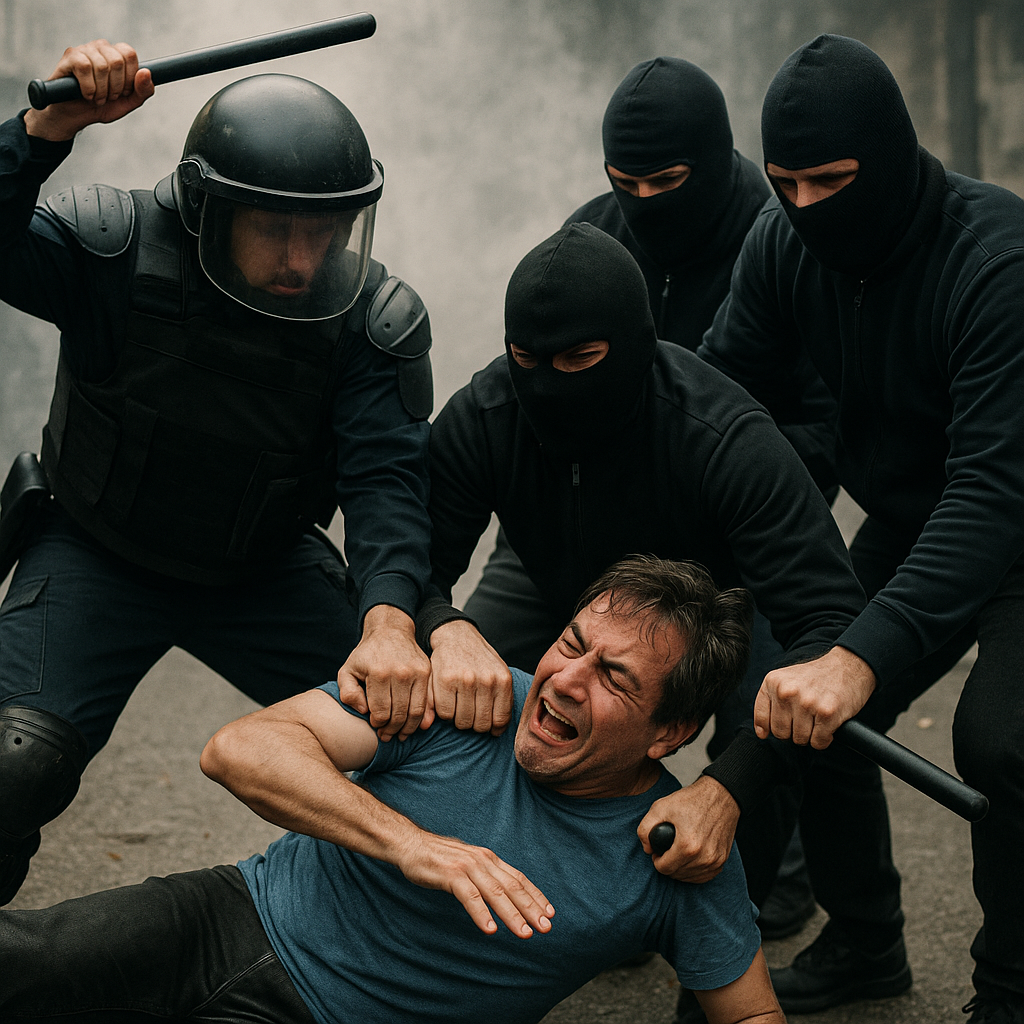
The totalitarian rule of a single man has lasted far longer in Serbia, and its citizens have endured the consequences of their neutrality and “blank ballots” for thirteen years. When you shake popular champagne that long, it doesn’t take much for the cork to blast out of the bottle. In Serbia, however, something truly horrific happened: because of corruption and lawlessness, 16 innocent people lost their lives. After the tragedy in Novi Sad, an explosion of emotion and common sense sent people into the streets. Students and citizens demanded accountability, respect for the law, and functioning institutions. Instead of meeting those demands, Vučić leafed through the memoirs of his idols and forged a new tactic. In fascist Spain and later in Latin America, dictators were the first to understand that uniformed police often weren’t enough to crush popular revolt. So they hired civilian enforcers to intimidate, beat, and kill opponents. Under Franco they were called Falangists; Somoza in Nicaragua had his esbirros; Pinochet his brigadistas; Perón the Triple A. Many years later, in the heart of Europe, Vučić formed his “loyalists.” Men in black—most with criminal records—who, under the pretext of guarding party offices, pelt unarmed demonstrators with stun grenades, stones, frozen water bottles, and eggs. Meanwhile the police protect the criminals and arrest those who react to the thugs’ provocations.
PARDON ME, MR. PRESIDENT
If a lost Norwegian visiting Belgrade Waterfront or the Freedom Fair were to ask how it’s possible, in democratic countries, for criminals to attack unarmed citizens with iron rods and walk away unpunished, he’d get a simple answer: presidential pardon! In July and August 2025, Aleksandar Vučić pardoned several of his protégés accused of violence against students. Instead of defending the victims, the state sided with the perpetrators, erasing the line between justice and loyalty.
Donald Trump went a step further and, on Inauguration Day, issued mass pardons to participants in the January 6, 2021 attack on the Capitol. Sentences for members of extremist groups were drastically reduced, while thousands of other participants received permanent clemency for serious crimes. Thus ended the judicial epilogue to one of the fiercest assaults on American democracy: responsibility erased with a rubber, violence legitimated as part and parcel of political struggle by the privileged and the president’s bullies. At the moment, the president is reportedly toying with pardons for convicted pedophiles as well—but that’s another story.
In the play Balkan Spy, Danica Čvorović says at one point: “If they betrayed their wives, why wouldn’t they betray their country?” Applied to political mimicry in the U.S. and Serbia, we might freely say: whoever lies to their own citizens—no wonder they cheat their allies. Here begins the double game on Ukraine and the tragedy in Gaza. The “governorate” of Aca the Serb from Red Star’s north stand presents itself as a country with an independent foreign policy. Weapons and ammunition produced in Serbian factories end up in the hands of Ukrainian soldiers, while President Vučić insists Serbia will never impose sanctions on fraternal Russia. Public friendship with Moscow; secret trade with Kyiv; and the final paradox—Serbia profits from a war it officially condemns.
America, for its part, openly backs Ukraine with billions in military aid. Yet while telling the home front it stands in solidarity with embattled Ukrainians, behind closed doors it negotiates with Moscow—without its “protégé,” Zelensky, at the table. In mid-August, Vladimir Putin visited the United States. Donald played the clown as usual; Volodya’s knees buckled—not from fear, but from arthritis. They discussed a “peace plan” in which Ukrainian resources and territory served as bargaining chips for two great powers. Thus the word peace was, and remains, a diplomatic screen for a redistribution of interests.
The same story applies to the war in Gaza, where slogans about ceasefires and humanitarian aid scatter under the weight of weapons delivered to the aggressor. In the first six months of 2025, Serbia exported arms to Israel worth €55.5 million. Only when a UN special rapporteur publicly warned that international law was being violated did Serbia’s leadership react. The president announced a supposed halt in exports—only to, as usual, break his promise.
The U.S. went many steps further: in February it scrapped the law barring the use of American weapons where international humanitarian law would be violated—paving the way for arms shipments worth billions. According to the Stockholm International Peace Research Institute, America accounts for over 70 percent of global arms exports to Israel.
At the end of this masquerade, Serbia and America stand before the same mirror: preaching peace while exporting weapons; invoking democracy while crushing protests; promising a bright future while dragging citizens backward. Democracy wasn’t killed with one thunderous volley, but with a thousand small bullets of lies, backroom deals, and pardons for political thugs. If once great ideas and principles led nations forward, today we’re left with petty haggling over interests and the weighing of power. Serbia increasingly resembles Franco’s Spain; America, Mussolini’s Italy—while the citizens of both countries teeter between hope and despair.
The crisis of democracy is no longer an external threat; it’s becoming an internal metastasis. The question is no longer whether democracy will survive, but whether citizens will fight to win it back—someday.
September 6, 2025
It was Saturday, early morning, when customers discovered that Slava’s barbershop was closed. Next to the sign with working hours stood a short, bilingual message: “This Saturday, due to marital obligations, I will not be working!”
No, no—it’s not what you think, mischievous reader. This Arizona barber is an honest Serb with permanent residency in the U.S., who keeps intimacy behind closed doors. This was actually about tourism.
The last time Slava took his Stana on vacation was in 2012, through her union in Serbia. After that, they went a few times to the “Pumpkin Days” festival in Kikinda, where the biggest pumpkin is chosen, but since coming to Arizona—vacationing was forgotten. This weekend, they decided to visit the northern part of their new desert “homeland.”
After drinking his coffee, packing the trunk, and starting the Buick to cool the inside, Slava paced nervously down the hallway, waiting for his lifelong companion.
“Just five more minutes!” Stana called from the bathroom.
“Come on, woman, we’re going to the mountains—who’s going to look at you there? Your five minutes last as long as two Trump terms!”
As soon as they sat in the car, the barber adjusted the mirrors and hit the highway. Stana carefully typed the destination into her phone app, but Slava didn’t trust GPS.
“Some woman from a phone isn’t going to tell me where to turn. The best navigation system is a wise male head—and if you’ve got a map, even better…”
“But Slava, this ‘woman’ knows where Flagstaff is. Last time, you ended up toward Nogales when we wanted to go north.”
“That wasn’t a mistake—it was… an alternative route.”
He popped in a CD with the Yugonostalgic hits of his youth, they reached Ash Fork, where they joined the famous Route 66.
“On this road, my dear, Peter Fonda and Dennis Hopper rode their motorcycles in Easy Rider!” he sighed wistfully.
“Don’t be biased—Thelma and Louise drove here too!” Stana snapped back.
After an hour and a half, they stopped for breakfast at the Monte Vista Hotel, famous for its mystical happenings and paranormal events. They stepped into a restaurant filled with the smell of bacon, coffee, and the Wild West. Everything was authentic, including staff that could scare any normal child. They sat at a table near the entrance, with a clear view of the reception desk where old Billy, a hundred years strong, dozed off.
Their waitress could have passed for a witch—messy hair, black makeup, and a tattoo of an evil spirit on her forearm.
“Good morning, what can I get you?”
Stana ordered a pastry with white coffee, Slava went for a full omelet and extra bacon—or, as the menu called it:
“One ‘Morning Apparition in a Vampire’s White Cloak’ and ‘The Sheriff’s Last Stand,’” the waitress summarized.
“I thought I was ordering breakfast, not a horror-western. But fine, I’ll take it before they change the genre and bring sushi!”
As Slava poured his third coffee, he thought he saw the bellboy and porter vanish through the western wall, where there were no doors or windows.
“Watch out for the Lady in White,” the waitress teased. “Sometimes she shows up after the third coffee.”
She confided in them that at a corner table often sat a pale man with long white hair, who came in every day, drank a bottle of red wine, and when the bill came—simply disappeared. They checked security cameras, but no trace of him until the next day. It had been like that for years.
“This place reminds me of the in-laws—you’re never alone, and you always end up paying for their drinks.”
“They say once a guest reported his chair dancing around the room,” Stana added.
“And when my customers steal newspapers, you all say Slava exaggerates!”
After breakfast, they continued to Sunset Crater, the volcano whose terrain resembles the surface of the Moon.
“See, Slava, Armstrong and the other astronauts trained here before flying to the Moon,” said Stana.
“So, they practiced walking on the Moon… in Arizona?”
“Yes, the terrain is similar.”
“Then I can claim I was in Egypt, because I walked on sand in Kikinda.”
“Hopeless case.”
“If they went to the Moon, then I fought in the Battle of Kosovo!”
That evening, they visited Lowell Observatory. The curator explained that Pluto had been discovered right there.
“So, little Johnny from Flagstaff peeks into a telescope and bam—a new planet. Like guessing the right rakija in a tavern—pure luck.”
When he heard Pluto was no longer a planet, Slava shrugged: “My buddy retired too, but we still call him Tika the Postman.”
They spent the night in a modest motel, free of mysteries. The next morning, as Stana was getting ready, Slava impatiently tapped his feet by the window:
“If you’re not ready in five minutes, we’ll get to Bisbee after the third mining shift is over.”
“There are no mines anymore, Slava.”
“That’s why we’re leaving early—to see what’s left.”
As they drove south, the landscape changed: pine trees gave way to rocks and desert, until finally the hills of Bisbee. The town’s entrance looked like an old postcard—brick facades, winding streets, and ruins where the copper mine once stood.
Their first stop was the Serbian Orthodox Church of St. Stefan Nemanja. An elderly man in a black cassock greeted them.
“Father Radovan,” the barber said warmly, “when I was a kid, I heard my great-grandfather—my namesake—worked as a miner in America. I’m curious if it was here in Bisbee.”
“We have a donor book from 1877, so if he was a man of faith…”
“But the church was founded only in 1956?” Stana asked.
“Among the miners, there was always a man of God, or a priest’s son. Services were held in homes. Here, look—there’s a Slavoljub, last name Števin?” Father Radovan said, leafing through the old book.
“That’s him! My namesake and distant ancestor, a tambura player. They say he sang in the mine when times were hard. He made it far by ship, and I barely dragged myself here by plane.”
They bought a few souvenirs, lit candles for the late grandfather Slava and for the health of his descendants, then headed downtown. When the mine closed in the late 1970s, the town was soon filled with bohemians and artists, and later with members of the LGBT community—then frowned upon in much of America. Stana wanted to see the galleries lined up one after another.
The first was “55 Main Gallery.” The walls were covered with paintings, jewelry, and bent metal shapes Slava couldn’t describe even under a polygraph.
“Look at this, Stana… someone bent a spoon and glued it to a wooden board. And that’s art?”
“That’s conceptualism, Slava.”
“I conceptually wanted to clean out the garage, but never got around to it. Imagine how many ‘artworks’ could be found there!”
Next stop: the Artemizia gallery. Walls full of graffiti, Warhol, Kusama, and in the corner the famous “Banksy rat.”
“You know who’d like this? That bald Šumadijanac who used to be a journalist, now a banker. He claims to understand these modern tricks. When I see this critter on the wall, my first thought is to call pest control.”
Among the exhibits was a sculpture of seashells, a bicycle, and a tennis racket.
“Is this art or did someone forget their stuff?” Slava asked a young artist with purple hair.
“It’s the journey of the soul.”
“Hmm, no wonder it looked familiar.”
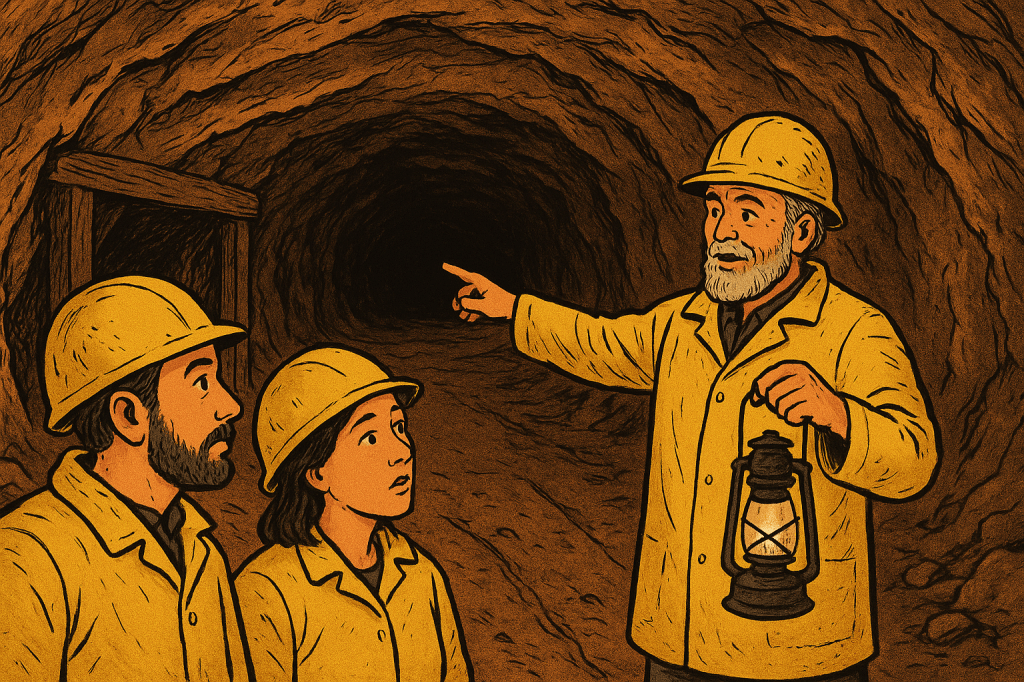
After fulfilling his wife’s artistic wish, the barber finally got his turn: the Lavender Pit mine. After viewing the open pit, they put on yellow raincoats and helmets and descended into the tunnel by a small mining train. The guide, an old man with Popeye’s arms, spoke calmly, as if counting minutes to the end of his shift.
“People worked here twelve hours a day, deep underground. No air conditioning, no cell phones… just sweat, dust, and copper.”
Slava cut in: “So what did they do when they got bored?”
“Worked harder, so they wouldn’t get fired.”
“My great-grandfather dug here too. They say he played tambura and sang.”
The guide smiled and pointed to a niche in the wall:
“Maybe he stood right here, where the air was a little warmer. I know some used to sing, to make the shift go faster.”
The guide continued: “The mine ran for nearly a hundred years, until it closed in 1975 when copper prices fell. Today, when we tell tourists how life was, many think we exaggerate.”
Slava waved it off: “I believe you, my friend. I know what it’s like to be stuck twelve hours under the lamp—on pensioner days in my barbershop, I shave and cut until my arms fall off.”
At dusk, they stopped at a restaurant. Slava ordered “Desert Winds Beans” and got beans with coconut milk.
“Is this beans or perfume?”
*“Vegan fusion,” the waiter replied.
“Listen, pal, I’ve eaten beans with ribs, with sausage, even plain beans—but never with coconut!”
Stana picked at her arugula salad, blushing at her husband’s complaints:
“Stop grumbling. A man should try something new.”
“Every time I tried, I regretted it!”
After finishing this so-called dinner, they drove back through the desert. The night sky was dark, only the cacti outlined by the moonlight. Slava was silent for a few minutes, then couldn’t resist:
“You know, Stana… I’m not sure about walking on the Moon, but today I went underground, saw where my great-grandfather worked, toured an artists’ town… and survived beans with coconut. Isn’t that enough?”
Stana laughed:
“You deserve a medal! Whether from Trump or Vučić, we’ll see!”
“A medal? Nonsense…” he waved her off. “That’s just barber talk—with a little salt, to make it sound like I opened the mine myself.”
The car sped toward Phoenix, Leo Martin singing from the back seat. Slava pressed the gas and kissed his wife:
“See? Even without the sea, we had a lovely mini-vacation. Next year we’ll stay a whole week. Since when was Slava a cheapskate?”
Summer Stories from Arizona-Tucson: PUMPING IN A-117
At the far south of Arizona, Mount Lemmon and the Santa Catalina range formed a natural wall, reminiscent of an ancient time when people moved freely, loved openly, and lived together. All was peaceful until the day some gringo decided to draw a border with a ruler. North of the mountains lies Tucson, and to the south – times when no one asked for a passport. In the largest town in the American part of the Sonoran Desert, summer is not just a season, but a “torture chamber” for schoolchildren and students alike. The authorities, in their wisdom, decided the school year should begin in late July – when temperatures don’t drop below 110°F even in the shade. And people, as people do, long for shade.
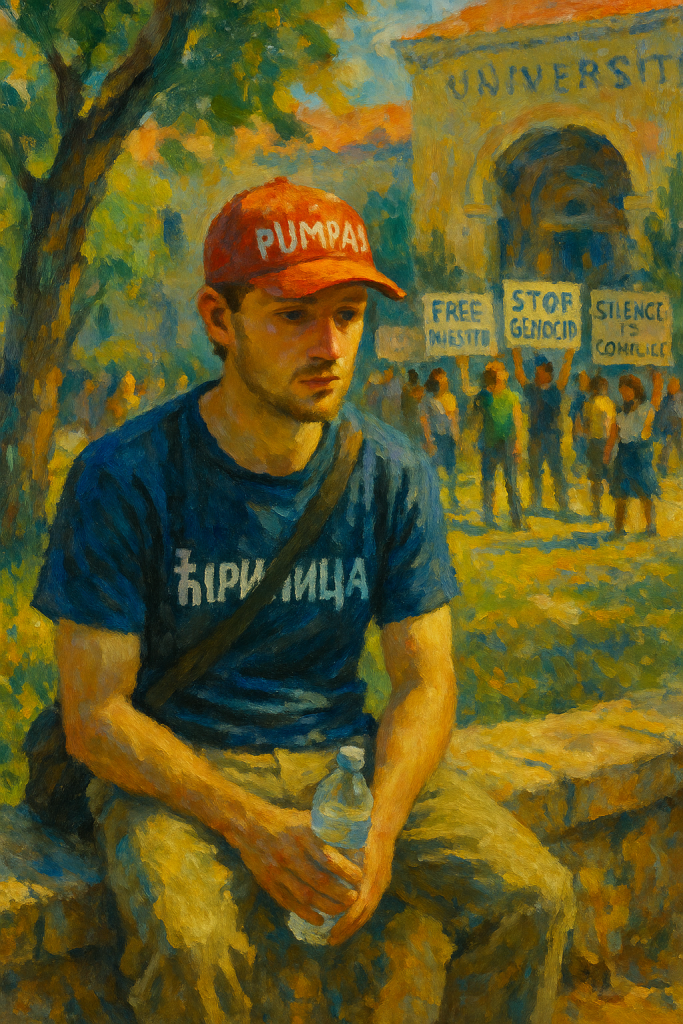
It’s noon. The hot air clings to the skin, the streets are deserted, and the sidewalk shadows are as short as the patience of Tucson’s residents. In the middle of the desert, the Arizona State University campus rises like an oasis of knowledge, free thinking, and tolerance – but there are fewer and fewer who thirst for truth. Students move slowly, disinterestedly. On the walls: slogans – “Freedom for Palestinians in Gaza,” “Stop the Genocide,” “Silence = Approval!” Between lectures, on the yellowing lawn in front of the library, about twenty students protest. Despite their cries against atrocities, the atmosphere is subdued – lukewarm in contrast to the blistering desert heat.
Bane, a student from Serbia, arrived in the U.S. last month. Today was his first day of professional development. He sat on a low stone wall beside the path to the library, beneath a scraggly pine whose needles barely offered shade. In his hand, a plastic water bottle. He sipped from it now and then – not out of thirst, but to give his hands something to do. He watched the students walk by, slow and lifeless, like wind-up dolls. Posters, slogans on T-shirts… All of it evoked tragedies taking place far from this campus, far from Tucson, and even further from the American mind. The whole protest seemed limp – as if done out of obligation, not out of the desire to expose truth.
He tried to feel a sense of belonging, to believe in the values these young people claimed to uphold – at least on paper. He walked with his peers toward amphitheater A-117. A massive lecture hall at the end of the corridor – dark and perfectly air-conditioned. Professor Michael Greenberg stood before the board, mentally preparing for his first lecture to the freshman class. A short man in his late fifties, he wore a gray blazer. Wisps of thinning hair fell across his collar, dandruff clinging to the lapels. Fatigue weighed down his hunched shoulders. On the board, in rushed handwriting, was scrawled a quote by Aristotle:
“Where the law does not rule, there is no constitution. The law should be supreme, and even the rulers must be its servants. For if justice is equality, then all must be subject to the same rules.”
The students took their seats – some scrolling through phones, others scoping out their classmates. Bane sat next to a stunning Black woman and two guys he couldn’t quite place – either Arab or Latino. Back home, friends had predicted this: at first, he’d obsess over ethnicity, trying to decipher people’s bloodlines. But eventually, he’d stop counting red and white blood cells. In America, people from all over the world live side by side – racial math is a dead end. At least until Trump and his kind change the equation. And by the looks of it…
The professor sipped from a bottle, then closed it. As the noise faded, he began:
“Dear colleagues, future philosophers, let’s not waste time on introductions. Let’s dive right in. Who wants to comment on the quote on the board?”
A few students offered textbook platitudes – about law as the foundation of society, justice as a gradual conquest, nothing being absolute. The professor nodded along, encouraging further thought. Then a short-haired guy wearing a T-shirt with Cyrillic letters and a crossbody bag, raised his hand.
“Yes, go ahead.”
Bane hesitated for a moment, then responded with a question:
“Professor, were you at the protest out front today?”
Silence blanketed the room. As if on cue, every eye turned toward the accented student with a shirt that read – Pumpaj!
Greenberg slowly lowered his water bottle and leaned against the wall by the board.
“It’s expected of faculty to remain neutral. Our role is to teach, not take sides. If each of us shared our political opinions publicly, we’d stop being professors and start being propaganda.”
Bane’s neighbor by the door didn’t wait for permission – he shouted:
“The propaganda is already taken care of – by state-run and, frankly, most other media. If you intellectuals stay silent, what can we expect from some uneducated American getting all their info from Facebook?”
Though he agreed, Bane disliked being interrupted. He picked up where he left off:
“Aristotle says: A citizen is one who takes part in deliberation and in governance. If you remain silent, Professor, you’re not a citizen – you’re just a spectator. Academic neutrality becomes complicity the moment power turns into autocracy and you do nothing.”
A voice from across the amphitheater rang out:
“Exactly! Silence isn’t a defense – not when it comes to genocide in Gaza or fascism in America.”
Greenberg hesitated. Good pay, great benefits, funding for research… But hard to trample everything he’d learned about humanism, civilization, ethics…
“That’s a strong, though somewhat simplistic, interpretation of Aristotle.”
From the back row, a girl with messy curls and Israeli flags painted on her sleeves stood up:
“What about October 7th, 2023? What they did to us -was that justice? Should we just stay quiet and wait for terrorists to strike again?”
“Evil doesn’t stop by multiplying it,” Bane shot back. “An eye for an eye blinds both the victim and the aggressor – even when their roles reverse.”
A group of silent students in the far-right corner shifted. One heavyset guy wore a hoodie with an American flag. On the back: a semi-automatic rifle and the words: AR-15 for Trump.
“Easy for you to preach, foreigner. You weren’t here when our people died on 9/11. If you don’t like it, go back where you came from.”
“Yeah,” said his pale, ratty sidekick. “Trump’s guard is happy to escort you out.”
The professor wondered whether the debate had gone too far. He let it roll a bit longer.
Then a tall guy with a Pancho Villa mustache stood up. His shirt read: On stolen land, everyone’s an illegal. He looked directly at Greenberg:
“If you’re neutral about genocide in Gaza, how come you’re not upset when your President locks migrants in cages?”
The professor stayed quiet. But a new punch came from the far right – literally. A red-faced blondie in a MAGA hat jumped up:
“All you foreigners are the same. You come here, use our benefits, take our jobs, and then preach to us. We don’t care what Mexicans, Arabs, or people with weird alphabets think. Where’s this punk from anyway?”
“That alphabet’s called Cyrillic, you MAGA philosopher,” Bane snapped.
The professor tried to keep control:
“Everyone is free to speak here.”
“Yeah, and we’re free to say we’ve had enough of America-haters!”
Bane ignored him and locked eyes with Greenberg.
“Plato says: In democracy, people live as they please. Freedom is exalted above all, but when it becomes excessive, discipline erodes, laws are ignored, and democracy slides into tyranny.”
“See! Even Plato says we need order,” the MAGA crowd snickered.
But Bane kept going, quoting the philosopher:
“Plato also says: Democracy gives power to those with neither wisdom nor responsibility. And so, the state ends up in the hands of people unfit to lead.”
Silence.
Professor Greenberg used the pause to outline the semester syllabus. But “ceasefire” didn’t last long. A soft voice spoke up – from a girl with no slogans, no flags, wearing jeans, a white shirt, and loose black hair.
“Excuse me, Professor, but it’s not fair to interrupt someone in the middle of a debate. The guy in the Cyrillic shirt hasn’t finished.”
Swallowing hard, Greenberg turned to Bane.
“Please, go on.”
The student from Serbia rose slowly, looked at the young faces around him, and spoke plainly:
“I’m not here to lecture you. Or to win you over. I came to see what it’s like to live in a free country with functioning democracy. But I found fear – on the faces of people who have everything, except the guts to speak up. You ask why I care? Because silence equals complicity. If you mind your own business, you’re no different from those who disagree – and you’re helping your oppressors. I know how it feels to keep your head down to survive. I know how tear gas burns. How police batons sting. And the kind of silence you don’t choose – it’s imposed. You say: ‘Go home.’ Where, exactly? Back to where the government swings a stick and the people pretend not to see? Even there, students speak up. Even there, I don’t stay silent. Freedom isn’t American, Palestinian, or Serbian. It has no passport, no flag – but it has a price. You chose silence. I chose resistance. It may feel easier now – but one day, guilt will catch up to you. At least, for those who still have a conscience.”
The professor used the break to wrap up the lecture. Others stayed quiet. Some stared at the floor, some at their phones. Most just wanted out.
Outside, the sun was still scorching, the heat working overtime. At the edge of campus, Bane stopped and looked up at the mountains.
“In the land of the ‘free,’ telling the truth is the hardest thing,” he thought.
Summer Tales from Arizona: Scottsdale TH E W A L L
Scottsdale is a city where the wealthiest residents of Arizona have found refuge. The owners of enormous houses are doctors, jewelers, engineers, and political functionaries. Although it borders Phoenix, the people of Scottsdale are proud of their ZIP code and look down with disdain at the “poor folks” from the neighboring city. Desert Peace is one of many gated communities. At the entrance, there’s a barrier and an armed guard, so any traveler without an invitation is not a welcome guest. “You shall not pass!” the head of the homeowners’ association would shout if he happened to spot a random passerby near the gate.
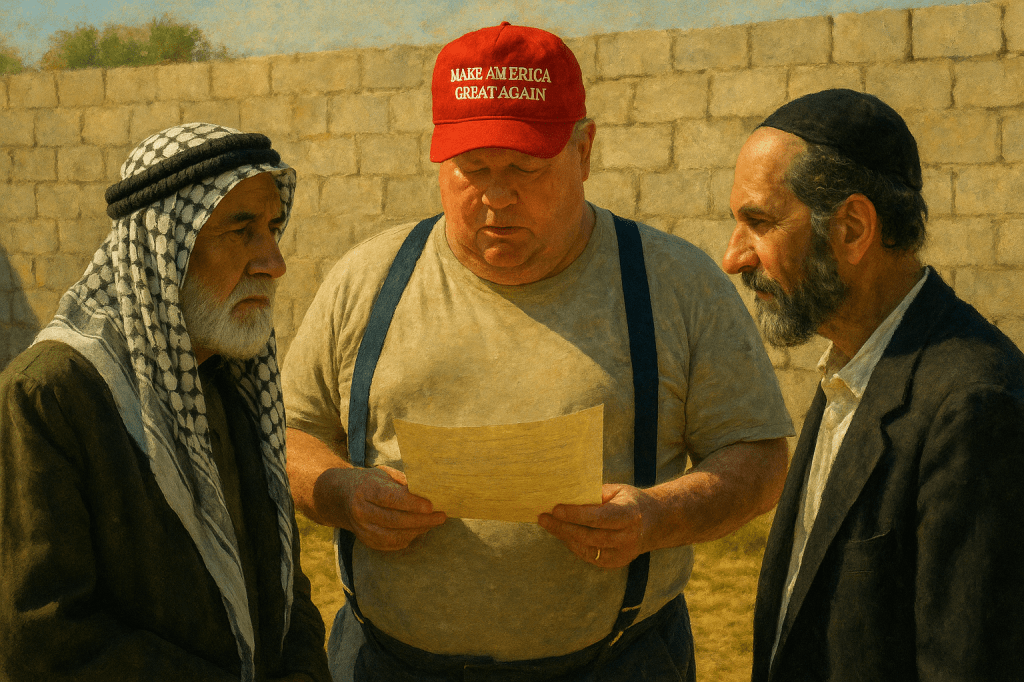
In the community’s meeting room, the HOA was in session. After a fruitful discussion, it was time to summarize and make decisions. The president, a chubby man in his early seventies, with suspenders partially covering a T-shirt reading Make America Great Again and a pistol hanging loosely on his ample right hip, took the floor to deliver the summary:
“By majority vote, the homeowners’ association rules that the owner of property number 1988 on Understanding Lane must compensate his neighbor at number 1948 for damages and finance the rebuilding of the shared wall that was destroyed during the recent storm. If this is not done within seven days, the HOA will cover the repair costs and move the property line two meters into the responsible party’s yard. Meeting adjourned!”
Even the wealthy are not immune to small human flaws, but on Understanding Lane, the situation was growing more serious by the day—starting with the house numbers. In villa 1988 lived the family of retired botanist Amir Gazavi; next door, the house of jeweler Aron Schwartz bore the number 1948, followed immediately by 1990, 1992… When the local mailman complained about this inconsistency, he was immediately threatened with reassignment and labeled an anti-Semite. According to the zoning plan, backyards were separated by two-meter-high walls so that residents—whether they wanted to or not—minded their own business. The residents obeyed the strict rules set by the wealthiest among them—everyone except Gazavi and Schwartz.
Amir moved in first, living out his retirement peacefully with his wife and their dog Yasser, until the day Englishman Charles Attlee sold the house next door to jeweler Aron. From that day on, the stone-block fence turned into a wall of trouble and lament. The new neighbor immediately raised an Israeli flag, positioned so it fluttered directly above the Gazavi family’s living room. The next morning, neighbors noticed Amir armed with a ladder, tinkering on his roof. By noon, a flag with Palestinian symbols was flying.
Having handed the jewelry shop over to his son, Mr. Schwartz, in his later years, took an interest in computers and artificial intelligence. He completed various online courses and became fairly skilled. Amir, on the other hand, loved flowers, grass, and trees, turning his yard into a lush oasis in the Arizona desert. He had even trained his dog to respect the garden, so Yasser never soiled it. When Aron first peeked over the wall, he burned with jealousy. He waited until Amir went on vacation, sat down at his computer, and hacked into the irrigation system. When Amir returned, his botanical pride resembled his homeland: shriveled plants, withered flowers, a dried-up lemon tree—only the palms had survived. Yasser looked at him sorrowfully, as if apologizing for failing to protect his master’s handiwork.
Amir wasted no time. He ordered a drone from Amazon and paid extra for same-day delivery. After a crash course on YouTube, he learned to “pilot” the marvelous device. On Saturday, when Aron and his family went to synagogue, Amir launched the drone and destroyed the neighbor’s menorah-shaped fountain.
The next day, loud commotion came from 1948. Workers were busy repairing the fountain, while technicians installed a massive video screen aimed at the Gazavi home. When night fell, fiery speeches from Bibi Netanyahu blared first, followed by footage any reasonable court would declare genocidal. Aron, however, was proud of his “countrymen’s work” in Gaza. The noise agitated Yasser, who leaped over the wall and tore the screen’s fabric in seconds. The picture was gone, but not the sound—Hava Nagila Ve-Nismeha still blared from the speakers. Aron had had enough. He pulled out a taser and incapacitated his neighbor’s dog. Hours later, Yasser appeared at his master’s front door draped in a black-and-white checkered keffiyeh.
For the first few months, the petty hostilities ranged on an imaginary scale from harmlessly silly to risky and dangerous, but remained a secret between the two families on opposite sides of the wall. Then the neighborhood madness escalated…
The jeweler reported the professor for animal abuse, bringing the Humane Society to his door. Amir retaliated by accusing Aron of tax evasion, prompting auditors to spend days combing through the jewelry store’s books. Schwartz then sent an anonymous letter to environmental groups claiming his neighbor used excessive water to irrigate his restored garden; Gazavi responded with a letter to city hall alleging the fountain next door was built without a permit. Both dragged various institutions into their private war, but avoided the HOA, fearing expulsion from Desert Peace. These hostilities raged from October 2023 with no end in sight—until recently.
Every July 4th, America celebrates Independence Day. For the Gazavi family, it was a tradition to gather in full. Their son and daughter-in-law from Minnesota would come—and most importantly—bring their five-year-old grandson, Rami. Grandpa Amir prepared thoroughly for the visit. He chose toys carefully and stocked up on ice cream, cakes, halva, and kadaif. Rami played outside, eagerly awaiting nightfall for the surprise his grandfather had prepared—fireworks!
On the other side of the wall, preparations began by noon. Aron tidied the yard, arranged tables and chairs, and lit the grill early “just to let that villain stew in the smoke.” Fat dripped and sizzled, sending unpleasant-smelling smoke toward the neighbor’s yard, while Aron sat at his computer, meticulously preparing his holiday program. Around four, his son and six-year-old grandson Avi arrived. Though it was 113°F in the shade, the Schwartz’s wore dark jackets and black kippot. Father and son baked under the sun while the boy played near his grandfather’s fountain.
Mrs. Gazavi prepared a lavish spread: baba ghanoush and dolma to start, then roast lamb from “Yusuf’s Market,” tabbouleh salad, and fresh pita bread; baklava and tea to finish. Next door, the menu included matzah ball soup, kosher grilled beef, kugel, and challah bread; for dessert, babka cake and watermelon. The women set the tables, the men argued politics, and the kids—unplanned—began a peace mission. They met over the fence, quickly befriended each other, and agreed to meet out front.
They petted Yasser and played with Rami’s new toys (since Grandpa Aron rarely loosened his jeweler’s purse strings). They parted with a promise to watch the fireworks together after dinner. During the meal, the TV blared in the background—Al Jazeera at the Gazavis’, Channel Keshet 12 at the Schwartz’s’. At dusk, as the neighborhood erupted in celebratory firecrackers, grandfathers and grandsons stepped into their yards. Amir had set up his rockets and proudly asked his grandson’s permission to begin.
“Are you ready?”
“Like Paw Patrol before a mission!” the boy replied.
The barrage began: white, green, red… and again. With the first rocket, a little head peeked over the wall. Avi had taken his grandfather’s ladder to get a better view. As the neighbor’s fireworks ended, Aron launched his own show—a virtual display projected onto the Arizona night sky. Blue and white lines formed an expanded map of Israel, the Star of David, and finally the Israeli flag intertwined with the Stars and Stripes. Amir couldn’t believe his eyes. Looking down, he saw Rami on the ladder beside his new friend, both mesmerized.
The grandfathers soon erupted into another fierce argument, joined without hesitation by their sons. They all leaned over the wall like voyeurs in a public park. The boys ignored them at first, then whispered to each other and dashed off home. Minutes later, a racket erupted—Avi and Rami were banging pots with wooden spoons they had swiped from their grandmothers. Shocked by the boys’ protest, the old men fell silent, went indoors, and didn’t speak for the rest of the evening.
In the following days, the neighbors tried to mind their own business. One morning, as they were pulling out of their garages, the grandfathers even let a “good morning” slip. But, as Amir’s mother-in-law wisely said, “It’s not who you say it to—it’s who it’s meant for.”
At the end of the month, monsoon season began—rain, wind, then a big storm. The tempest swept through quickly and efficiently. Trees fell, cars were damaged, basements flooded, and on Understanding Lane, between 1988 and 1948, the wall collapsed. Unable to reach an agreement, they turned to the HOA.
And so, working backward, we return to the start of our story.
When the meeting ended and the decision took effect, Aron immediately filed an appeal, demanding that the Gazavi home be demolished because their dog had urinated on the wall, making it porous.
“Excellent idea!” the HOA president blurted. “We could put a gym there, with a nice restaurant.”
July 26, 2025
Tales from Arizona: Tombstone
THE LAST GUNSHOT OF WYATT EARP
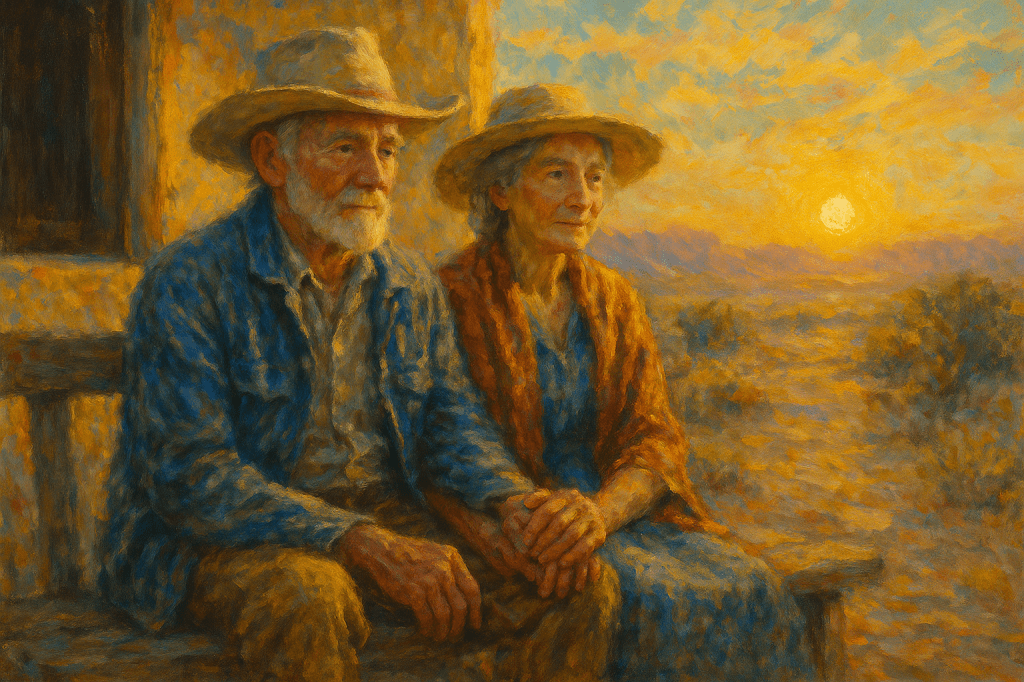
In the lovely town of Tombstone, where the Santa Cruz River no longer flows due to drought, only one memory remains — a daily show in the center of town, nearly every evening. In the theatrical reenactment of the historic gunfight at the OK Corral, for two decades the role of Wyatt Earp was played by James Russell. But then age caught up with him — his voice and strength began to fail, and younger actors took over the show. It was five or six years ago when the director asked him for a drink after the “shootout.” James knew something was up. The tattooed brat of a director “carried a snake in his pocket” and had never bought a round in a saloon. That night, he told James that from now on, he’d be playing the villain — the outlaw Clanton.
From that day on, James was no longer the same man… Once a charmer and joker, beloved by both locals and tourists, now he sat silently in the corner of the dressing room — hollow-faced, eyes lost in thought.
In Tombstone, the sun scorches from early morning, and by midday, the asphalt begins to melt. Wooden houses crackle in the heat, and shadows retreat under porches. The town looks like a film set. The main street, with its saloons and faded Colt revolver ads, becomes a stage every day. At the far end, near the mock sheriff’s office and replica jail, stands an improvised set. Every day at high noon, the shootout at the OK Corral is reenacted. Visitors sit on wooden bleachers, waiting for gunfire and the triumph of good over evil.
Before stepping on stage, James would always twist a silver ring on the pinky of his left hand — an old habit, a charm against bad luck. The ring had been a gift from Mary, the woman he once loved madly but lost to his own stubborn pride. They had acted together across Arizona, performing side by side. Mary was fiery, witty, clever. Her hopeful, electric gaze always nudged him to wake from provincial slumber and leap toward adventure and uncertainty. She begged him to leave with her, but the “head sheriff” stayed put.
She left Tombstone and, after years of wandering, reached Hollywood. She never became a star, but made a modest career — appearing in background roles remembered only by those who paid close attention. They never saw each other again.
After one show, James sat outside the saloon, staring into the dry riverbed of the Santa Cruz. Just a trace remained where water once flowed — a few puddles, some greenish silt in the desert sand.
“This river is like my life,” he muttered. “The bed’s still here, but the water’s long gone.”
Suddenly, a man in a loud shirt approached. He looked like a tourist, but walked with the confidence of someone who knew exactly where he was headed.
“You played that fall and slow dying better than most professionals I’ve hired!” the stranger said.
James looked up.
“So, you’re a movie guy? If you buy me a whiskey, maybe I’ll fall over again.”
The man introduced himself: Roger, a producer of low-budget westerns. He was looking for someone to play an aging outlaw — a man of few words, whose eyes told the whole story. After three drinks, James began to open up. He spoke of acting, of love, and the chances he let slip. People told him he should go to Phoenix, maybe Los Angeles… But he stayed. Alcohol. This town. One makeshift stage — that was his life.
“How did you find me?” he asked, not really expecting an answer.
Roger took a sip of coffee and studied him.
“My mother recommended you. Mary Bush,” he said with a soft smile.
Silence. James coughed and looked carefully at the young man. The familiar lines of his face, the fire, the passion for art… He saw everything he had once loved in the woman he never forgot. He said nothing — just gripped his ring and twisted it slowly. He didn’t want words to ruin the moment.
He ordered another drink and asked Roger to leave the script and his number.
“Just so you know — shooting starts in a month,” Roger said as he toasted the local cowboy, packed his things, and drove off in a Tesla.
James called the Tombstone director that night to ask for some time off. The pretentious kid responded,
“Big deal, I can get any drunk to fall during the shootout.”
James swallowed hard, hung up, and muttered,
“You’ll see, you arrogant little mule, who you’re calling a drunk.”
He walked to the dry river, stared at the dusty bed, and thought about his wasted life.
“That role, no matter how small, is better than this wordless tumble in the dirt.”
He smoked a few cigarettes, went home, and found a package sticking out of the broken mailbox. He ripped open the envelope and recognized the handwriting.
My dearest Sheriff,
My sweet Wyatt,
You’ve met Roger. I’m sure you saw how much you have in common. I told him all about you — what a good actor and man you are. Take the role and come soon!
Yours, M.
He opened the large yellow envelope containing the script for Dust and Silence. The room was stuffy, despite open windows. No breeze. Just dust — and silence.
He brewed coffee, lit a cigarette, and read the script in one sitting. Then read it again. He texted Roger his acceptance. The reply came swiftly — with the address of a motel in Yuma where he’d be staying during filming.
A week later, he pulled out an old suitcase, the same one he once took on tour across Arizona. Mary had traveled with him back then. It still smelled faintly like her. He twisted the ring again and packed only the essentials.
Before leaving, he glanced once more at the Santa Cruz. The river no longer flowed — but it was still a river.
Maybe he too was still that actor, as they once called him?
At the bus station, he avoided familiar eyes. He wasn’t just leaving Tombstone. He was heading for something bigger: maybe… a new beginning?
That same evening, at the motel, he met the film’s director — a young man who clearly distrusted the amateur actor from a cowboy town. But then Roger, the lead producer, arrived. He ordered dinner, and the conversation lasted late into the night.
First day of shooting.
James put on the costume and waited for his scene. He didn’t have many lines. He played a man who had already said everything there was to say.
“Camera?” — “Rolling!”
“Sound?” — “Rolling!”
“Action!”
They filmed the scene where his character sits silently as the son he never met dismounts and walks toward the stranger. They stared at each other. James let a single tear fall, then embraced the young man tightly.
“Cut! Sold! Perfect!” the director shouted.
That evening, they sat outside the motel. The cowboy from Tombstone drank bourbon. The producer, beer.
“I hoped you’d come, but I was afraid you’d turn down the part,” said Roger.
“I hesitated… but I couldn’t say no to you,” James replied.
Silence.
“When I was little,” Roger began, “my mom used to tell me about you. Always with a certain caution. She loved you more than she cared to admit. I could only imagine you back then. Now I don’t have to.”
James raised his glass.
“To the roles we never played.”
“To a new beginning. Cheers!”
At that moment, the director appeared. He stood before the veteran actor, bowed slightly, and offered his hand.
“Mr. Russell, what you did today… I didn’t think silence could be louder than a monologue.”
James looked up.
“Neither did I. Not until today.”
They were alone again. Roger brought out a bottle of whiskey from the motel room.
“I’m still not sure if you’re my father.”
“I’m not either, son… but maybe that doesn’t even matter anymore.”
“How can it not?”
James looked up at the cloudless night sky and said softly:
“What matters is that now… we’re in the same frame.”
Filming wrapped.
Cameras packed, costumes sent to dry cleaning. Most of the crew had left. Only a few techs remained, plus the producer, a supporting actor, and one unfinished film — waiting for editing and an audience.
James sat under the motel awning, waiting for the cameraman to drive him back to Tombstone. Now, as a “star,” he had a ride arranged.
Then, a dark blue car pulled into the parking lot. A woman stepped out — wearing a cowboy hat and sunglasses. She walked slowly, but tall and steady. She stopped in front of James, removed her glasses, and looked at him for a long time.
“So you really came,” she said.
“When you called, I realized I didn’t want to die a bitter old man.”
They sat beside each other, quietly, for a while.
“I saw the way he looks at you,” she said. “The same way you once looked at me — that night after our last performance together. But Roger’s not yours.”
James said nothing. He stared into her eyes — still green, fiery, restless… just like before.
“His father was a producer from Chicago. Never acknowledged him. Never even saw him. So I invented a father. I told Roger his dad was just, a little stubborn, but always true to himself.
I taught him to walk like you. To keep quiet like you.”
James nodded.
“So… he grew up believing in a legend?”
“No,” she corrected. “He believed in the truth.”
James looked off into the distance — at the sky, the shadow of a tree.
“Thank you,” he whispered.
“For what?”
“For making me a father — without me knowing. And for letting me feel it before I go.”
Mary placed a hand on his shoulder.
“You’re not going anywhere soon. You’re too stubborn to die quietly!
You’re not Clanton or Wyatt Earp anymore. You were and always will be — my James Russell.”
The sky changed color. From gray to orange, then gold.
The breeze was faint, still shy to disturb the day.
James and Mary sat on a wooden bench in front of the motel.
Before them — an empty bottle and ash from too many cigarettes.
The sky lightened slowly. As the sun rose over the desert, their hands met at the middle of the bench — fingers intertwining like two shadows recognizing each other after years of wandering.
And there they stayed.
July 1, 2025
Tales from Arizona: Sedona
THE CACTUS THAT REMEMBERS
The Desert Silhouettes profile had just gained its milestone follower. Exactly ten thousand people on Instagram were enjoying Lena’s artistic photographs. Red rocks, canyons, open skies, and desert serenity—her eternal inspiration—were now capturing the attention of other lovers of landscape. The beauty of nature had long since crossed all borders, bringing joy alike to a Chinese farmer in Sichuan who had never heard of the internet and to a Silicon Valley hacker who had only seen landscapes through Instagram filters.
It had been about ten years since Elena Novak moved to what she called the most beautiful town in Arizona. A lady of Czech origin, she had once walked modestly through the marble corridors of the U.S. Embassy in Prague, following every rule to the letter. It was there she met a divorced American diplomat who fell in love with her at first sight. They married and, after his posting ended, moved to Washington, D.C. They loved each other deeply, and lived a joyful life together.
When retirement came, they moved across the country to Sedona, buying a house on the same street where Walt Disney once owned a weekend home. Lena had hoped the desert’s energy vortexes and the positive charge of the Red Rocks would heal the man she loved—her companion and best friend. But she lost him far too quickly.
She was left alone in a house full of sunlight, beautiful memories, and haunting absences. The deep emptiness in her soul gave her no peace, but she fought bravely. She could have returned to either capital—Prague or Washington—or moved elsewhere. Still, the desert’s beauty quickly took hold of her heart, and the pastel landscapes claimed her spirit.
In moments of solitude and longing, she would return to the photos she and her husband had taken during countless travels. Throughout the year, they traveled for work—and in summer, for the soul. She’d flip through an album where her husband smiled from the cover, and inside: the world in miniature—strolling through Montmartre, skating in Moscow, pyramids in Bugojno, safari in Kenya, the Yellow Mountains of Huangshan in China…
In youth, photography was a hobby; in maturity, a passion. Since settling in the heart of Arizona, the search for perfect light and composition had become Lena’s obsession and way of life. The encouragement she received online only deepened her desire to experiment—with abstract forms and desert shadows.
It was Saturday. The day began quietly, with no great plans. A mild migraine pulsed above her eyebrow—her familiar weak spot that dulled life’s beauty. She got up, made coffee, and sat on the patio. Gazing into the distance, she tugged the rubber bracelet on her right wrist with her left hand, letting it snap against her skin. She did it unconsciously, rhythmically…
The bracelet was thin, dark blue, with a barely visible motif—a gift from her husband, bought in Thailand more than twenty years earlier. In a small temple on Ko Lipe island, an old man had tied the bracelets to their wrists, saying: “Love is like this rubber band—it adapts, but it mustn’t be stretched too far, or it will snap. So take care of it, and it will last forever.”
Back then, Lena hadn’t thought much of the symbolism, but since she’d been alone, she often recalled that moment, the wise man, the bracelet… She hadn’t taken it off since. Whenever sadness crept in, she’d tug it a few times—it was her reminder of eternal love, her shield against sorrow.
She edited a few photos—a portrait of a desert rabbit and some shots taken above Cathedral Rock. She posted them in a new album titled “Traces of Wind.” Lena dressed in a tunic, hicking shoes, and a hat. After checking her camera and phone batteries, she slung her backpack over her shoulder and paused at the door. She tugged the bracelet one more time—hard—and set off down the street, then uphill toward the Red Rocks.
The afternoon was clear, not too hot for early July. The wind carried a fresh scent of dried pine. Lena walked her favorite winding trail, through stone sculptures carved by nature. The sun was lowering toward the horizon, painting the rocks in deeper shades of red.
She jumped a ditch, leapt from one large rock to another, and emerged into a clearing. And that’s when she saw it—a tall cactus with crooked arms, and the sun slowly sinking behind the rocky ridge. “Saguaro at sunset! Perfect frame,” she whispered to herself.
She clicked a few times, then again, and again… Wide shots, then details… She circled the cactus, seeking the perfect angle. She didn’t check the images right away, but she felt a special kind of satisfaction—that deep fulfillment every artist knows after good work.
As the sun disappeared behind the rocks, Lena returned to town. At The Secret Garden café, she ordered a double espresso—no milk, no sugar. Strong coffee in the late afternoon—a European habit that always puzzled Americans. She ignored the comments, sometimes replying that she slept well because she had a clear conscience—and caffeine couldn’t touch that!
On the café terrace, as the wind hummed mystically, she decided to review her latest shots. By the eighth photo, she zoomed in—something on the cactus had caught her eye. Two carved letters with a curvy mark in between. She zoomed further. At the base of the cactus were the initials: B + K, framed in a simple, awkwardly drawn heart.
Carved initials. A heart. Romance. Memory. Permanence.
“This is a cactus that remembers,” she thought, satisfied.
She posted the photo on Instagram with the caption: “Some plants never forget great love. Does anyone know the story of B + K who once loved each other here?”
At that very moment, walking past the café garden was Frank Begay—a local naturalist, wise Navajo elder, Lena’s friend and guide in her search for untouched desert landscapes. As one of Sedona’s oldest residents, Frank was known as a flawless chronicler of local history. He waved from across the street, and just as he was about to cross, Lena called out:
“Frank! Please, come here! I’d like to ask you something,” she said, immediately ordering two Southern Comforts—his favorite whiskey.
Frank turned, nodded, and headed toward The Secret Garden. He shook her hand, sat beside her, and the drinks arrived. They toasted, and Lena showed him the photo. Frank focused on the faded markings at the bottom. After enlarging and applying a filter, they saw hints of numbers…
They peered from all angles, until Frank’s still-sharp eyes spotted part of a date.
“The year is clear. And part of the month… I can’t make out the day. But the epitaph was carved in September of 1986.”
Lena didn’t stop there—she flooded him with questions: Did he remember any couples from that time? What stood out to him about the autumn of 1986? Could he help her solve the photo mystery?
Frank promised to ask around and check his journal, which he had kept faithfully since youth. After they finished their drinks, the local chronicler bid farewell and walked toward the reservation.
Night had already fallen when Lena packed her things and returned home. She printed several of the best photographs, poured herself a glass of wine, and once more studied the image of the saguaro cactus and the initials that wouldn’t leave her mind.
She dozed off in the living room and moved to bed just before dawn. She didn’t sleep long—around seven, a knock at the door woke her. It was Frank Begay.
“Put the coffee on. Double strength… The cactus story is far more interesting than I first thought. I’ve written everything down in my journal.”
Lena served honey with the coffee and squeezed fresh lemon. They sat on the terrace overlooking the Red Rocks. Frank lit a cigarette and began recalling events from four decades earlier.
The aging Navajo drew a long breath of smoke, wanting to organize the images in his mind before turning them into words. He flipped through a worn, weathered notebook. Halfway through, his finger paused.
“August… and here’s the start of September!”
As if reading his mind, Lena brought out a bottle of whiskey and two glasses.
“Somewhere in the world, evening is falling,” she said, justifying the morning toast.
Frank’s face lit up, and after the first sip, he returned to the journal.
“That year, I was working as a desert guide. People came from all over the world, and I was learning trails I hadn’t even known as a child. It says here—autumn 1986—I met a young couple from California. Betty and Karl. She was a painter. He recorded the desert’s voices, patiently waiting for the perfect sound—whispers, trickles, silence. They were in love with each other, with nature, with people, firewater, and the herb of laughter and silence.
Betty spent hours painting the Red Rocks from different angles, while Karl roamed with a giant reel-to-reel recorder—it looked like he was carrying an entire radio station on his back. He told me he was searching for something special—the sound of silence, or silence that sounds.”
Frank licked his finger, turned the page, and gazed at the painted sky, recalling that distant time.
“One morning, just after sunrise, they were walking near the cactus when Betty hurt her leg. They sat down and carved their initials. Later, Karl carried her on his back to my reservation, where the shaman wrapped her ankle and gave her healing herbs. The next day, a storm was coming…”
He lit another cigarette. With a slow match strike and deliberate inhale, he continued.
“Karl told me that rain and wind create the best resonance behind the Red Rocks—and that the storm was his chance to finally capture the sound. That one, unrepeatable sound you can only hear in Sedona. I tried to stop him. I felt something bad coming. Betty begged him not to go. But he wouldn’t listen.”
Lena poured them another drink and waited in silence.
“He never returned. We searched for days. My tribesmen joined in, along with the police and locals. Eventually, we found the broken recorder and tapes scattered by the wind. Then, by pure chance, Betty spotted a cassette. ‘He always carried a dictaphone—just in case,’ she explained. His body was never found.
When we got back to town, we played the cassette. We heard incredible sounds—strange whispering, unreal voices. And at the very end, Karl’s voice: ‘My love! Forgive me for leaving you forever—for chasing obsession and being selfish.’”
Just then, Lena’s laptop chimed. It sat beside the bottle of whiskey, gently “pinging,” begging for her attention. She opened it—an Instagram DM from user Beti Art:
“That was our saguaro. Betty + Karl. Forever. Thank you for finding it and reviving the memory of the cactus and of Karl.”
Two days later, Lena and Frank walked the familiar trail in silence. Instead of her camera, Lena carried a bouquet of flowers and a thin rubber bracelet. Dark, simple, engraved with the memory of eternal love. The cactus stood in its place, proudly bearing the heart with initials B + K carved into its skin.
Frank stood a few steps behind. Lena approached, knelt down. She stretched the bracelet one last time, let it snap gently against her wrist—one final time—then slipped it off and laid it at the cactus’s root.
The air smelled of sage and red earth. The wind rustled softly through the cactus’s spiny arms, spreading the song of love.
June 30, 2025
Tales from Arizona: Phoenix
LIFE LOTTERY
Every morning, exactly at nine o’clock, a short, slender man with a hat on his head and stiff shoulders would slowly open the door and head toward the right corner of the store, where the take-out coffee was served. Into the steaming liquid, he’d first pour a little milk, then sugar, snap on the lid, grab a sandwich from the fridge, and join the line. The young man working the register immediately noticed the regular customer but didn’t greet him right away—mornings were always busy.
“Good morning, Igor!” the frail man called out when his turn came. “How are you managing in our desert heat?”
“Much respect, Mister Tony. I’m surviving. Honestly, it’s a lot easier to endure the sun and heat than bombs and shrapnel!” replied the young man, speaking English with a heavy accent.
That Friday, like every Friday, Tony picked up his breakfast and played the lottery. Over time, Igor had memorized his numbers—9, 19, 29, 39, 49…
“Hopefully, the madness in your country will end someday!” added the man with the cap. “All the best, Igor. See you tomorrow!”
As soon as he stepped outside, Tony approached a homeless man and handed him the sandwich and coffee. The scruffy young man slowly pulled his hands from the pockets of his filthy pants, accepted the food and drink, nodded, and went behind the store to share breakfast with his girlfriend. The man with the hat pulled a bunch of keys from his pocket, spun them around his finger, then got into his pickup truck and left the parking lot.
“He does that every morning,” thought the cashier, scanning a pack of cigarettes for two young men in work uniforms.
“What the hell do they put in these things to make them so expensive? Weed and cigarettes will cost the same soon!” grumbled the uniformed plumber as he paid the bill.
Igor let his coworker take over the register so he could make a fresh pot of coffee. It had been a year since he started working at this gas station, and it felt like he’d been a clerk his entire life. Just two summers ago in Kyiv, he was teaching math. His students loved him, his colleagues respected him… He had fled to America to escape senseless war and ended up in the heart of Arizona working as a cashier. He cleaned the parking lot, scrubbed floors, and most of all, enjoyed stocking the cooler—his only chance to cool down a bit during the unbearable desert summers. In rare moments of solitude, he’d quickly organize the shelves, stack beer, juice, and frozen food, then sit on a crate and check updates from the Ukrainian front on his phone. He had escaped that hell, but his parents and younger sister hadn’t. “Severe Russian retaliation after Ukrainian drone strikes. According to health organizations, more than a million have been killed or injured since the conflict began.”
For most foreigners starting their immigrant journey, every day looks like the one before—work, overtime, home, food, sleep. Yet in the monotony of his routine, Igor noticed that Tony had stopped coming by since that Friday.
A month later, it was Wednesday, early morning—Igor’s day off. He wasn’t lucky enough to enjoy weekends like regular folks; according to the schedule, he rested on Tuesdays and Wednesdays. He set his alarm for six to go get a chest X-ray. During his visa medical screening, he tested positive for TB. Immigrants from Eastern Europe (including the former Yugoslavia) often struggle with the tuberculosis test, having been vaccinated at birth—resulting in lifelong false positives in Western countries screenings. Some twenty years ago, a Russian man spent two months in quarantine for the same reason. After various medical boards reviewed the issue, it was explained that in many countries, babies are still vaccinated against this eradicated disease. Since then, U.S. officials no longer panic, but an X-ray is still mandatory.
Igor quickly drank his tea, threw on a pair of shorts, the thinnest T-shirt he owned, and set out—because in Arizona, going anywhere without a car becomes an adventure. The immigration office was about thirty kilometers away, requiring three different bus transfers. A taxi was too expensive, and he didn’t have a credit card for Uber. He needed to get that screening done quickly, as the deadline was looming. “If I don’t finish today,” he thought, “next Tuesday will be too late… and knowing them, they might just deport me!” He walked to 7th Street, took a bus to Thomas, then another to Central Avenue. At the bus stop, an old woman gave him advice:
“You must be new in Arizona. In summer, we don’t walk around without long sleeves and pants… Shorts are for people with cars!”
At the immigration office, he waited for two hours, worrying whether he’d finish before closing time. “At least no one cuts the line like they do back in Ukraine,” he thought, breathing in the stale, chilled air. When his turn came, he picked up the forms and headed straight to the hospital. He prepaid for the exams and received two referrals—one for imaging, the other for a pulmonologist. While trying to locate radiology on the hospital map, he felt someone grab his arm.
“Mister Igor, greetings!” said Tony, sitting in a wheelchair. He wore a hospital gown, a thin tube delivering oxygen into his nose.
“What happened, dear Tony?” asked the younger man, startled.
They moved away from the reception and headed to a nearby cafeteria. The nurse caring for Tony wheeled him to a table, promising to return in half an hour. Igor brought two coffees and a sandwich for his friend.
“I didn’t get you a lottery ticket—drawing’s on Saturday,” he said, placing the referrals aside.
“Saturday’s far away, my young friend. I might not make it. But don’t worry about the lottery—I won’t be needing money anymore,” Tony replied with a bitter tone.
Igor watched people pass by. Some were rushing, eyes glued to papers, searching for the right floor, department, or office… Doctors, nurses, and hospital workers in colorful uniforms moved with purpose. The support staff—those noble souls enduring the hardest moments of their patients’ lives for pitiful wages… The young man could no longer avoid Tony’s gaze, which hinted at an impending truth. He took a sip of coffee, looked the man in the eyes, and quietly said:
“I’m listening, my friend.”
Tony spun his keys around his index finger, adjusting the oxygen tube with his other hand. In a halting, distant voice, he began:
“Well, Igor Borisovich, my young friend, my story starts on September 9, 2019, at nine in the morning, on the ninth floor of this hospital—and you won’t believe it—in office number 919. That day, they diagnosed me with that disease people often live with but rarely survive. In this ‘lottery,’ all my organs participated, but the lucky winner was the nastiest one! What I, as a former car salesman, would call—human exhaust pipe! They found it too late, and I didn’t want them cutting and patching me up. That very day, I quit my job and started spending my savings. I’ve long been divorced, we had no children, so there’s no one to mourn me. It’s been nine months since then, and I’m now happier than I ever was when I was healthy!”
A ten-year-old boy with a bandaged head was wheeled past them, explaining to his parents that the helmet wasn’t strapped on right, but swearing he was riding the electric bike slowly. At the next table, an elderly man gently fed the love of his life a chocolate muffin. Tony asked a passing nurse for a glass of water, then continued.
“That’s when I started coming to your store regularly. It’s close by, and I noticed the homeless gather there. I began doing small good deeds and always bought a lottery ticket…”
There’s something in human nature that bends even the most tragic tales back toward ourselves. “So here’s America—huge, rich, and people are still sad, sick, dying…” Or as his grandfather used to say, “There’s no death without Judgment Day!” Igor mused inwardly. Then, almost unconsciously, he stood up and touched the shoulder of the only friend he’d made in America. His eyes welled up as he tried and failed to suppress a sob. That kind old man had always been dear to him, but now he wept for everything he’d endured in recent years. It had all piled up and had to come out.
“Come on now, don’t go all gloomy on me—you haven’t even heard the best part yet! I sold cars for decades. People say we’re all crooks and liars… maybe they’re right, I don’t know. My whole life I played those sweepstakes, bought lottery tickets and those scratch-off scams. Never won a damn thing, believe me! But after I got the diagnosis, I decided to play just one ticket—a single one—with all nines. And twelve Saturdays later, I hit the jackpot…”
Igor flinched. “If there had been a nine instead of those twelve weeks, that would’ve been too much!” thought the young man, suddenly reminded of a joke about an old man who, after winning the lottery late in life, built a public restroom so people could “piss on his luck.”
But Tony wasn’t joking. His brow was furrowed, wrinkles deeper, eyes red and dry—there were no tears left.
“Yesterday, my lawyer called—he said it’s all settled. I’ve donated most of the money to various foundations that fund treatments for children—those outrageously expensive surgeries without which they wouldn’t survive. I also gave to some artists and poor students who want to study… Here’s my lawyer’s number—he’ll help you get your family out of Ukraine.”
All the pain Igor had managed to bury deep in the depths of his Slavic soul surged to the surface. Tears streamed down his face as he struggled in vain to stifle his sobs. That kind old man had always been dear to him, but now he wept for everything he had endured over the past few years. It had all built up—and finally had to explode. Just then the nurse returned, and they all accompanied Igor to the radiology wing.
“Stop by when you can. I’m on the third floor, room 351. As you can see—no more nines in my life!” Tony smiled.
“Unless you add up the digits in your room number!” replied the Ukrainian mathematician.
April 17, 2025
A THIN BLACK LINE
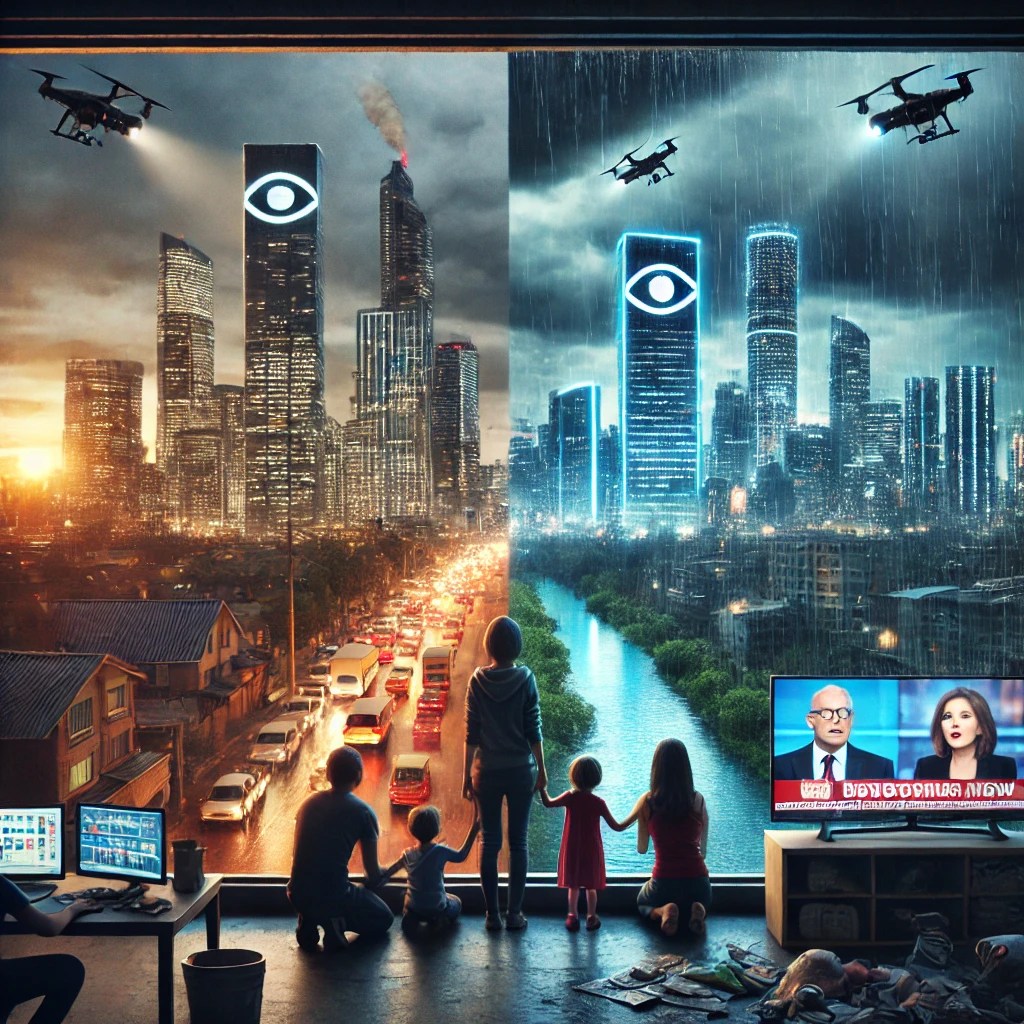
We were once taught to seek the truth in newspapers, on the radio, and on television, and to develop our imagination through literature, theater, and film. But experience tells us that reality is quite the opposite: truth is elusive, and the world is upside down. Today, the media feed us fairy tales and shiny lies, while art carves a path to the truth, decodes and exposes reality, and often even predicts the future. Artists have sensitive radars; they see what others miss, often long before anyone else. Writers are neither oracles nor prophets. They simply observe what unfolds before them with great attention, because art is not a mirror of the future — it is a scanner of the present.
One might think that in the age of the internet and global digitalization, being intuitive and visionary would be easy. And yet, few people see beyond their own noses. Twitter is more appealing than National Geographic, and Instagram seems more important than the digital content of all the world’s libraries. Literature, on the other hand, offers incredible examples of foresight, often in works created in times when even a light bulb above pen and paper was considered a luxury. Exactly one hundred years ago, Yevgeny Zamyatin’s novel We predicted totalitarian surveillance, people without names identified by numbers (just like Elon Musk’s children), and the erasure of individuality for the sake of “collective happiness.” His vision marks the first modern dystopia, warning us about the loss of freedom and identity. Zamyatin inspired George Orwell, who didn’t know what exactly would happen in 1984, but clearly saw the post-WWII world’s trajectory: propaganda, mind control, repressive systems, mass surveillance, manipulation of information and history, and perpetual wars as instruments of internal control. In Brave New World, Aldous Huxley, back in 1932, “predicted” genetic engineering and embryo selection, a society rooted in hedonism and consumerism, widespread use of calming drugs, and a uniform world devoid of identity and spirituality. Huxley claimed people would love their servitude because the system would give them everything — except the freedom to think. In Serbia, the novel Rabies by Borislav Pekic, structured as a thriller, reads today like a simulation of a pandemic crisis. The book depicts an epidemic used for manipulation and control, bioterrorism, and dubious medical experiments. Chaos ensues as fear, disinformation, mistrust in healthcare, and political interference in science overwhelm the system. The corrupt establishment exploits the crisis to strengthen its grip on power. That novel was published forty years before COVID.
WHAT JUST HAPPENED?
These days, while the authorities in both of my homelands conduct a silent implanting of full-scale idiocy into the minds of their subjects, I decided to rewatch the 2019 British series Years and Years. It’s a dystopian drama charting humanity’s rapid downfall from 2000 to the mid-2030s. The series portrays how society gradually slips into authoritarianism, technological dependency, and collective anxiety. Through the everyday life of one British family, we witness the systematic collapse of humanity across all aspects of modern society. Charismatic leaders gain popularity with shocking and populist statements, only to introduce repressive measures that most harm their own voters. Numbed by harsh reality, obedient citizens wake up too late — only to realize the devil has long since played his cruel joke on them. Truth is meaningless, justice is relativized, and hypocrisy becomes official currency. Information is filtered through algorithms, and people withdraw into their media bubbles. Unnamed viruses, quarantines, and mass panic serve as catalysts for new repressive measures and a redefinition of the individual-state relationship. Mass migration due to war, climate change, and economic collapse meets bureaucratic walls, unseen repression, and brutality. Young people strive to escape bodily limitations and dissolve into digital identities. Artificial intelligence becomes a more acceptable form of existence as the real world turns into hell. By 2025, the world no longer resembles what it was two decades earlier. Horror becomes the new normal. Stability is an illusion; common sense, a rarity. Technology doesn’t solve problems — it complicates them. Society becomes emotionally and economically shredded. And since the show’s creators have predicted nearly everything so far, we’re left wondering: what’s next? Nothing good. After 2025, things get darker. Nations become fortresses. Borders close. “Undesirables” vanish from the system. Regime critics are silenced via advanced mechanisms of digital control. Mind uploading becomes reality — not as scientific progress, but as a desperate escape from an unbearable world. The economy becomes fully centralized. Cash disappears. Every transaction is monitored. Without system access, a person essentially ceases to exist. People comply not out of belief, but out of helplessness. In the end, the series doesn’t offer salvation — just a question: What happened to us while we were minding our business, silently observing, and philosophizing on social media instead of fighting back?
For the past hundred years, both conservative and liberal media have presented us with the “absolute truth” — allegedly based on verified facts, scientific knowledge, and logical reasoning. Some support Russia, others Ukraine; most justify Israeli brutality in Gaza, while a minority expresses empathy toward Palestinian civilians. Locking down the world for a virus was “scientifically justified” and the global use of a newly developed vaccine deemed perfectly logical. Individuals who don’t believe this carefully curated propaganda are labeled as conspiracy theorists or, in simpler terms — lunatics. According to this logic, the world’s greatest conspiracy theorists are Zamyatin, Orwell, Pekic, Huxley, Bradbury, Paul Auster, and Russell T Davies, creator of the aforementioned series. Meanwhile, politicians, CNN, FOX News… are the keepers of the truth.
COINCIDENCE OR CONSPIRACY?
Some events repeat far too often to be dismissed as mere coincidence. It’s reasonable to ask: is it really all coincidence, or is someone, watching from the shadows, pulling the strings of our destiny? In the gap between official narratives and common sense emerges what we call a “conspiracy theory.” Coincidences become suspicious when they recur regularly. If certain elites always profit during pandemics, wars, and market crashes, if the same people rotate through positions of power regardless of ideology, if information is always “accidentally” censored in one direction — then something is clearly off.
Healthy skepticism is the foundation of a free mind. The term “conspiracy theory” is often a label used to discredit politically inconvenient truths. When truth seriously threatens an official narrative, it rarely gets debunked — it gets mocked. Ask about the overlap of political and corporate interests, and you’re instantly branded a conspiracy theorist, even if your question is perfectly legitimate. In practice, the “conspiracy” label works as a tool for discourse control. On one hand, we’re told not to fall for misinformation, while on the other, reality reminds us daily that “coincidence” has become a pattern. Yesterday’s “insane” ideas become today’s headlines. And art, literature, and satire, meant to amuse or scare us, more often sound like a warning of what lies ahead.
When we hear the word “conspiracy,” many imagine secret societies in dark rooms performing strange rituals. Reality is less mystical — and far more dangerous. Key players simply act according to their interests, and the system rewards their (mis)deeds. There’s no need for secret meetings — the system is built to function “automatically.” That’s why it often seems like “someone planned it all,” when in fact, everyone is just playing by rules designed so that the same people always win. If we say that powerful actors exploit crises they themselves caused to strengthen their position — that’s not conspiracy, that’s political realism. The difference lies only in tone, nuance, and openness to facts.
Many ideas that started as satire, science fiction, or dystopian fantasy have gradually become political platforms. Digital identification, mandatory vaccination, social credit scoring, banning cash transactions… All of these seemed paranoid just a few years ago. Today, they’re part of serious policy proposals. If the public reacts strongly, the plan gets shelved. If the public is indifferent, it moves forward. There’s no need for a conspiracy to steer society toward total control. All it takes is gradual normalization. Art plays a key role in testing the boundaries of acceptability. What was shocking yesterday is today a tweet, meme, or TikTok story. Tomorrow — a law.
In modern societies, there are no forbidden topics — only fear of the answers. The line between conspiracy theory and political reality is not fixed — it depends on how willing we are to question what’s presented as “truth.” We must defend the right to doubt — not out of paranoia, but out of recognition that every form of power always demands more power, and that systems don’t become corrupt by accident. In this global “mastercrafting,” art and media are not just mirrors — they are instruments.
So, whenever something “really important” happens, and the same people emerge even richer and more powerful, it’s worth asking:
Is this really just another coincidence? Or is it time we stop pretending that coincidence is the only explanation?
November 15, 2024
VOLUNTARY COLLAPSE OF DIGNITY
“MAKE AMERICA GREAT AGAIN”?
By Dejan Krstic
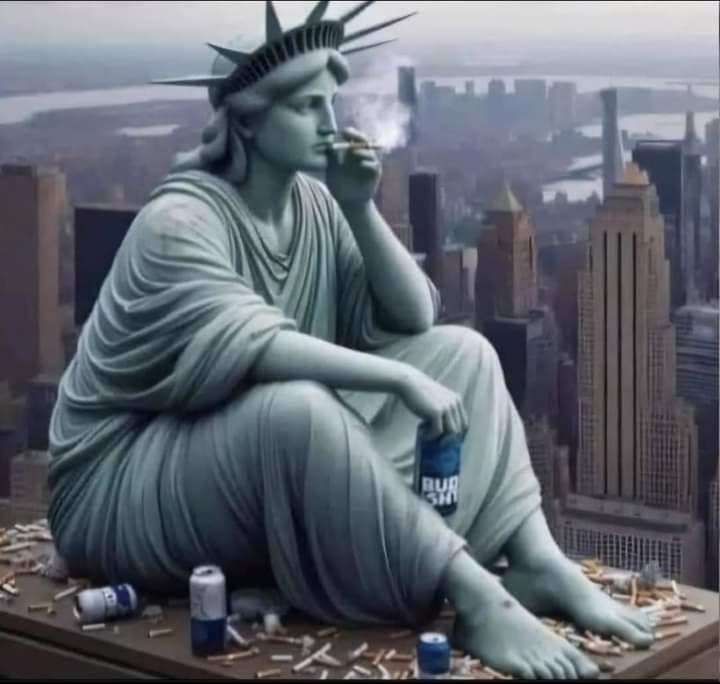
Scene One – Berlin, February 27, 1933: A massive fire broke out in the German Parliament building (Reichstag) in Berlin, causing enormous material damage. The Nazis immediately blamed the Communist Party of Germany (KPD) and used this event as an excuse to persecute communists and other opposition forces. This event marked the further course of German history, as Hitler exploited the disaster to consolidate his power and enforce repressive measures against his political opponents. A journalist from Reichsrundfunkgesellschaft (Germany’s state radio network) asked a passerby what he thought about the situation, to which he responded: “I’m not a supporter of Hitler, but I’m certainly not going to support the communists either!”
Scene Two – Cleveland, USA, November 5, 2024: CNN reports that Donald Trump has been elected President of the United States for a second term, decisively defeating Kamala Harris. In a brief street poll in Cleveland, a young woman in her 30s, white, said: *I’m not a big fan of Trump’s policies, but there’s no way I would vote for Kamala!”
The analysis of German voters’ support for Hitler is best left to historians, but we’ll attempt to “explain” how it’s possible that someone like Donald Trump could win a second presidential election in the United States.
PEOPLE, HOW IS THIS EVEN POSSIBLE?
At a campaign rally in Iowa in 2016, Trump famously said: “I could stand in the middle of Fifth Avenue and shoot somebody, and I wouldn’t lose any voters.” With this statement, he aimed to underscore the loyalty of his supporters, and he was right — he went on to defeat Hillary Clinton and become the 45th President of the United States. Eight years later, Donald’s narrative has become much more vulgar. During this year’s campaign, he lied on an epic scale, used rhetoric that dehumanized migrants by calling them “animals” and accusing them of “poisoning the nation’s blood.” He claimed that teachers in some American schools were changing students’ genders without parental consent. At a rally in Milwaukee, in front of thousands of his supporters, Trump grabbed a microphone stand and mimed an act of oral sex.
Of course, this wasn’t the end. Throughout the campaign, he insulted women, suggested he would use the military to deal with political opponents, and repeatedly talked about the size of golfer Arnold Palmer’s penis, reminiscing about a time they showered together. These are just a few examples from Trump’s arsenal of vulgarity.
Trump’s first victory in 2016 could be seen as a fluke, a deviation from the norm, a mistake. But now, America has chosen him for a second term, effectively playing out the worst-case scenario. A convicted criminal, a chronic liar who attempted to overturn the previous election results and incited an armed mob to storm the Capitol, a man who calls America “a garbage can for the modern world,” has been reelected.
To answer how this is possible, we first need to ask — who voted for “handsome Donald”?
THE VOTERS: WHO AND WHY?
First up, the Yugoslavs! Once again, Serbs, Bosniaks, and Croats living in America gave unwavering support to the Republicans. Since emigrating to the US 30 years ago, many elderly Yugoslavs, despite not knowing English, have benefited from state welfare programs, free healthcare, and ultimately pensions. Unlike the Democrats, Trump advocates drastic cuts to social programs, repealing Obama’s healthcare reforms, and privatizing social security. Yet, this demographic, accustomed to illogical choices back home, continues their habits abroad. Serbs, for example, haven’t forgiven the Democrats for the NATO bombing, while their neighbors conveniently forget the support they received during the civil war.
Trump embodies a typical Balkan charlatan — posing as a “man of the people,” pretending to be devoutly religious, while treating women like cattle. His only fault? He doesn’t drink rakija, but his hatred of foreigners earned him a pass on that.
Next, the Latin Americans. Toward the end of Trump’s campaign, during a rally at Madison Square Garden in New York, a little-known comedian Tony Hinchcliffe called Puerto Rico “a floating island of garbage” and criticized Mexicans for overbreeding. Despite such insults, Cubans, Mexicans, and Puerto Ricans seemed more invested in the Republicans’ commitment to “family values” and banning abortion than acknowledging Trump’s disdain for immigrants, including members of their own families.
Finally, let’s address women. This is the second time “Macho Donald” has defeated a female opponent, largely thanks to female voters. Shockingly, 55% of white women consciously voted against their own rights, supporting a demagogue whose primary agenda is to let the state control contraception, artificial insemination, and abortion.
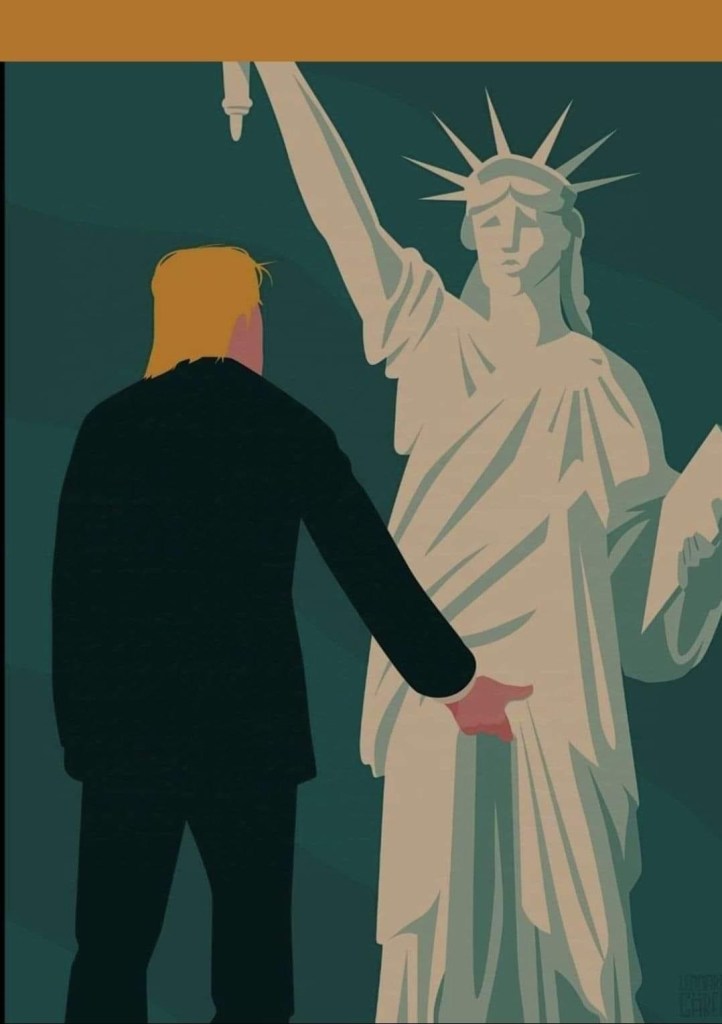
WHAT NOW?
Trump has promised the largest deportation of migrants in U.S. history, sweeping tariffs on imports, freezing environmental agreements, overhauling healthcare, and introducing ideological changes to education. Domestically, many fear he will use the military against political opponents. If Trump’s rhetoric translates into action, the United States may soon resemble a dictatorship akin to the one we began this story with.
Two possible scenarios emerge. In the first, nothing dramatic happens—just like eight years ago. Savvier advisors will let Trump bask in media attention, posing as a peacemaker while gifting Putin captured territories and relegating Zelensky to history. Meanwhile, immigrant Elon Musk might bring order to the country, while Melania handles things in the bedroom.
The second, more dire scenario, suggests that Trump’s first term was merely a rehearsal for global chaos. With wars raging in Ukraine and Gaza, nationalism rising across Europe, and right-wing parties in power in countries like Italy, Austria, Hungary, and potentially Germany, the stage is set for disaster.
The intellectual elite, whose political correctness helped bring Trump and his ilk to power, fear the approach of a Third World War. Meanwhile, conspiracy theorists argue that the global elite has already assigned roles: political wolves will continue spreading hate, military hawks will fight and die, while the sheep — locked in their homes — watch it all unfold on live TV.
Meanwhile, the horror in Gaza might last forever.
ONE FOR A HUNDRED, MISERY FOR ALL
“Human madness is often clever, and like a cat, a cunning thing. When you think it has fled, it may have only transformed into an even more refined form.”
Herman Melville: “Moby Dick”
The captain of the ship Pequod, Ahab, undergoes a personal tragedy when the white whale, Moby Dick, inflicts a severe injury on him, leaving him without a leg. This experience leaves a lasting psychological scar from which hatred and the need for revenge against the creature that brought him misery are born. Ahab’s hunt for Moby Dick becomes his obsession, a life mission in search of redemption. Ahab is fixated on destroying Moby Dick, turning his revenge into a destructive force that ultimately threatens not only him but the entire crew. While the most famous whale in world literature escaped the retaliation of the mad captain, millions of innocent people have perished in countless acts of revenge at the hands of their tormentors.
AN EYE FOR AN EYE
Revenge is a complex concept, defined as an act of retribution or inflicting pain on someone who has previously caused harm to another. It is present in different cultures, mythology, religious texts, and literary works as a universal motivation for the ruthless actions of individuals, groups, and nations. It represents the most primitive reaction to an injustice endured and is deeply rooted in human nature. However, revenge does not appear among animals, who are instinctively focused primarily on protecting their offspring or pack. The human reaction to suffering goes a step further, involving planned retaliation, which is characteristic only of the “most intelligent” biological species.
In ancient Greece, revenge was a means of achieving political dominance. Driven by the desire to avenge earlier Persian destruction of Greek city-states, Alexander the Great exacted revenge on the Persian Empire. His revenge culminated in 330 BC with the burning of Persepolis, the Persian capital, thereby settling old scores and demonstrating the power of the new Greek Empire. During this period, revenge was seen as an act of establishing honor and justice in a world dominated by military power. Motivated by vengeance, the principle of “an eye for an eye” was introduced into the Roman legal system to punish rebels and antagonistic peoples. Julius Caesar, “by law,” took revenge on the Gauls, whom he considered enemies of Rome.
In the Middle Ages, revenge became part of social and familial obligations, introducing us to the concept of blood vengeance for the first time. This was a traditional customary law in which members of a family, clan, or community sought justice for the murder of their relatives by punishing the perpetrator and his family. In the feudal society, blood revenge was socially accepted. In Scotland and Ireland, for example, customary revenge was a way of maintaining family honor and social standing. In the Balkans, blood feuds were passed down from generation to generation through customary law codes, such as the Kanun of Lekë Dukagjini in Albania. Similar practices existed in the Middle East and the Caucasus, in Yemen, and parts of Turkey. Families had the obligation to restore honor and enact justice on their own terms. During the Renaissance and Baroque periods, Europe adopted dueling as a specific ritual, usually to address insult or injury to one’s honor or reputation.
In the 19th century, the idea of revenge took on political and national dimensions. The French Revolution and the subsequent Napoleonic wars helped shape European nationalism, where revenge was used as a trigger to awaken and strengthen feelings of ethnic belonging. In the early 20th century, revenge acquired a global dimension through inter-state conflicts and military actions driven by past defeats. It became a political and ideological tool that motivated peoples and states to engage in conflicts of unprecedented scale.
The defeat of the Central Powers (Germany and Austria-Hungary) in World War I and the decisions of the Versailles Treaty left the Germans with a sense of collective humiliation. Hitler capitalized on this sentiment to popularize Nazi ideology and promote revenge, which soon turned into an all-out war against the entire world. Revenge thus became a driving force that politicians used to mobilize the masses and justify violence. One of the most horrifying examples of this vengeful impulse occurred in Kragujevac and Kraljevo, where, in October 1941, German troops executed thousands of civilians in retaliation for the deaths of their soldiers. The occupier brutally carried out mass retribution under the principle of “100 civilians for every killed German soldier.”
A TOOTH FOR A TOOTH
The sense of historical injustice over crimes during World War II caused national traumas among the peoples of the former Yugoslavia. In the early 1990s, the intellectual “elite,” media, and inflamed masses dug into the wounds of the past, searching for the sins of their neighbors. Political leaders in Serbia, Croatia, and Bosnia and Herzegovina used the awakened nationalism to escalate ethnic tensions. The wars in Croatia and Bosnia became grounds for a series of revenge actions in which all nations committed heinous crimes. Serbs, being the most numerous and militarily the strongest, began to exact revenge for all the injustices they had suffered during World War I and II. Justifying it with the fear of repeating Jasenovac, the Serbian leadership ordered the siege of Sarajevo, which lasted nearly four years, and the massacre of Bosniak civilians in Srebrenica. Various events during the Yugoslav civil war demonstrated the devastating power of revenge, used to assert ethnic superiority and heal the complexes of the past.
The attacks on the World Trade Center and the Pentagon on September 11, 2001, shocked America and awakened a sense of vulnerability and the desire for retribution. Al-Qaeda immediately claimed responsibility for the attacks, but the U.S. bombed not only Afghanistan but also Iraq, despite Iraq having nothing to do with the attacks. The “War on Terror” turned into a prolonged invasion, resulting in thousands of civilian casualties.
The first military intervention after the collapse of the USSR occurred in 2008, when Russia intervened in Georgia. Putin supported the separatist regions of South Ossetia and Abkhazia, and after the conflict, recognized them as independent states. Thus, Russia ensured its permanent presence and military influence in these areas. The annexation of Crimea in 2014 and the conflict in the Donbas region in 2022 showed that Russia harbored deep frustration over the loss of influence in the region. President Vladimir Putin reacted to Ukraine’s pro-Western aspirations and decided to “correct the crooked Dnieper.” The ongoing war in Ukraine resembles an act of revenge by a betrayed husband towards an unfaithful wife, with no end in sight. The consequences of this divorce are tens of thousands killed and wounded on both sides.
WE BECOME WHAT WE AVENGE
The most recent and simultaneously the most brutal example of vengeance is Israel’s response to the terrorist attack by Hamas that took place on October 7, 2023, during the Sukkot music festival. Over 1,200 civilians were killed in this attack, creating a sense of collective trauma within Israeli society. Soon after, Israel launched intense air and ground attacks on the Gaza Strip. The daily bombardment of this densely populated area lasted over a year, and the number of Palestinian victims surpassed 45,000. The brutal and disproportionate response of Israel to the terrorist attack brings the ratio of Palestinian casualties to one Israeli civilian closer to 40:1, evoking painful associations with known German retaliations during World War II. This event carries a special weight and additional symbolism, as the Israeli community, whose ancestors endured horrific suffering during the Holocaust, today carries out vengeful actions akin to those they themselves once suffered. Initially, the Israeli response to the terrorist attack was interpreted as self-defense, but the continuous and intense bombardment of Gaza brought muted condemnation from parts of the international community and raised many questions about the ethical boundary between defense and excessive retaliation.
Analysts argue that this case represents a moral dilemma related to the entire Israeli-Palestinian conflict. On one hand, Jews, who have experienced genocide themselves, harbor a deeply rooted sense of insecurity and survival, often presented as a legitimate basis for military actions. On the other hand, the use of disproportionate military force against the civilian population in Gaza raises moral responsibility and further illuminates the profound contradictions of Israeli foreign policy. Their military strategy raises a legal and ethical question: to what extent can aggression be considered legitimate defense, and when does it cross into unjust, bloody vengeance?
Reality, unfortunately, refutes philosophical dilemmas, as the catastrophic consequences for the civilian population in Gaza are evident—schools, hospitals, water supply networks, and residential buildings have been destroyed. The humanitarian crisis escalates day by day, with the lack of water, food, and medical aid bringing the population to the brink of survival. Tens of thousands of people have been displaced, and the survivors face permanent physical and psychological consequences of the conflict. Meanwhile, the world’s most powerful nations, led by the United States, support Israeli aggression and fund unprecedented ethnic cleansing and war crimes in the Gaza Strip. Strictly controlled media defend the indefensible, labeling any criticism of Israel’s actions as antisemitism. The final phase of the decades-long conflict in the Middle East resembles a tennis match where one competitor uses a racket and the other a mortar launcher. As long as such rules prevail, the outcome of the match is predetermined, and the endless cycle of violence and revenge, in which rivals alternate between victim and avenger, creates an inescapable vicious circle of violence.
Revenge, as a rule, exceeds the boundaries of rationality and moral acceptability, drawing individuals, societies, and entire nations into an endless cycle of repression. It does not bring true relief nor delivers genuine justice; instead, it creates an illusory balance that may temporarily satisfy the sense of hurt but ultimately leads only to deeper chaos and suffering. Just as Captain Ahab, driven by hatred for the white whale, lost the ability to distinguish justice from his own pain, so do modern states, under the guise of collective responsibility, relentlessly violate all legal, moral, and humanitarian norms. Revenge thus becomes a symbol of the inability to see the broader context of conflict and to find a fundamental answer to the injustice suffered. The only way out of this vicious circle of violence lies in changing collective consciousness and building a global value system that places humanity above the primitive impulse for retaliation… Or perhaps we should seek counsel from animals, who know nothing of revenge.
November 7, 2024
STORY OF FORGOTTEN PEOPLES
Native Americans in the USA and Serbs in Kosovo
By Dejan Krstic
I asked my friend, the artificial intelligence ChatGPT, to help me with a chronic health problem. Namely, after repeated media bombardment from domestic and international TV channels, acute symptoms appear regularly, giving me no peace. I describe them in detail, and after about ten seconds, I get an answer: “Waterboarding is a form of torture that simulates drowning. This method induces extreme fear and a feeling of suffocation. The person physically cannot breathe but remains conscious and under the control of the torturer. Although it doesn’t leave lasting physical injuries, waterboarding creates intense feelings of panic, helplessness, and acute physical suffering.” Not to brag about my buddy, but he truly knows me to the core.
MEDIA PRIORITIES
Indeed, the media torturers waste no time. We learn that Donald Trump, after two failed assassination attempts, still spreads racist misinformation about how Haitian immigrants are chasing the pets of Springfield’s American hosts to consume them for Sunday lunch. It didn’t help that the mayor, governor, and senator denied the orange clown’s lies, as Trump’s followers aren’t listening and are taking “justice” into their own hands. Pressure began mounting on the immigrants of this small Ohio town. Racist outbursts and threats unsettled the unfortunate people from Haiti, who had legally immigrated to America, leaving them afraid to go to work or send their children to school. In the next segment of the news, flustered astronauts stranded in space during the Boeing Starliner mission tell us they will miss Christmas and New Year’s this year, but they’ll still fulfill their civic duty and vote in the elections!? Then comes the report on how American allies are “defending” Gaza to the last Palestinian, and for lighter topics, there’s the arrival of a panda at the California zoo and the price list at the restaurant “Adalina” in Chicago, where a glass of martini costs $13,000. Since there were no major sports events, before the weather forecast, a reporter from the Arizona desert tells us: “In the last ten years, the issue of missing and murdered Native Americans (a politically correct term for Indians), especially women and girls, has become a global problem requiring urgent action…” Besides journalists, not a single politician or human rights advocate has addressed this topic. Clearly, they’re more concerned with the price of that martini in Chicago. Annoyed by the thematic priorities of American TV stations, I decide to take a media trip back home, where only one man is on all channels. Angry, frowning, sad, worried… the president of Serbia emphatically presents seven points under the multilingual title “Return to ‘Status quo ante.’” The first demand concerns new local elections in North Kosovo, although the previous ones were repeatedly boycotted by Serbs at the urging of Belgrade. The second and third demands suggest the return of Serbs to the police and judiciary, which they again left of their own accord. The fourth relates to the withdrawal of Kosovo police forces from illegally built bases and checkpoints (but not the removal of those bases)! The fifth demand and the leitmotif of all the president’s addresses—the Community of Serb Municipalities, which can be summarized with an old Serbian saying: “It might happen, but then again, it might not!” The sixth demand is the release of prisoners, and the seventh is the re-enabling of payment transactions and postal services. After the president’s speech, one-sided panel discussions followed on the theme—“he really told them!”
Exhausted from the “dry waterboarding” of the media, I reluctantly resort to a nowadays despised activity—thinking. Is it just me, or do the fates of the Native Americans in the U.S. and the Serbs in Kosovo painfully resemble one another?
The number of missing and murdered members of indigenous peoples in North America is increasing year by year, and this phenomenon is more frequently referred to as an “epidemic.” According to the Canadian government, it is estimated that in the past decade, the number of missing indigenous women has exceeded four thousand. The situation in the U.S. is not much better, as according to FBI data, women from Native American tribes make up 0.8% of the American population but represent as much as 7% of reported missing person cases. One of the key problems is the inadequate response of authorities and police to reports of missing persons, which further fuels the feeling of discrimination and a deeply rooted mistrust in state institutions. The movement supporting the missing Native American women of North America doesn’t attract widespread public attention. Protests, performances, and artistic projects demanding justice for the missing and murdered have received no support from official institutions or indifferent fellow citizens outside the reservations. Through the symbolism of red dresses, the natives demand changes in the legal system and the government’s approach to handling these cases. At the same time, it’s not uncommon for protest participants to end up behind bars, as outside the reservations, the laws of the white people prevail.
For years now, the Serbian authorities have used Kosovo as the key theme of their political campaigns, and the Serbian minority as a symbol of resistance and the fight for national rights. Despite bombastic media appearances and quasi-patriotic rhetoric promising protection and support, the situation in northern Kosovo is getting worse. Faced with tragic reality, growing political and existential problems, Serbs in Kosovo feel forgotten, abandoned, and betrayed. Until recently, state media bombarded us with the pledge of the Serbian president that the homeland would never recognize Kosovo’s independence and that everything would be done to protect brothers and sisters on “holy Serbian soil.” Since the (un)signed Ohrid Agreement, Serbs living in northern Kosovo can only see a better life on television, as they remain victims of Kurti’s regime. On the one hand, there are empty promises from Belgrade, with appeals to remain steadfast and dignified, while on the other, legal, political, and social pressures from Pristina intensify. The result is complete confusion in the Serbian enclaves in northern Kosovo, where, as a minority without real support, they see no way out of the vicious circle of hopelessness. It leads to the conclusion that Belgrade’s insincere rhetoric is merely a media mask covering the fact that Serbs in Kosovo are essentially abandoned.
HISTORICAL SIMILARITIES
If we are to believe history, Native Americans and Kosovo Serbs have lived on their territories since at least the 14th century. Both lived in accordance with their faith, upheld traditions, nurtured customs, and minded their own business. Everything was fine until some idle, curious, and above all aggressive people decided to attack their “tribes” in search of a better life. When they found what they were looking for, the wild ones decided to chase away the tame ones.
In North America, the conquerors arrived from Europe. Hungry for land, gold, and domination, they responded to the natives’ hospitality with violence. Systematic enslavement of the indigenous people, of the land that would soon be called America, began. The modern “pilgrims” brought with them weapons, whiskey, infectious diseases, and terror for the natives. In the new state, the land of the Indian tribes became the subject of discord, deception, and wars. The natives resisted for a while, but as the years went by, the sovereignty of their tribes crumbled. The surviving natives were driven from the territory of their ancestors and placed in reservations where they still live today.
In Kosovo, it’s the same story, just different actors. The Ottoman Empire expanded westward, bringing Islam, taxes, and the devshirme (blood tax). Kosovo was part of a larger entity that was always seen as a strategically important route between east and west. Here, Serbs, like the Native Americans, lived for centuries, and the Kosovo plain was a symbol of culture, faith, and statehood. After the defeat at Kosovo Polje in 1389, the centuries-long struggle began, which, in its way, continues today. The Turks conquered it, Tito and Fadilj Hodža repopulated it, Clinton bombed it, and Milošević and Vučić “defended” it. When you sum it all up, it’s hard to judge who brought the greatest harm to the Serbs in Kosovo.
The strategy changed over time, but the motives remained the same. In North America, Indian land was taken either by force or deception because treaties were always signed to the detriment of the natives. After placing most Native Americans in reservations, the U.S. authorities provided them with lifetime social assistance to discourage them from education, creation, and advancement. Cigarettes, alcohol, recreational drugs, and unhealthy food are sold at dirt-cheap prices in the reservations, and the average life expectancy of Native Americans in North America is 48 years for men and 52 for women. A staggering 25% of this population are alcoholics, and 20.6% suffer from diabetes.
Today, there are barely four million Native Americans in the U.S., while there are just about 100,000 Serbs left in Kosovo. The first quarter of the 21st century is nearing its end, and the problems of the indigenous peoples of North America and Kosovo grow larger by the day. It’s no longer just about the legacy of the past, but also about the tacit consent of the surroundings that the slow disappearance of the natives is a natural process that should not be stopped. The world, like the Palestinians in Gaza, has completely forgotten them. Burdened by their own struggle for survival, some count likes on social media and discuss the fate of pets in Springfield, while others worry about astronauts and the panda from the beginning of our story. Life goes on…
“I told myself, my God, how much demagoguery systematically arranged in artillery salvos.
How many stolen thoughts that stand for nothing but hatred, vanity, power…?
And how much corruption must spill before our feet?
And how thoroughly the essence of deception has been brought to unrecognizability…?”
Branimir Štulić: “When Pheasants Fly”
October 26, 2023
THE MORAL SEWAGE OF GLOBAL “HUMAINITY”
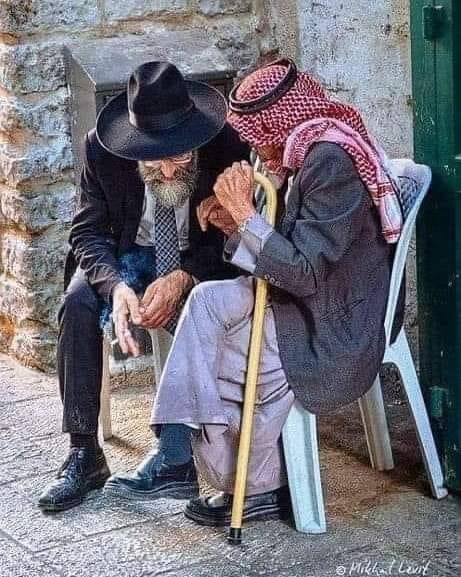
These days, a witty joke is making the rounds on the Internet, and it accurately mirrors the world we are living in today.
“Is the war between Russia and Ukraine because of religion?”
“No, both are Christian Orthodox.”
“Does America support Ukraine, while China supports Russia?”
“That’s correct.”
“Were the ancient Chinese Buddhists, and are they mostly atheists now?”
“Yes.”
“What about Americans?”
“Americans are a mix of Protestants, Catholics, and many other religions.”
“What about Israel?”
“They are Jews.”
“And the Palestinians?”
“Palestinians are Sunni Muslims.”
“Who supports the Palestinians?”
“Iran.”
“Are Iranians also Sunni Muslims?”
“No, they are Shia Muslims. They generally disagree with Sunnis, but if they have to choose between them and Jews, they side with Sunnis.”
“What about Albanians?”
“Albanians support the Jews.”
“But they are Muslims?”
“Yes, but they align with America, and America supports Israel.”
“If Muslims from Kosovo and Albania support Israel, then Muslims from Bosnia must support Israel too.”
“No, they support Palestine.”
“So, Serbs must surely support Palestine, which has not recognized Kosovo, and oppose Israel, which has?”
“No, Serbs also support Israel.”
“What about Ukrainians?”
“They support Israel.”
“So, Serbs must surely support Ukraine, which supports Israel.”
“No, Serbs are rooting for Russia.”
Though crafted for amusement, this hypothetical dialogue rings painfully true. In recent years, the modern world has come to resemble a department store overseen by a stubborn and corruptive manager. Every autumn, after returning from his vacation, he rearranges his “store.” Suppliers bribe him just to mess with customers. A few years ago, he created total chaos in the pharmacy by mixing aspirin with sleeping pills, substituting ibuprofen for cannabis oil, and mandating the wearing of cloth masks. Next winter, he turned his attention to groceries. Flour and oil from Russia were substituted with those from Ukraine, and vodka was permanently removed from the shelves. This year, it was the turn of oriental food. Baklava and Turkish delight were replaced by bagels, hummus, and other kosher foods. As for the people, they grumble for a couple of days, then adapt and become accustomed to the new arrangement. And so it goes, until the next year brings a new set of surprises.
The latest chapter in the global landscape of atrocities began on October 7th, when Hamas terrorists launched hundreds of rockets at Israel and used paragliders to attack attendees of the “Supernova” music festival. It’s estimated that the attack killed over a thousand Israelis and resulted in a number of hostages being taken by Hamas. Surprisingly, the attack eluded detection by the Israeli Mossad—widely considered one of the best-organized secret services globally, with an extensive network of spies across the Middle East. It’s astonishing that such a rudimentary attack by Hamas, managed to evade them. In usual fashion, what intelligence agencies missed was corrected by military action. A few hours after the onset of the attack, the Israeli army retaliated with heavy artillery and airstrikes, targeting Hamas. However, the real casualties were Palestinian civilians in Gaza. Israel’s response was lethal, with a ratio of approximately a hundreds of civilians killed for every music festival goer. Since the Israeli offensive in Gaza began, more than 6,000 Palestinians have died, and over 15,000 have been injured.
Parallel to the military operations, the machinery of media manipulation swung into action. Those defending the aggressor were often the same voices that had previously condemned the Russian aggression in Ukraine. With the obligatory narrative of “the Palestinians started it,” a wave of global amnesia seemed to wash over intellectual circles and the so-called “progressive” forces of the modern world. Historical aggressors have always found pretexts for subsequent atrocities; staged or tragic events often serve as a catalyst for far bloodier conflicts. The first step in this disingenuous propaganda is skillful public manipulation, leveraging people’s emotions and fears to garner support for military operations. The pretext for World War I was the assassination in Sarajevo of Archduke Franz Ferdinand, which led to over 20 million deaths. Hitler’s justification for invading Czechoslovakia, initiating World War II, was the supposed endangerment of the German minority in Sudet area – seven years and 70 million lost lives later, that issue was “resolved.” The Viet Cong’s attacks on American ships in the Gulf of Tonkin in 1964 precipitated U.S. involvement in Vietnam, resulting in 1,355,000 casualties by 1975. Putin, too, has invoked the “endangered minorities” argument, claiming to “protect” Russians in Ukraine since 2014.
When defending the indefensible, many turn to history—especially ancient, distant, and hard-to-verify history. Serbian nationalists often start narratives with the Battle of Kosovo, just as Zionists and their patrons invoke a 3,500-year Jewish heritage, Abraham, and the Torah. It’s easier to justify current war conflicts by citing events from distant history, as if taking a time machine thousands of years into the past would reveal all the answers.
At the beginning of the 20th century, present-day Israel was part of the Ottoman Empire. Jews were cautiously dreaming of returning to their promised homeland, as per ancient scriptures. This aspiration, known as Zionism, was formulated in the 19th century and has had significant ramifications. The fall of the Ottoman Empire after World War I paved the way for increased Jewish migration to the Middle East. Great Britain received the mandate from the League of Nations to govern Palestinian territory and initially supported Jewish immigration, triggering conflicts between the new arrivals and local Arab communities.
Unfortunately, the Allied forces did little to prevent the anti-Semitism that culminated in the Holocaust during World War II. Post-war, there was widespread support for the creation of a Jewish state in the Middle East. In 1947, the UN passed a resolution to partition Palestine into separate Jewish and Arab states. This sparked the Arab-Israeli War in 1948, which led to the formal establishment of the State of Israel on May 14, 1948.
The fulfillment of a centuries-old dream initiated another wave of Jewish migration, quickly overwhelming the allocated territory. Israel’s favored position in the UN encouraged further territorial aspirations. Over the years, Israel waged several wars in the region. After Egypt nationalized the Suez Canal in 1956, Israel, with a support od France and Great Britain, attacked Egypt and seized the Sinai Peninsula. In the Six-Day War of 1967 against Egypt, Jordan, and Syria, Israel captured the Golan Heights, the West Bank (including East Jerusalem), and the Gaza Strip. Israel’s 1982 intervention in Lebanon weakened Palestinian militant groups and displaced civilians in southern Lebanon. Despite Palestinians forming the majority in East Jerusalem, Israel declared the city its capital, effectively legalizing the eviction of Palestinians from the area.
Regarding the recent conflicts in the Gaza Strip, American intellectual Ben Shapiro recently said, “Israeli intervention must continue until the last son of a bitch in Gaza is killed!” This statement caused a collective media orgasm and received unconditional support from Western intellectual elites. Global efforts for human rights, freedom, and democracy slid into the sewerage of global morality. Israel closed off the Gaza Strip and banned journalists from entering the occupied territory, so all reports are coming only from border areas in Israeli territory. The senile U.S. President also joined in on the unprecedented media propaganda, spreading disinformation about Gaza. First, he reported false news that Hamas members were beheading children (the White House later denied the President’s “report”), and then informed the world that the attack on a civilian hospital in Gaza was carried out by the Palestinians themselves. If the President of the world’s most powerful country openly lies, one can only imagine how his media reports.
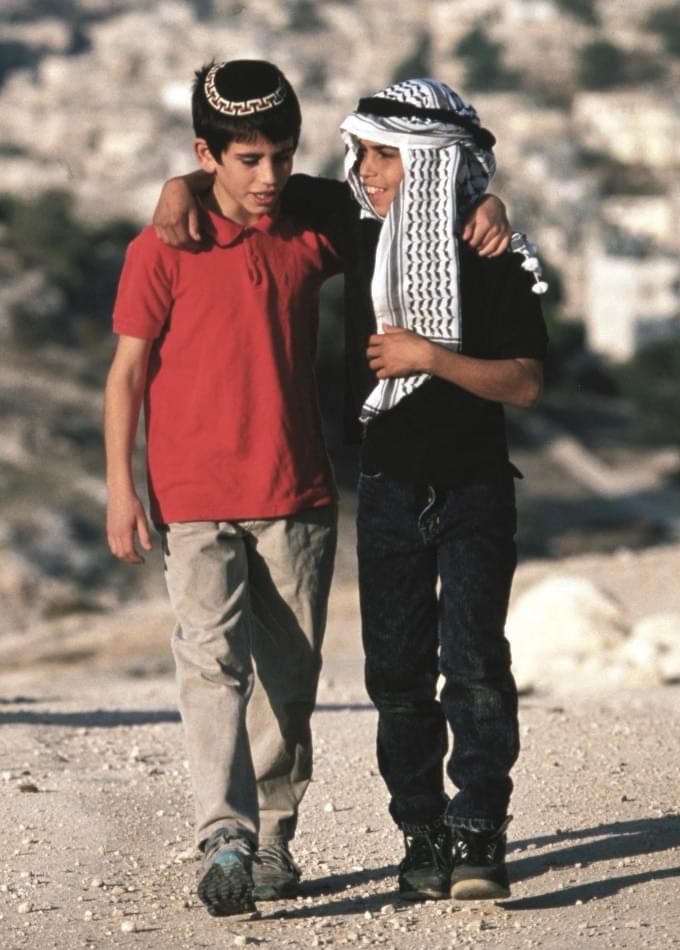
Every war represents an irrational category, and it is difficult to find any sense in it. The little logic and common sense that remain force us to ask: how is it possible for a people who have survived the Holocaust to so ruthlessly ethnically cleanse Palestinians just a few decades after the genocide against their own nation? “But they started it first!” still echoes in the world media.
In Serbian language, there is a saying, “he kills a cow for a pound of meat,” which aptly describes Israel’s recent actions in Gaza; they resemble a bailiff ordering the demolition of a house to solve a mouse problem in the basement. Human rights activists around the world aid in the “forced eviction” and demolition of the “building,” and will soon, without any conscience, finance the construction of a new multi-story building, which will again be torn down in a few years.
When it comes to war, the first casualty is truth. There is no greater folly than when people commit evil against each other in the name of God. In war, no one wins, except the war industry, forgetting that all the ideals in the world are not worth the tears of a single child. (Johnson, Pascal, Brecht, Dostoevsky)
THE PROCESS TO THE THIRD EMPIRE
OPENING STATEMENT IN THE COURTROOM
“No one accused Henry K. of the many evils he had done, if there had been luck, he would have been arrested long ago.”
When he was little, Henry K. loved fairy tales and picture books, but he always despised art. In high school, Russian writers and composers tortured him with music and litterature. His first girlfriend who loved avant-garde painters of the twentieth century left him since he was blind for paintings. Later, Henry K. turned to high politics. He was a key figure in all international affairs, causing conflicts, local and civil wars, and he became very rich from it all.
Years passed, but those Russians from his childhood did not leave him alone. Every night he dreamed of a landscape with five houses where The Nutcracker sailed on the Swan lake and in a nearby cottage, Rodion Raskolnikov listened to “Rachmaninoff’s Sonata” performed by the magical Lolita. The nightmares didn’t stop, and the accumulated experience of centuries didn’t offer a solution. One day, he decided to take revenge on his enemies. He took the book “The Third Empire: Russia as it should be” by Mikhail Yuriyev off the shelf, packed it in a large yellow envelope and wrote the address – Vladimir Vladimirovich
23, Ulitsa Ilyinka, 103132, Moscow, Russia.
PROSECUTION AND DEFENSE
In February 2022, Putin announced an attack on Ukraine. Seven months and five thousand deaths later, the war still continues, innocent people are dying, and the West is worried about something else. Life goes on, and stupidity follows like a conveyor belt. Soon, Dostoevsky is banned in Rome, Malevich in Amsterdam, Tchaikovsky in Cardiff and Zagreb… Russian fairy tales have served as scenarios for horror movies in Hollywood, and the Periodic Table of Elements by Dmitry Mendeleev will be replaced with the multiplication table.
When bad times come, normal people are left with nothing else but to crawl into a mouse hole and read books. In wars, life is often lost due to a wrong religion or surname, and because of wars, here we are, banning art. Consenquentlly, Russian literary classics become more and more popular every day. However, if one makes a list of the most significant Russian writers, it will always include Dostoevsky, Tolstoy, Chekhov, Gogol, Pushkin, Lermontov… If their names won’t surprise anyone, their origins certainly will, because of the mentioned giants of the written word, only Tolstoy is a “pure” Russian, while the others are connected to Ukraine by family ties. Before the “historical hematologists” start counting the blood cells of 19th century Russian writers, let’s turn to facts.
Gogol was from central Ukraine, and the grandfather of Fyodor Mikhailovich Dostoevsky lived in the Ukrainian city of Vinnytsia, while Chekhov was born near Mariupol. A century later, Mikhail Bulgakov lived in Kiev, Anna Akhmatova and Igor Petrov in Odessa, and if we add that Pushkin had African and Lermontov Scottish blood, the story of ethnically pure literature definitely falls apart. Intelligence, esthetics, and talent are humanistic and cosmopolitan values, while nationalism is cheap entertainment for fools.
Nikolai Gogol (Ukrainian name Mykola Hohol) was born in the Poltava region of central Ukraine. They spoke Ukrainian in the house, and when he went to school, he began to learn Russian, which was also the official language of the empire. His father taught him literature, and his mother religion. When he turned twenty, Gogol moved to St. Petersburg. During his studies, he wrote school assignments and literary projects in Russian, while using Ukrainian for himself. At that time, there was a “circle” of Ukrainian writers in Petrograd, led by Taras Shevchenko, in whose work Gogol actively participated and was a respected member. In his early stories, he nostalgically described memories of youth and homeland, while in his mature literary phase, he became much sharper. In his seminal work, the novel “Dead Souls,” he used a sharp satirical style to describe the reform and emancipation of Russian serfdom, when landlords were allowed to own peasants. The word “soul” was used as a unit of measure for peasants! Thus, the Russian peasant tycoons of that time owned hundreds of “Slavic souls.” Gogol traveled throughout Western Europe, getting to know the culture of other countries. Towards the end of his life, he became completely devoted to religion and advocated for the reconciliation of the Eastern and Western churches, which he believed were equal before God. He called Russia the empire of “dead souls.” If he were alive today, he would probably align himself with Christian intellectuals who advocate for peace but not at any cost.
Leo Tolstoy comes from a noble Russian family. He was raised traditionally according to conservative canons of national pride. Following in the footsteps of his father, Count Nikolai Ilyich, young Tolstoy at the age of twenty-six goes to the Crimean War, which in many ways resembled the one being fought in the same area today. Tolstoy arrived in Sevastopol with the romantic idea of military honor and obligation to fight for his homeland. Patriotic dreams quickly vanished in the smoke of gunpowder. In his autobiographical work “Sevastopol Sketches,” Leo Tolstoy portrayed a bloody battlefield with drunken Cossacks, beardless young men lost on the front line, the sound of bayonets, and the cries of nameless victims. Uncharacteristic of a Russian soldier at the time, Tolstoy concluded that propaganda from the conceited rulers was designed to sacrifice the uneducated people who would die for “Mother Russia”. Newly awakened pacifism is even more explicitly expressed by Tolstoy in the book “Resurrection,” stating that war is an evil that cannot be justified by any master, king, or priest, and unfortunately, they have become the ones who encourage, initiate, and lead it. Due to these views, Leo Tolstoy was excommunicated from the Russian Orthodox Church. As a requalified peacemaker, he would probably be at the head of some non-governmental organization today.
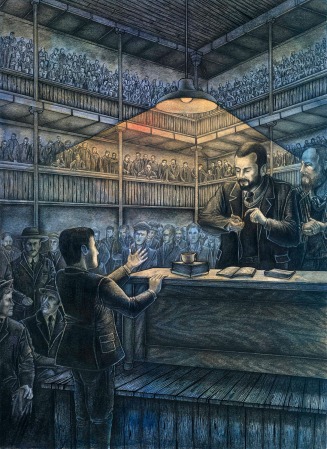
Anton Pavlovich Chekhov was born in Taganrog, a small town near Mariupol. After finishing high school, he moved with his family to Moscow, where he enrolled in medical school and later published his first collection of short stories. During his studies, Chekhov would spend every summer with relatives in Ukraine. He stayed in the village of Luka near the city of Sumy, where he came up with the ideas for the first plays that would later bring him literary fame. He wrote about the egoism and arrogance of high Russian society. In Anton Pavlovich’s works, we discover a unique atmosphere and a brilliant dramatic approach. Chekhov did not analyze the causes of social behavior, but rather satirically depicted the lives of his characters, whose fates we experience through tears and smiles. If he were alive, he would surely have helped as a doctor on the Ukrainian front.
Fyodor Mikhailovich Dostoevsky came from a poor family and he viewed society and the world around him critically. He found beauty only in faith and art. Dostoevsky inherited his love for literature from his grandfather Andrei, a Russian priest who lived in Ukraine. As a child, Fyodor would visit his grandfather and bring back many books from Vinnytsia, which his grandfather would select specifically for him. Today, the graves of the Dostoevsky family can be found in the Ukrainian town of Kalynivka, and their descendants live in Kyiv, Odessa, and Makijivka. In the town of Vyatichi, there is a museum dedicated to Fyodor Mikhailovich that showcases his connections to Ukrainian culture, societal conditions, and population.
During a debate where he expressed positive views towards books and writers who represented socialist ideas, Dostoevsky was sentenced to death. After being arrested and subjected to a sadistic farce by the imperial police, the author and his companions were led to a staged execution. While awaiting their execution in front of the firing squad, they were granted clemency from the emperor. Their supposed punishment was changed to a lengthy prison sentence. In reality, the authorities never intended to execute them; it was merely a form of sadistic abuse towards powerless individuals. While in prison, Dostoevsky underwent a significant ideological transformation. Previously, he had leaned towards Christian mysticism and liberal social ideas, but after his time in Siberian exile, he began to have a positive view towards monarchy, Russian Orthodoxy, and nationalism. In the winter of 1881, Dostoevsky was given a magnificent funeral attended by over one hundred thousand people, mostly students. The funeral spontaneously turned into demonstrations against the Tsarist regime. If he were alive today, he would undoubtedly criticize those in power, but he would also vigorously oppose Western politics, which he never tolerated.
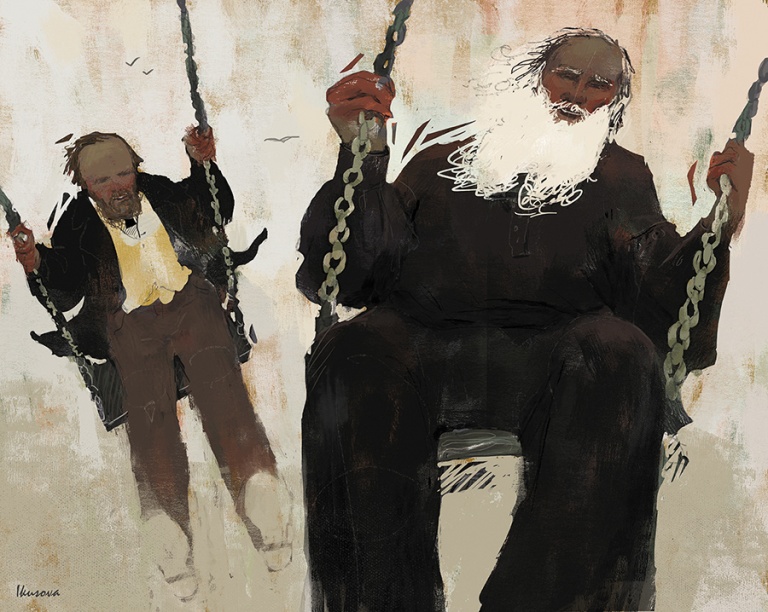
FINAL WORDS
No one can interpret Putin’s thoughts, but we can read the book that inspired the Russian president to start a war against the whole world. Mikhail Yuriyev’s utopian novel “Third Empire: Russia as It Should Be” was published in 2006 and represents a textbook whose lessons are still diligently studied in the Kremlin today. The book explains the necessity of re-establishing the old world order, when Russia surpassed Europe and America in total power. The first empire was established during the reign of Peter the Great, the second under Stalin, and now, it is time for the third and final one.
The novel describes in detail the years of Russian renaissance that began under the rule of Vladimir II and continued under Gavriil the Great until the final creation of the Third Empire. Both rulers successfully implemented the “new Stalinization” project. The first step in this direction was the annexation of Crimea and the invasion of Donetsk and Luhansk. In a referendum, 93% of the population voted for the creation of an independent Black Sea Republic of Donetsk and the annexation of the territory of eastern Ukraine. Soon after, the independence of Belarus and Ukraine was abolished.
Although he did not predict the world’s economic sanctions towards Russia, Yuri in the book describes in detail the gas and nuclear weapons blackmail. At one point, the protagonist of the book, Vladimir II, says in an interview with French television, “If you don’t love us, start a war and conquer us, or even better, stop buying gas, energy, and food from us and die of hunger!” With a decisive stance to confront the whole world, Vladimir II provokes a reaction from the West when the Third World War begins. After years of destruction and countless human casualties, Russia emerges as the winner, and at its helm is Gavrilo the Great, the successor of the great Vladimir II who deservedly goes down in history.
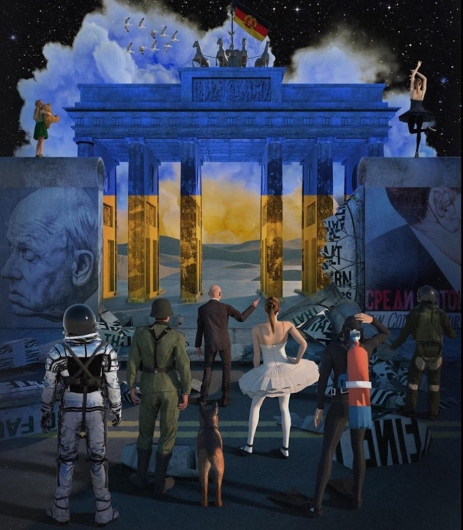
INTERMISSION
While waiting for the verdict, the defense attorney was flipping through the morning edition of the “Fraud” tabloid. In the middle of the third page, it read: “In May 2023, Henry Kissinger will celebrate his 100th birthday. There is no disaster, war, or moral filth that happened in the world in the past century that was not somehow connected to him. When asked by a reporter what’s next, Henry K. seriously replied, “Another hundred years like this, and then we’ll see!”
VERDICT
“On the evening of his birthday, around nine o’clock when silence prevailed on the streets, two gentlemen in tailcoats, pale and corpulent, with top hats seemingly bolted to their heads, came to K.’s apartment. With eyes that were dying, K. saw the gentlemen, cheek to cheek, watching the execution of the verdict. ‘Like a dog,’ he said, and it seemed that shame would outlive him.”
NOTE: Slightly modified quotes from Franz Kafka’s novel “The Trial” were used in the text.
If you are caught with a Kinder egg in your luggage when entering the United States, you can be fined $2,500. The sale of this popular candy has been banned in America since 1997 due to the risk of choking on the plastic toy inside. Americans who want to purchase Sudafed (pseudoephedrine) at the pharmacy must show identification and proof of age to buy it, just like they would with alcohol. In some states, semi-automatic rifles such as the M50 and AK47 can be purchased from well-equipped department stores without any background checks.
In the first three weeks of 2023, there were 39 reported mass shootings in the United States. On January 21st, seven people were killed in Half Moon Bay near San Francisco, and just two days later, 12 people were killed during a Chinese New Year celebration in Monterey Park, California.
According to the Oxford English Dictionary, a mass shooting is defined as a crime in which more than three people are killed or injured using firearms. This definition excludes wars, conflicts between organized criminal groups, armed robberies, or domestic violence. The perpetrators of these crimes are often disgruntled individuals who seek revenge on those closest to them due to personal failures in areas such as school, career, or love life. They also may be seeking attention and popularity. Statistics show that these “fame seekers” tend to be more violent and their crimes more deadly.
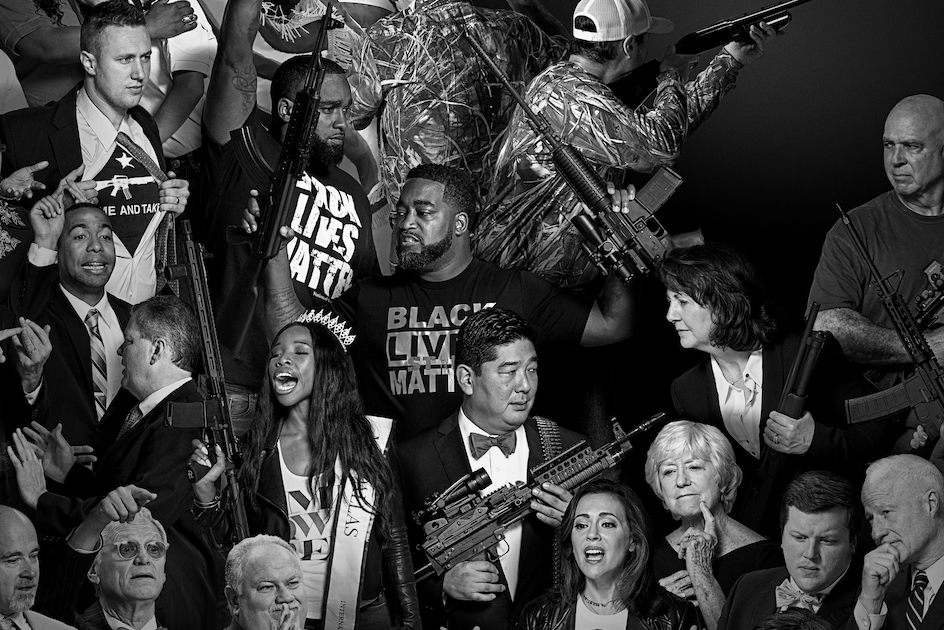
The American gun culture has a long history and problematic practices. The Second Amendment to the US Constitution guarantees citizens the right to bear arms for self-defense. However, some Americans treat it as a sacrosanct commandment rather than a constitutional amendment.
The Bill of Rights is a collection of ten constitutional amendments designed to protect citizens’ rights from tyranny. The amendments have been updated over time to reflect changing social trends. The First Amendment guarantees freedom of speech, while the Second Amendment protects the right to bear arms and is the subject of ongoing and often heated debates.
The interpretation of the Second Amendment varies greatly. Liberal activists who support limiting access to firearms downplay its significance, arguing that it primarily relates to the role of the National Guard as part of the armed forces reserve. Conservative opponents, on the other hand, view the right to possess firearms as the cornerstone of the American constitutional order, citing its inclusion by the “founding fathers.”
Armed Americans often overlook the fact that the Second Amendment was enacted at a time when rifles and pistols could only fire one shot and required several minutes to reload. Today, a semi-automatic rifle like the AK47, commonly known as the “Kalashnikov,” can fire 600 rounds of 7.62-millimeter caliber in just one minute.
The right to bear arms has deep historical roots in the US, having helped cowboys, farmers, and settlers to conquer the Wild West. However, in modern society, the role of the citizen, hunter, and soldier is no longer combined in one person, making the right guaranteed by the Second Amendment outdated.
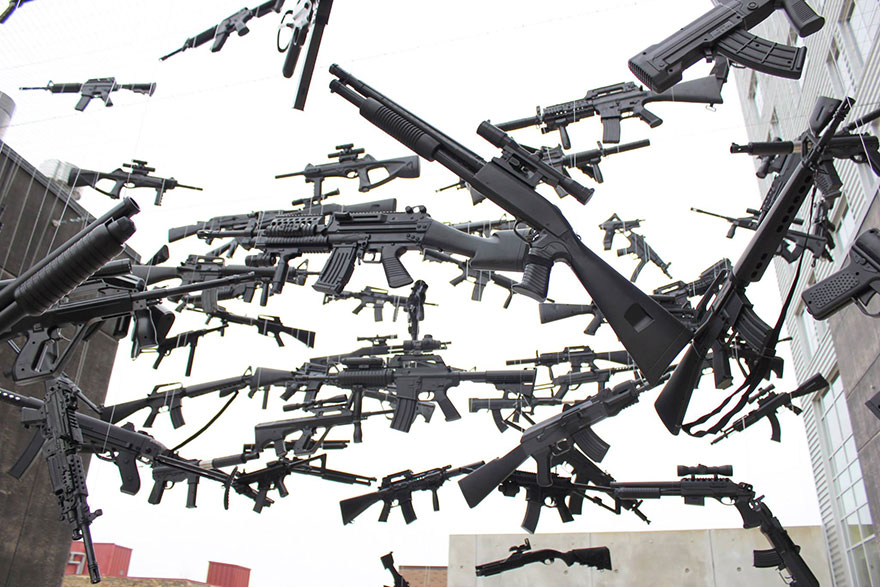
Throughout history, the United States has implemented various gun bans. In addition to Native Americans, slaves, and blacks, servants, foreigners, non-Protestants, minorities, and convicts were also prohibited from owning firearms. There were also restrictions on shooting on Sundays, in the dark, or while under the influence of alcohol. Despite these strict laws, Americans now have the most permissive access to firearms in the world.
The number of mass shootings in the US has always been significantly higher than in other countries. From 1900 to 2014, 2,625 serial killings were recorded in the US, compared to 142 in England, the next highest on the list. In every decade of the 20th century, more mass shootings occurred in America than in the rest of the world combined, while in the most developed countries in Europe and Asia, this trend was reversed.
In 1996, a massacre occurred in the Australian town of Port Arthur, where 35 students from a local elementary school were killed. Two weeks later, the federal government of Australia enacted a new law banning all personal firearms, except for hunters who had to register their weapons and keep them in hunting clubs. The following year, the government launched a gun buyback program, resulting in a 74% decrease in gun-related murders in Australia over the next decade.
In the same year, Great Britain also experienced a tragedy when 16 children attending a local nursery school were killed in Dunblane, Scotland. The country promptly tightened its laws, making it illegal to own any firearms overnight, from pistols to semi-automatic rifles.
The “gun culture” in America is a unique characteristic that is difficult to change, making it unlikely that the cycle of mass shootings will end soon. Liberal analysts attribute the aggressive approach to reality in the US to fear, poverty, and racism. Fear has been a part of American society since its founding, stemming from the settlers’ fear of the native people they immediately brutalized and later the fear of slave rebellions, which they controlled through violence and weapons. It is not surprising that until 1966, blacks were prohibited from owning guns, and until 1968, Native Americans.
Today, the media successfully creates a state of fear through its coverage of murders, robberies, and family crimes. After watching the evening news, many Americans feel compelled to purchase a semi-automatic rifle or pistol, lock themselves in their homes, and protect themselves from perceived dangers. The crime rate may be declining, but the media creates the impression that an armed African or Latino American is lurking around every corner.
Given this media propaganda, it is not surprising that 75% of guns are owned by middle-class Americans, specifically white suburbanites. When black people are killed in a gun battle, it is perceived as a criminal gang shootout, but if it is a white person or group, condolences and prayers are sent from the highest levels. In both cases, unfortunately, it seems that little is being done to restrict access to firearms.
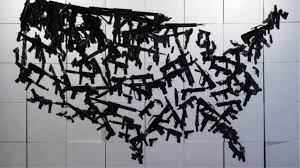
Since the massacre that occurred on April 20, 1999 in the town of Columbine, Colorado, over a hundred mass shootings have taken place in America, resulting in the deaths of over two thousand people. The most tragic of these was in Las Vegas in 2017, where 58 people were killed at a country music concert.
Right-wing advocates argue that more guns lead to less crime, but this claim is contradicted by the daily reality of mass shootings in America. Americans possess far more firearms than any other country, yet they also lead the world in the number of mass shootings. The constitutional right of Americans is to defend themselves and their families in life-threatening situations, but they do not need semi-automatic rifles for this purpose. Americans own over 400 million firearms, which equates to over 120% per capita. The Falkland Islands have the second highest rate of gun ownership, at 62.1%, followed by Yemen with 42.5%. Serbia and Montenegro share third place with 39.2%, while Russia is 68th with 12.3%, Spain is 103rd with 7.5%, and Germany, the United Kingdom, and China have the lowest rates, at 7%, 5.3%, and 3.6% respectively.
Although the US leads the list of mass shootings, the deadliest attacks have occurred on other continents. The most tragic of these was in 2015 at Garissa University in Kenya, where 148 students were killed by members of the Somali Islamist group Al-Shabaab. This was followed by the massacre at a Pakistani school in Peshawar in 2014, where 141 students were killed, and in 2011, when 77 attendees at a youth camp in Norway were killed by Anders Breivik.
Opponents of firearms restrictions in America claim that guns and pistols are not to blame for mass shootings, but rather the people who use them. The absurdity of this argument is demonstrated by the accident that occurred in Arizona in 2014, when a nine-year-old girl accidentally killed her instructor at a shooting range. The girl, who had previously fired a revolver, wanted to try an automatic Uzi pistol, which jerked to the side and killed the instructor.
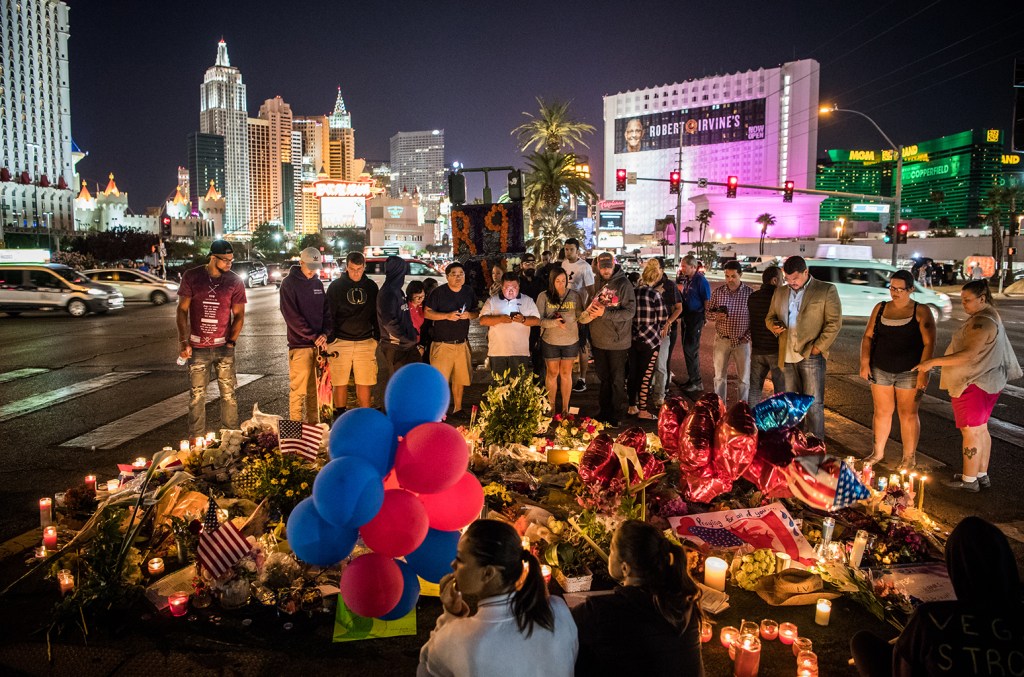
In the age of advanced technology and artificial intelligence, people still have a fascination with Colt guns and rifles. How can the Wild West be tamed in America and the rest of the world?
Is the problem rooted in the population’s mental health?
According to the National Institute of Psychophysiological and Mental Disorders in Baltimore, less than 40% of mass murderers showed symptoms of mental illness. Can we blame mass shootings on broken families and childhood traumas? One-third of mass murderers had difficult childhoods, and this number is even higher among “school shooters,” at 68%. Mental illness and family problems are not unique to America. Northern European countries have higher rates of divorce and mental disorders among young people, but unlike the US, mass shootings are rare.
Psychologists point to America’s culture of violence and the popularity of violent video games, but a fascination with weapons and aggression is not unique to America. Throughout history, Germans and Japanese have also demonstrated an interest in these areas, but strict firearms laws have prevented the mass arming of their populations. Violence-themed video games are a popular pastime among young people worldwide, but countries like Canada, where one in six people owns a Sony PlayStation, have not seen a corresponding increase in firearms ownership.
Violence and aggression have long been a part of the American reality. In almost every Hollywood movie, guns and pistols are depicted as killing at full speed. In contrast, in British-made series, murder is usually committed using a knife, blunt object, or, as in the case of Agatha Christie’s novels, poison. The choice of weapon often makes the plot more interesting, the storyline more original, and the number of casualties much smaller.
Sports also reflect this trend. While Italians, Spaniards, and Englishmen chase a round soccer ball, Americans use an oval football to wage war and conquer territory. Baseball, the second most popular sport in the US, also involves the use of bats or clubs.
John Lennon left England and tried to enlighten Americans with his pacifist ideas and peace activism. Unfortunately, he was killed by a mentally ill individual who owned a firearm without a license. Ten years later, another Beatle was almost killed in London. The assailant broke into George Harrison’s house and attempted to kill him with a knife, but the musician’s wife was able to neutralize the attacker using a table lamp. While it is true that murders are committed by evil people, weapons play a significant role in their ability to carry out their crimes. To prevent mass shootings, it is necessary to implement strict firearms control laws. When firearms are taken away, a brave individual with a lamp in hand is often enough to bring the perpetrators to justice.
 STORY TELLER