

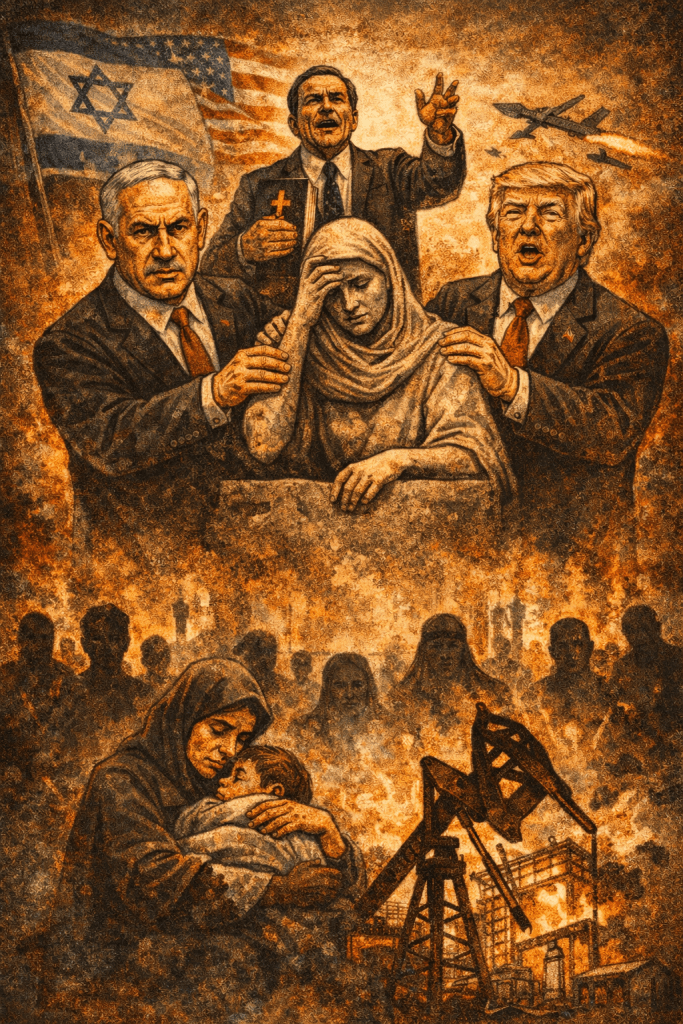
For years, the American public was told that Iran is an existential threat, until fear itself became the primary political tool. In late February 2026, the military operation “Epic Fury” began. As soon as the war escalated, the narrative suddenly shifted, and the same actors who actively support the genocide in Gaza started claiming they were bombing Tehran to help the Iranian people. Wars were once fought for interests. Today, they are increasingly fought in the name of the victim.
What preceded “Epic Fury”? At the end of last year, from December 3 to 7, a gathering was held in Jerusalem that, at first glance, had nothing to do with military operations. The “Friends of Zion Ambassadors Summit” brought together more than a thousand evangelical pastors along with top political and security representatives of Israel and the United States. Among them were Prime Minister Benjamin Netanyahu, Foreign Minister Gideon Sa’ar, and Chief of Staff Eyal Zamir, while the American side was led by Ambassador Mike Huckabee, who described himself not only as a diplomat but also as an “ambassador of God’s kingdom.” Numerous influential representatives of American Protestantism attended, as well as political-military figures like Pete Hegseth, whose appointment to lead the Pentagon further strengthened the connection between this ideological framework and the structure of state power. The summit was organized in cooperation with Israel’s Ministry of Foreign Affairs and represented a fusion of politics and theological mobilization. Through visits to military sites and meetings with victims of conflict, participants reinforced the belief in Israel’s special role. The event concluded with certificates confirming loyalty to Israel and a commitment to promote it within local communities. The messages from this summit suggest that the return and gathering of Jews in the “Holy Land” is a prerequisite for the Second Coming of Jesus Christ. The inevitability of war with Iran thus emerged from a long process in which religious ideas, political interests, and military power were gradually fused into a single operational framework. While missiles lit up the Middle Eastern skies, Joseph Kent, director of the National Counterterrorism Center and a veteran of numerous conflicts, resigned. In his explanation, Kent stated that Iran does not pose an immediate threat to the United States and that the conflict was initiated under pressure from Israel and its influential lobby. He warned of a recurring pattern: campaigns filled with disinformation, manufactured panic, and promises of quick victory, similar to those preceding the Iraq War. Having personally participated in wars in which he lost his wife, Kent concluded he could not support sending new generations into a conflict that lacks clear security logic and does not justify the loss of human lives. Donald Trump’s reaction was immediate and personal. Instead of addressing the facts, he attempted to discredit Kent, saying he “never really liked him” and that his departure was no loss. He even suggested Kent got the job out of pity, adding that after his wife’s death he “quickly remarried.” This reveals what Kent indirectly suggests: the war against Iran is not the result of a unified security assessment, but of a complex mix of political pressure, ideological beliefs, and religious interest networks operating alongside formal institutions. When combined with religious narratives framing the conflict as part of a “higher mission,” the line between military operation and ideological project becomes dangerously thin.
Welcome to the “newest” world order — an age of technologically advanced barbarism, where for the strongest, rules no longer exist. The logic is simple: refuse to comply, and you will be bombarded with missiles and bombs. We see this madness daily in Iran, southern Lebanon, Syria, and Gaza. International institutions like the United Nations have been reduced to hollow remnants of another era. In just a few weeks, over one million people — one-fifth of Lebanon’s population — have been displaced. Israeli Prime Minister Netanyahu has long lobbied for U.S. entry into war with Iran. Previous administrations resisted, largely due to strong opposition within the Pentagon, which did not consider Iran an existential threat nor foresee a positive outcome. Donald Trump, encouraged by hardline Zionists, his son-in-law Jared Kushner, and advisor Steve Witkoff, accepted it without hesitation. The justification for war keeps shifting: stopping Iran’s nuclear program? Regime change? Combating state terrorism? Meanwhile, revelations like a Mossad agent’s files on global elites have vanished from public discussion. The ultimate goal of Washington and Tel Aviv is far more ambitious: breaking Iran into ethnic and religious enclaves. Persians make up about 61% of the population, while minorities account for 39%. Fragmenting Iran would leave Israel as the dominant regional power and allow control over its vast gas and oil reserves.
Wars against Palestinians, Lebanon, and Iran are justified by the Holocaust. Yet many Holocaust scholars refuse to draw parallels or condemn the genocide in Gaza. Jewish suffering is elevated as unique, while Israel is shielded from accusations of war crimes, colonialism, apartheid, and genocide. The exclusive “ownership” of Holocaust memory has eroded both academic credibility and moral integrity. As Aimé Césaire wrote, Hitler shocked Europe not because of his cruelty, but because he applied colonial methods to Europeans that had long been used elsewhere.
Israel today embodies an ethnonational state admired by Christian Zionists and far-right movements. It rejects pluralism and uses indiscriminate force against those labeled “human pollutants.” Historian Charles Maier writes that the Holocaust has become “moral capital,” raising the question: if one suffering is publicly recognized, must we not recognize others? Criticizing Israel often leads to accusations of antisemitism. This simplified formula serves not only Israel but also Western powers seeking to conceal their own historical crimes.
For the U.S., war with Iran brings economic benefits: higher oil prices, increased arms sales, and a stronger dollar. Chaos boosts demand for the U.S. currency, while weakening Iran preserves the petrodollar system. However, ordinary citizens pay the price through rising costs, risks to soldiers, and potential escalation.
Who is really driving this war — and why? Countries that challenge the dollar system often become targets. Iraq, Libya, Afghanistan — all followed similar patterns. Iran fits the same profile, trading oil outside the dollar system and maintaining an independent central bank. This challenges global financial dominance.
The West can no longer credibly lecture others on human rights. The illusion that America promotes democracy has collapsed. From religious gatherings to political decisions, from military structures to operations on the ground — what began as a religious idea ends in the killing and displacement of civilians. When faith becomes part of military doctrine, war crimes are no longer exceptions — they become expected outcomes.


Leave a Reply