

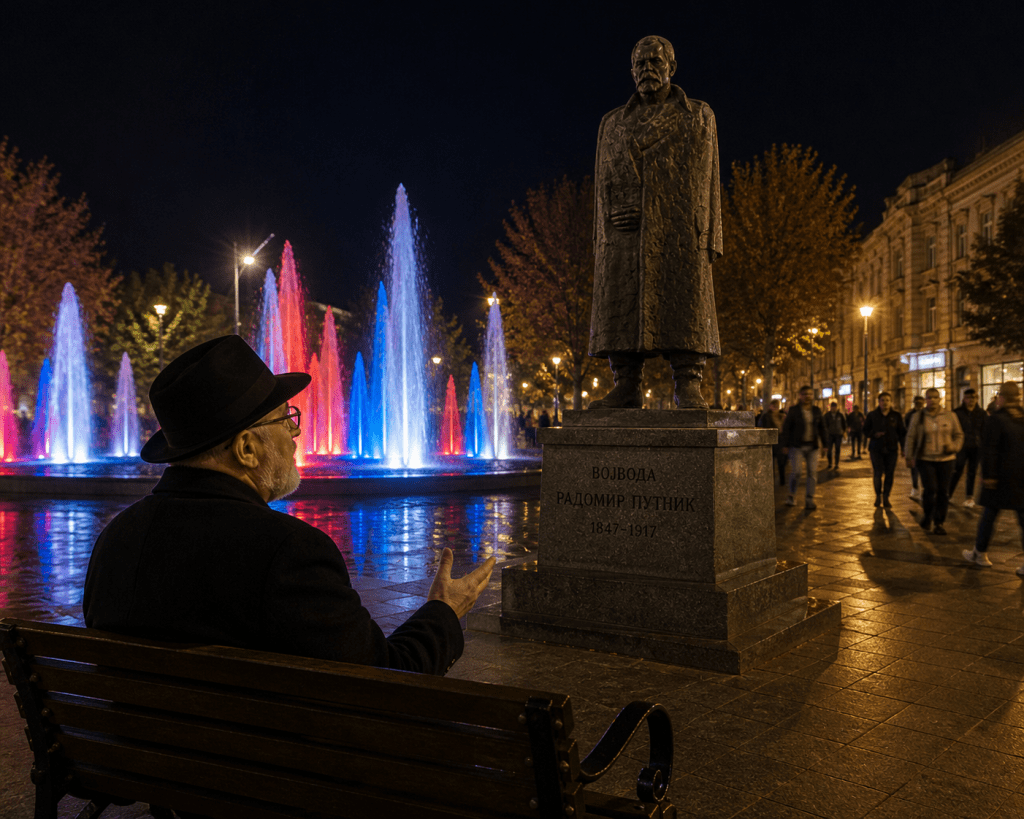
During my stay in my homeland, I visited a distinguished colleague whose roots are deeply woven into every clod of our long-suffering native soil. After a fruitful conversation, I decided to call a taxi, thinking it would not do to embarrass myself. To the taxi driver’s sharp question, “Where to?” I naively replied, “To the old courthouse.” The driver of the pink limousine then delivered, in a single breath, a lecture on the toponyms of my hometown.
“When you say ‘the old courthouse,’ most taxi drivers won’t know where that is!”
“All right, then what should I tell them if I intend to get out precisely by the old courthouse?”
“Well, say Radnički Shopping Center.”
Not to drag the story out, but in the end the gentleman dropped me off in front of the Ured.
I crossed the street and claimed a bench which, over the shoulder of Vojvoda Putnik, looked straight at the former “palace of justice.” Children were running around the fountain, parents were staring at their phones, and the water light show had just changed color: from a “macho” tricolor into a suspicious rainbow palette. I lit a cigarette to calm myself after that multilayered stress, when suddenly, as if in a film, Vojvoda Radomir spoke.
“All that philosophizing about how to get here, when you could have simply said ‘Vojvoda Putnik Square.’ But that’s what you ‘Second Serbia’ types are like…”
“For years I didn’t write even to my own aunt, just because she lives on Slobodan Jovanović Street…” I replied.
“America has corrupted you!”
“I understand, Vojvoda, but with all these people around, how did you decide to address me of all people?”
“I’m bored, Krstić. They made me a handsome square, but what good is it when I have no company?”
For a moment I thought I had lost my mind, but then, on second thought, in this mad world far greater miracles had become possible, so I decided to continue the debate while the magic still lasted.
“They could easily have put up a monument to Živojin Mišić as well, so he could keep you company.”
“I asked the city authorities for that, but they said Živojin’s descendant is a serious opposition figure here in Kragujevac… A journalist, and on top of that, one of those blockade people! It just isn’t meant to be, my friend, that’s all there is to it.”
I won’t lie: however much I may swear by pacifism, I enjoyed talking to the greatest Serbian military commander. Still, the whole time I kept turning around to make sure the good people from emergency services were not coming out of the Ured to collect me.
“Tell me,” the Vojvoda spoke again, “how are you spending your time back home? How does this Kragujevac of ours seem to you?”
I wanted to impress my accidental interlocutor, so I began with a joke, hoping it had come into being after his time. Namely, all of us who at some point left our native place, when we come back to visit, encounter different reactions from acquaintances, relatives, and friends. If we are gone for a long time, they greet us with: “Well, where have you been, man? You’ve completely forgotten about us!” If we drop by once a year, the reaction is: “You’ve been coming rather often. Missing Serbia? Nostalgia is a powerful thing!” And for those of us who decide to show off a little and visit our nearest and dearest every six months, there comes a full serving of honesty for the money: “You’ve come again! You’re neither here nor there, are you? When are you going back?”
Vojvoda Putnik burst out laughing.
“They’re right to say it. Why are you wandering around so much? Sit where you are, because you’re no good even for where you are! I asked you how you spend your time.”
Since my family general staff had remained in Arizona, my old man was struggling with miracle medicines on the internet, and my friends were out pumping on all fronts, I had to invent an interlocutor, so it was only fair that I show him some respect. “Brother Radomir,” I thought, “here’s how things stand…”
“I have a hard time adjusting to the time difference, so during the first couple of weeks I wake up very early. While the working people of Šumadija, lulled by sweet dreams, prepare for new victories of labor, I read, write, and wait for the first tavern to open. I have learned the difference between a short and a long espresso, and the cruel truth that the word ‘double’ does not affect the quantity, only the strength. I have also practiced other Serbian orders: half a kilo of white bread and a soda siphon, and the newest one: a small, a large, and a ‘just right’ beer. I get my morning coffee and thick juice without waiting, leaf through the daily papers, and read the articles of the journalist who bears a famous surname with particular attention. On my way back I buy apple pie to cheer up my father, who by then has gathered the latest online information. Unlike me, who still naively believes in journalism, my old man has embraced artificial intelligence, so they serve him news according to his wishes. In good spirits and even better informed, I set off for a walk. Once I used to hurry to Šumarice to enjoy nature, but as I grow older, I increasingly enjoy the urban, as you would say, Vojvoda, ‘surroundings.’ Down the main street to the Great Park, then to the basketball court, past the Faculty of Science and Mathematics and the Technical School, downhill along Vojvoda Mišić Street, back to the center.”
“I know, my friend, everything is clear to me. They gave Živojin a better street, even though he isn’t from Kragujevac!”
Putnik was not pleased, but I consoled him by saying that whenever I go to Vašarište or Aerodrom, I always take the street that bears his name. And even if I fall into one of the many holes in the nonexistent sidewalk, what is that compared with everything Uncle Radomir did for his descendants? I did not promise anything, but since I know a lawyer who receives proposals for changing street names, I’ll see whether I can help. I continued where I had left off, adding that Mišićeva Street connects to Karađorđeva, where they had not exactly overexerted themselves either, and then along Karađorđeva, this way and that, I arrive at “Old Serbia”… I mean the tavern, not the social order.
There, the journalistic-artistic society, plus associate members. Panta and Mića confirm for me the name of this year’s NIN Award winner, and then Megi and I go to the promotion of Darko Tuševljaković’s excellent novel Karota. A few days later, the same company, but another location: another literary evening at the Gymnasium. Kalymnos, a book by Goran Joksimović, full of emotion, sincere concern, and humanity. The “teacher in short pants” had, over time, become a retiree in jeans. A serious poet and writer who, with this bilingual collection of stories and poems and a beautifully conceived book launch, brought both tears and laughter to his readers.
I had just gathered speed with the story of my several-week stay in the homeland when my interlocutor yawned for the second time.
“I may have gone a little too broad, excuse me…” I justified myself awkwardly.
“And you’ve pounced on those books like death on an old woman! Did you watch at least one war film, or get into a tavern fight?”
The Vojvoda caught me off guard with that question, but fair enough — we had only just met, so the man did not know my priorities.
Then I pulled the ace from my sleeve.
“The closest I came to violence was at a football match!”
I then confided to the Vojvoda that I had spent my early childhood in Picmala, across from the Čika Dača stadium, so I had wanted, for the first time, to watch Radnički under the floodlights. There were slightly more spectators than at a classical music concert, the atmosphere intimate and chamber-like, until the fans from the south spiced it up with rockets and cannon blasts.
“The only things missing were goals and good football,” I explained, “until the last minute, when we, pardon the expression, capitulated!”
“You really are unlucky, aren’t you? You go to a match after so many years, and your team loses. By the way, you just reminded me that for a while I lived on the street that now bears my name, and in 1915 I lived in Čomić’s villa… Where did you grow up, Krstić?”
“Some say Stara Kolonija, others call it Erdoglija…”
“Two Serbs, three opinions,” Putnik added.
I explained that, despite disagreement over the administrative border between the two neighborhoods, the revival of Stara Kolonija and part of Erdoglija was the most positive impression I would carry with me across the ocean. When I climbed from the Kolonija Gate to the next traffic light, it felt as if I were leaving Spitalfields and passing through Shoreditch on my way to Canary Wharf.
“All right, you American, for heaven’s sake, why are you throwing around those expressions? I didn’t travel much — no farther than Greece and Albania, only to end my ‘life career’ in France…”
“Easy, Vojvoda, don’t spoil my dramaturgy… I still have texts to write, and this comes to me as what our people would call a cliffhanger.”
“You really aren’t normal,” he said without ceremony.
I pretended not to hear him and continued the story about the part of Kragujevac where I grew up. On my way to school I used to pass wooden barracks built after the First World War as war reparations.
“I’m sorry I didn’t live to see that, damn the Swabian lot of them!”
“Now everything has been demolished, so Stara Kolonija resembles a real metropolis… something like Berlin!” I blurted clumsily.
“You, Colony boy, really know how to talk nonsense. You speak a lot, and stupidly!” my interlocutor snapped.
Aware that this comparison had ruined the friendly tone of our conversation, I decided to ask a few counter-questions. After all, what kind of journalist would I be if I failed to use such an opportunity and interview a Serbian hero?
“Since I have explained in detail everything that interests you, may I now ask a few questions?”
“Fire away, brave lad!”
Although I had not prepared, the topics presented themselves.
“They say that in 1914 you were at a spa in Austria-Hungary and that they let you return to the homeland, thinking you were harmless.”
The bronze Vojvoda adjusted his hair and straightened his shoulders.
“I was not harmless,” he said quietly. “I was ill. And whoever makes a wrong assessment later pays the price.”
On the courthouse steps, someone lit a cigarette. The flame briefly illuminated a face, then disappeared.
“There is a story,” I continued, “that you promoted a man who had previously driven you out of service.”
“Because he was an excellent officer!”
“Regardless of the past?”
“The past does not concern itself with strategy. In war, a mistake costs more than an insult.”
Night was already settling heavily, the lights were still changing colors, and there were fewer and fewer passersby.
“They say you did not care for glory.”
“Glory is for the generations that come after us! All those legends were created to romanticize the suffering of innocent people. Empty stories search for a reason, and in wars there is none!”
I looked around: a young couple in an embrace, a lady walking her dog, and a foreign student phoning his family back home. I stood up, to check whether all of this had been a dream.
“And you were about to slip away without even saying goodbye… When are you returning to America?”
“First I’m going to London. My daughter lives there…”
“I hope you’ll find some idle old man there too. Safe travels, and the next time you come, stop by so we can have a proper talk.”
In the days that followed, I avoided monuments, especially that area near the Post Office and the Peron café, because you know what they say — run from it like the devil from the taxi stand in the center.


Leave a Reply