

During the final days of my stay in Kragujevac, I ran into an old schoolmate I had not seen for years. One word led to another, and I learned that he now held some important position in the city government. He was pleased with life, with his family, and most of all with the President. Toward the end of our conversation, he surprised me with a question:
“Will you be here for Đurđevdan?”
I said I would be around for a few more days, then I would stop by London for a bit, and only after that fly back to Arizona.
“What a shame,” he said, disappointed. “We’re preparing something Kragujevac has never seen before!”
I was just about to satisfy my curiosity with a question when, out of nowhere, my neighbor Sima appeared, an opposition man of the blockade persuasion. I quickly said goodbye to the city official in order to prevent a street incident, but my neighbor did not forgive me.
“Well, well, by God, so you’ve started hanging around with the wrong crowd?”
As punishment, I had to buy him a drink.
I left my homeland as planned, and while I was humming “London Calling” on the plane, I kept wondering what our local authorities were preparing for City Day. By the time I had watched two episodes of the Hercule Poirot series, the plane had already landed.
My daughter and son-in-law live in Shoreditch, where the Beatles, in 1968, made their famous “Mad Day Out” photo series. It is a neighborhood breathing an atmosphere in which images of old working-class London mingle with the modern creative one. The next day, while the children were working and building England, I set out to explore the neighborhood. In keeping with my age, I caught Old Street and, through quiet streets, reached Regent’s Canal. A walking path beside the boats I remember from English detective shows. I took a break at the café “Kiss The Hippo,” then, fortified by caffeine, went on to Spitalfields, where I immediately found the theatre in which Shakespeare began his career before gaining fame at the Globe. There is also a flea market selling antiques. Among the displayed goods, I recognized a miniature chess set with magnetic pieces. When I was a kid, all my friends had one. I asked the price — sixty pounds! In this neighborhood, the old East End collides with the concept of a modern metropolis. Between Victorian brick houses, old pubs, and Bengali restaurants rise glass offices and minimalist cafés full of young people with laptops who are “working from home.” I sat in the square, listening to my favorite podcast, “The Queer, the Priest and the Lawyer,” when the Đurđevdan surprise in Kragujevac suddenly came to mind. What on earth had they come up with?
That evening we all went together to a Premier League match. I had not watched football live for more than thirty years, and now I had done it twice in one month. At the stadium where the 2012 Olympics were held, West Ham and Wolverhampton were playing in a battle for survival. More than fifty thousand people cheered, sang, got angry, and rejoiced for the full ninety minutes. Even with the score 4–0 for the home team, West Ham supporters were still biting their nails, getting nervous, fearing the worst. Although these were currently teams of lesser quality, I would not even try to compare this match with the one I had watched in Šumarice. As my godfather once said — that is like comparing different sports. What especially shocked me was the way such a mass of people entered the Underground after the match. The police let us through in groups, and the whole thing lasted no more than forty minutes. Not a single argument, no jumping the queue, let alone a fight. And these were English football supporters. As we passed by Baker Street Underground station, an idea flashed through my mind about how to solve the “municipal mystery” from my hometown.
The next morning I boarded a train and headed for the street where, through the books of A. C. Doyle, I had spent a good part of my childhood. The train thundered through the underground tunnels of London as if passing through the bowels of a tired city. I sat leaning against the window of the carriage and watched the faces of people who, without exception, were minding their own business. A girl with headphones was scrolling through her phone, an older gentleman was reading one of those “serious” newspapers, a young man with a laptop on his knees was just then buying and selling stocks. It seemed to me that we were all taking part together in some old London ritual of silence. Only the artificial voice from the speaker occasionally interrupted the monotony: “Next station… Baker Street.” The carriage doors opened with a hiss of air and a warning that, in free translation, means: “watch it, mate, mind where you’re stepping, and don’t wander left and right!” Baker Street station smelled of dampness mixed with air freshener and morning coffee from paper cups. On the walls were silhouettes of Sherlock Holmes: pipe, hat, the profile of a man who never existed, and yet had managed to occupy an entire quarter of London. Black taxis, red double-decker buses, sirens in the distance, a cold wind passing between Victorian buildings, and that strange feeling that everything is at once chaotic and perfectly organized. At first glance, Baker Street does not look spectacular, but the farther I walked, the more the city began to resemble the London I remembered from books. Dark façades, old bricks, windows behind which one could glimpse offices, surgeries, and flats where someone was just then boiling tea. At one point I passed a souvenir shop full of pipes, magnets, and detective caps, and realized that everything was slowly turning into an introduction to a meeting with a literary friend from childhood who had left a deeper mark than many historical figures.
The Sherlock Holmes Museum does not look like a tourist attraction. In fact, if it were not for the queue in front of the entrance and the souvenir shop, a man could easily walk past thinking it was just another old London house. A black door, a narrow staircase, dark wood, and that Victorian feeling that this building too was guarding some great secret. Tourists were taking photographs as if entering a shrine, not the apartment of an imaginary detective who, as a literary character, had managed to secure for himself an address, a museum, and a postage stamp in a real city. London, it seems, long ago stopped distinguishing fiction from history. Inside, it was rather cramped and slightly stuffy, like an attempt to preserve the air of the nineteenth century. Carpets, lamps, chemical equipment, a violin, piles of books, old newspapers, an armchair turned toward the fireplace, even a seated English toilet. A little girl whispered to her father:
“Daddy, did he really live here?”
For a moment I had the feeling that a thin man with a pipe would appear on the stairs, toss his coat over a chair, and recite her father’s life story on the basis of the mud on his shoes.
Upstairs were wax figures and scenes from the stories. Moriarty, Dr. Watson, and Holmes, who looked less like a man than like the idea of order in a world falling apart. When I came out, the same gray sky greeted me, only now a fine rain had begun to fall. Tourists were buying souvenirs, and I headed back toward Baker Street station.
And then I saw him.
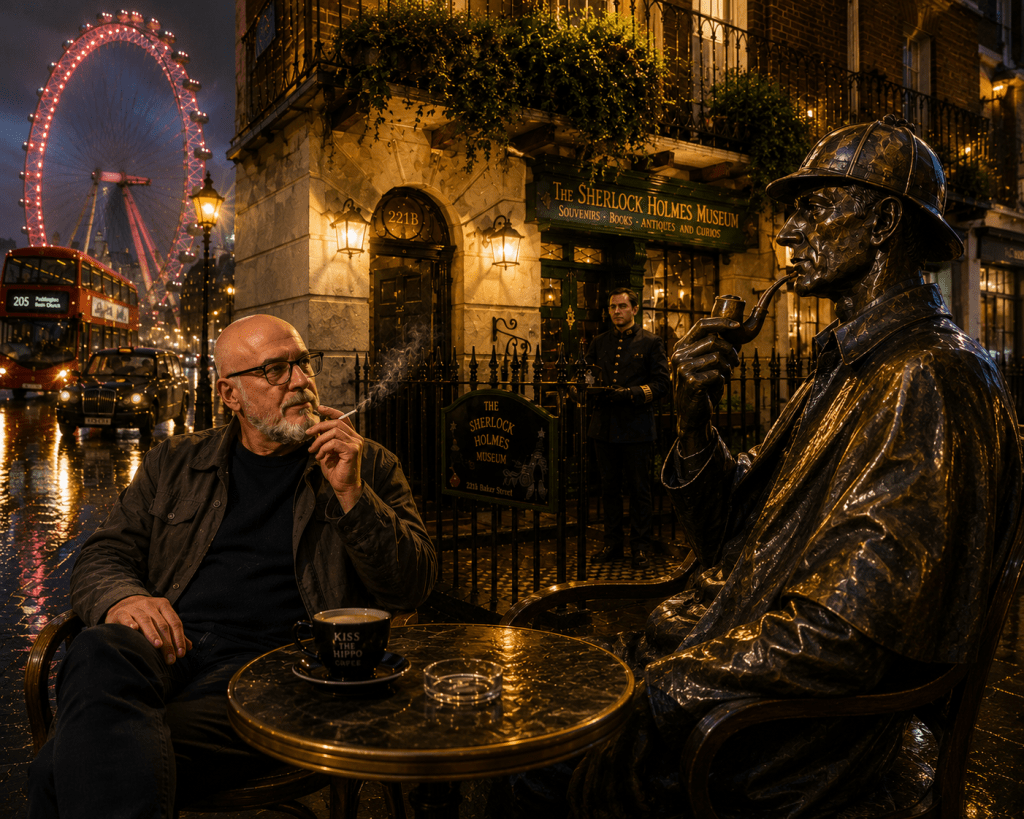
The bronze statue of Sherlock Holmes stood a few meters from the entrance to the Underground, tall and calm, with a pipe in his hand and the gaze of a man who already knows how the conversation will end. Rain ran down his coat and his hat, à la Matija Bećković, while people passed by him as if passing an aging policeman who had stood on the same corner for years. I stopped. I do not know whether the reason was fatigue, but I had the same feeling as I had once had beside the monument to Vojvoda Putnik in Kragujevac. I recognized the moment when a city stops being entirely rational.
I lit a cigarette and addressed the bronze detective.
“All right, Mister Holmes, let’s hear it… what have you concluded?”
The detective leaned slightly toward me. Rain tapped against the metal brim of his hat while Baker Street pulsed around us.
“I have concluded, Mr. Krstić, that it is not London that has been troubling you for hours, but Kragujevac.”
“Excuse me?”
“Very simple. The moment you left the museum, you were not watching the traffic or the tourists. Your attention was drawn instead to the Ferris wheel in the distance. Your brain automatically connected the London Eye with the mysterious ‘surprise’ mentioned by your friend from the city government.”
I had to admit that, for a beginning, this was not bad.
“All right, but that proves nothing yet.”
“On the contrary. Throughout your entire walk, you were thinking about that sentence. ‘We’re preparing something Kragujevac has never seen before.’ Your city has neither the funds nor the infrastructure for spectacular projects. Therefore, only imitations of great world symbols remain. And since you are in London, the city you are currently observing has naturally become the model of your deduction.”
“You mean to say that…”
“That the city government is putting up a Ferris wheel for Đurđevdan. Probably a temporary one, somewhere in the center, where it can be nicely photographed by drone.”
I laughed.
“Wait, wait… how did you guess it was exactly a Ferris wheel?”
Holmes blew nonexistent smoke from his bronze pipe.
“Because Serbian authorities adore modern symbols that require no maintenance. Bridges without rivers, fountains without water, gondolas, and panoramic merry-go-rounds. These are objects that look good on television and even better from the air.”
“All right, this is already becoming political commentary.”
“No, Mr. Krstić. Merely urban forensics.”
A group of tourists passed us with bags full of souvenirs. One boy stopped to touch Holmes’s shoe.
“But why a wheel, exactly?” I continued.
“Because you yourself gave me the final clue, the key to solving the riddle. Your friend from the city government did not say they were preparing something useful, lasting, or necessary. He said: ‘Something Kragujevac has never seen before.’ That means an attraction, not a project. A visual effect, not substance.”
I must admit, the bronze Englishman was slowly beginning to annoy me with his certainty.
“And what if you are wrong?”
“Then next time you will bring me a postcard from Kragujevac and write: ‘Dear Mr. Holmes, you are an ordinary fool.’”
The rain fell harder, buses passed, and somewhere beneath us the Underground thundered.
“You know what the worst thing is?” I said after a short pause.
“What?”
“That you are probably right.”
Sherlock did not move.
“Of course I am. London is full of copies of itself. Why should Kragujevac be any different?”
At that moment, my phone buzzed in my pocket. A message from my neighbor Sima:
“Have you seen it? They’re putting up a Ferris wheel. They say — the Serbian London Eye!”
I looked at the bronze detective.
“All right, Holmes… your clairvoyance frightens me a little… And the holiday surprise is creepy.”
Rain streamed down his metal coat as Baker Street sank into the London dusk.
“It is not creepy, Mr. Krstić,” he replied calmly. “It would be creepy if you had believed it was an original idea.”
As I descended toward the Underground, I thought about how cities are much more like people than we wish to admit. Both London and Kragujevac are desperately trying to leave the impression that they are larger, more modern, and more important than perhaps they really are. Some build Ferris wheels, others build copies of them, but the need is the same — to spin, if only for a moment, the illusion that we are the center of the world.
The train entered the station with its familiar rumble, and the refrain of the song I had been humming back on the plane passed through my mind: “London Calling…” Only now I knew the answer to the mystery from my hometown. Kragujevac was not pretending to be London. It was more as if it were trying to take a selfie with it.


Leave a Reply