

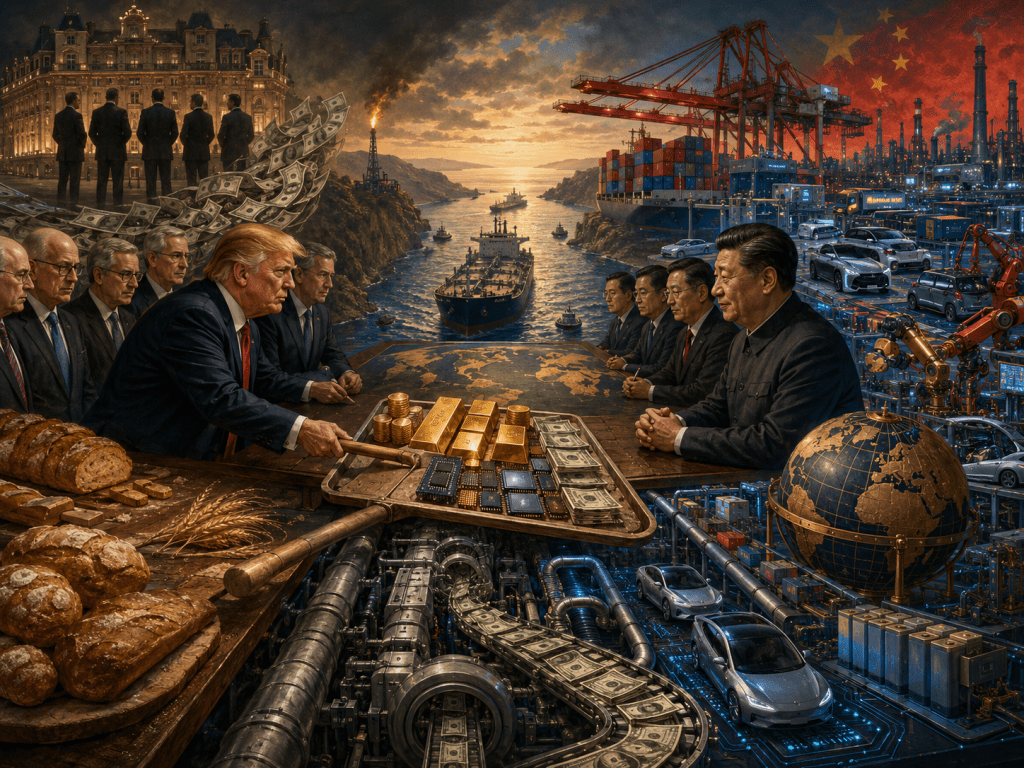
Imagine that the owner of a bakery owes the bank 65,230 euros, charges his creditor a 25 percent fee, and then sends his entire family to become clients of that same bank. Sounds absurd, doesn’t it? But if we move onto the global stage, we quickly learn that anything is possible. According to data from March of this year, the United States, which owes China 652.3 billion dollars, is raising tariffs on imports of Chinese goods to 25 percent, and then Trump, accompanied by eighteen CEOs of the largest corporations, goes to visit them in order to continue their “successful” economic cooperation.
One might think that in Trump’s era everything is allowed, but American-Chinese business acrobatics began back in the 1970s. In the 1980s, everything was turned into a joint plan, and from then on China became one of the main destinations for foreign capital. Judging by a report from the U.S. Congress, by the beginning of the 2000s almost 1,500 American companies already had direct investments in China, while foreign companies accounted for more than half of China’s exports and imports.
THE CHINESE DOLLAR LAUNDRY
A particularly important part of this story is the fact that capital did not always enter directly. Part of the investment regularly went through Hong Kong and other offshore zones, making it harder to see the true origin of the money. In such a system, the individual hides behind a fund, the bank behind a holding company, and family capital behind a legal entity. Tax logic additionally encouraged this model. Until the tax reform of 2017, American corporations for years postponed paying taxes on the profits of their foreign subsidiaries until the money was formally brought back to the United States. Thus China, together with Hong Kong and offshore centers, became a space in which capital turned into production, production into goods, goods into American consumption, and profit into new political and financial power.
The theory of a secret group of American power players who have been systematically “laundering money” through China for half a century has not been officially proven, although one may rightly ask the question: is this merely free trade, or is it a perfectly developed system for hiding ownership, relocating production and increasing profit? Once, negotiations were about cheap labor and factories. Today, chips, artificial intelligence, rare minerals, electric vehicles, batteries, financial markets and control over technological standards are all in play. In other words, China has become the great mirror of modern capitalism: a system that operated in public while its most important actors usually remained in the shadows.
Let us return to the recent visit of the American “bakers” to China, with the note that there is another theory about what actually happened when Trump took Elon Musk, Tim Cook, Jensen Huang, Larry Fink and others to China — the most powerful business leadership ever assembled for a single foreign trip. The reason was negotiations over a new monetary order, probably the most significant in our lifetime. After the Second World War, the rules of global money imposed by the United States have been slowly falling apart, while China, day by day, is gaining a more important role and dictating the emerging world monetary order.
This theory takes us forty years back, to a not-so-well-known economic agreement that rearranged the entire global economy. It was the Plaza Accord. In 1985, the United States was facing numerous financial troubles. It had a huge trade deficit, and because of the overvalued dollar, American manufacturers could not compete on the world market, which sounds almost exactly like today. The Reagan administration convened a secret meeting at the Plaza Hotel in New York, attended by France, Germany, Japan and Great Britain. Behind closed doors, they reached an agreement under which other countries agreed to manipulate currency markets in order to weaken the U.S. dollar, especially against the Japanese yen. Very quickly, the value of the yen almost doubled. Japanese exports became expensive, while American goods, compared with Japanese ones, became cheap. The trade deficit was reduced, and American manufacturing became more competitive.
In return, Japanese companies were allowed to invest massively in the United States. Toyota, Honda and Nissan began building factories in America, while Japanese money poured into American real estate, government bonds and American companies. For a while, it seemed that everyone was winning. But when the Japanese currency quickly doubled in value, the entire economy, which depended largely on exports, was left paralyzed. Japan tried to save its economy with cheap money, but without success. What does this have to do with China?
During the aforementioned meeting between the American “debtors” and the Chinese leadership, tariffs fell into the background while the focus shifted to drafting a new “Plaza agreement.” If they reach a deal, there will be no revaluation of the dollar against the yuan, but rather through another financial instrument. That economic anchor will become gold, after which major financial shocks will inevitably follow. The role of the dollar will change and inflation will arrive, affecting savings, investments and probably the entire monetary system of the United States.
In order to understand this agreement and why it is being negotiated right now, we must recall what is currently happening in the world.
THE THUCYDIDES TRAP
Let us begin with what Xi Jinping said in his speech, when he asked whether China and America are capable of overcoming the Thucydides Trap and creating a new paradigm of relations between great powers. The Thucydides Trap is a political theory named after the ancient Greek historian who studied the war between Athens and Sparta around 400 BC. What Thucydides observed was the following: when a rising power begins to threaten the dominance of an existing power, the result is almost always war. Fear, pride and competition make conflict nearly inevitable. When cases throughout history were studied, sixteen examples were found in which a rising power challenged a ruling power, and in twelve of them war broke out. So Xi Jinping is, in effect, saying: “China is a rising superpower, and we all know how this story usually ends. Let us prevent that.”
The answer to the question of why all this is happening right now is very simple: the flow of energy. Whoever controls the flows of energy controls the levers of power and dictates where the money goes. The Strait of Hormuz controls roughly twenty percent of the world’s energy. Since the American-Israeli war with Iran began, the strait has been closed. The official story that has been fed to us for months assures us that this will be resolved quickly. A peace agreement is coming. Everything will return to normal. The markets have already priced in that perfect assumption. But the truth tells us that the world is using emergency oil reserves in order to compensate for the closure of the strait, and those reserves are beginning to shrink. Bloomberg predicted that global oil inventories would reach the level of operational stress around June, while the absolute minimum needed for pipelines and refineries to continue operating at all would be exhausted by the end of September.
Morgan Stanley published research saying that demand for oil does not really begin to weaken seriously until the price reaches 140 dollars per barrel. But for some strange reason, oil remains below 100 dollars. Someone is using the media and derivatives markets to calm the situation and stabilize the global financial system. Oil, interest rates and market instability — all of this is still being kept under control in order to buy time for the United States. The official White House statement from the Beijing summit emphasizes that Trump and Xi agreed that Iran must never have nuclear weapons. In other words, they want the public to see this story as a Hollywood movie about the good guys against the petroleum monster. The real truth is that China and Russia are using Iran as an intermediary and a means of pressure against the West, in order to obtain a more favorable position in the new monetary agreement. That is precisely why the trip to China is important for Trump and his administration.
According to reports by Bloomberg and The New York Times, Trump and Xi are considering an agreement under which China would invest one trillion dollars in the United States. Most of that money would be used to build factories in America. In other words, industrial production and infrastructure. It is the same strategy that Japanese car manufacturers used in the 1980s after the Plaza Accord. Only this time it is Chinese capital, and the scale is incomparably larger.
At first glance, this sounds like a victory for America. Trump can say that the agreement will bring back jobs, factories and investment. In a way, that is true. But China first proposed this deal in October 2025 during negotiations in Madrid, when the offer was presented to Secretary Scott Bessent, and the conditions were as follows: China would flood America with investment money, but in return the United States would have to withdraw national-security restrictions on Chinese business and remove tariffs for Chinese-owned factories built in America.
The question is: what does China gain from such a huge investment in the United States? This is not a charitable donation. They are buying access to the market, because America is the largest consumer market in the world, and China’s export economy needs it. They are buying monetary legitimacy, a seat at the table when the global financial system is restructured. And most importantly, they are encouraging the rise in the value of gold, because if this agreement comes to life, the price of gold will rise, and China’s enormous reserves will guarantee profit, meaning that an investment of one trillion dollars could pay for itself. At the same time, the U.S. government holds more than 8,000 tons of gold, and in its “books” that gold is valued at only 42 dollars per ounce. That is still its book value, set back in 1973. The real market price of gold is now somewhere above 4,500 dollars per ounce. In other words, America’s gold reserves are worth far less in the official books than they would be if calculated at today’s market price.
Unlike America, China has been aggressively buying gold for years. According to FFTT research, over the past six months, the largest single export from the United States — larger than oil, pharmaceuticals and aircraft engines — has been gold, so-called non-monetary gold. Physical gold is leaving America and, through Switzerland, ending up in China. Why is this so important? There is an unwritten rule confirmed by history, and it says: the country that exports its gold is usually the loser, while the one that imports it always wins.
THE GOOD GUYS
It is becoming obvious that both superpowers are aware that the Thucydides Trap usually ends in war. But China does not plan to make the mistake of falling into the trap in which Japan ended up, and will not allow a direct revaluation of the yuan against the dollar. That is its red line, and the alternative is gold. Right now, in 2026, the United States is the world’s largest exporter of gold, while China is the largest importer.
What awaits us after the “Chinese-American economic agreement”? The United States could value its gold reserves at the market price, and the American state balance sheet would suddenly look much better, while the burden of debt would appear more manageable. The dollar would indirectly weaken against gold, rather than directly against the yuan. In that way, the value of China’s gold reserves would also rise, China would become richer, and the yuan exchange rate would remain the same. Both sides could present this as a victory, while their leaders would become Hollywood heroes who saved humanity by preventing Iran from having nuclear weapons. In reality, what awaits us is a controlled devaluation of the dollar and inflation that is not merely a side effect of this agreement, but may well be its very essence.
The open secret of modern financial flows is that inflation is the most efficient way to make an enormous national debt payable again, because inflation devalues it. A dollar borrowed in 2020 is repaid in 2030 with dollars worth half as much. In this way, debt is reduced in real terms. Ordinary people experience this through the price of eggs, rent and gasoline. But inflation does not affect everyone equally. Those who own stocks, real estate, gold, Bitcoin and similar assets become richer. Not everyone will be able to adapt, because transitions of this scale always leave an impoverished population behind. This creates anger and low consumer confidence, leading to social instability, protests, unrest and a potential collapse of trust in institutions.
The powerful people designing this monetary transition have known for a long time that this was coming. That is why they have now built the infrastructure for managing the new situation. They call it financial innovation, digital identity, programmable currency, a digital identity card, a world governed by algorithms — but we will discuss that in greater detail in the next issue.


Leave a Reply