

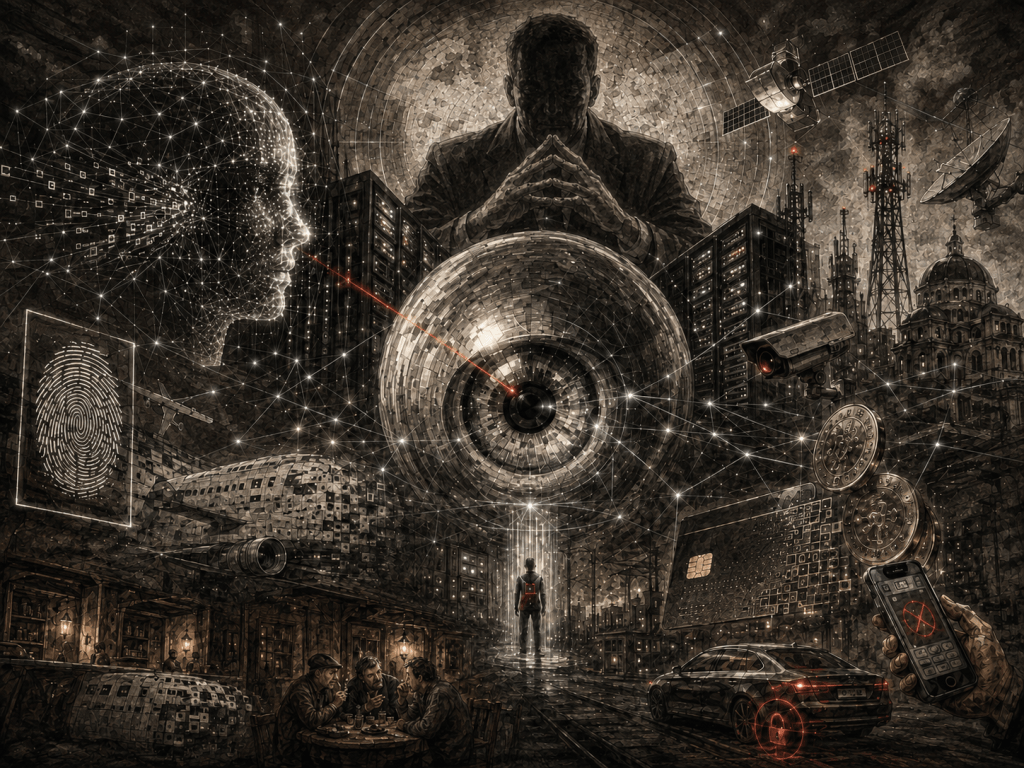
Three friends are talking in the Stara Srbija tavern.
“They’re threatening to kill our president again, and the two of you are making jokes,” says the domestic-affairs expert, firmly of the blockade-and-ćaci school. “I honestly don’t know how he doesn’t get tired of it.”
“Why are you surprised by him?” says the foreign-policy expert, visibly astonished. “Just look at America. They’re being led by an even bigger fool.”
“You two have obviously never heard of Peter Thiel and his company Palantir, have you? Now that is a madman operating at a high professional level — and far more dangerous than the amateurs we’ve just mentioned.”
One should not be too hard on tavern philosophers. For years, the life and work of the aforementioned “professional” have been almost a forbidden topic in mainstream media, while any mention of him is quickly dismissed as full-blown conspiracy talk.
Palantir is a data-analysis company that works directly with governments, intelligence agencies, and the militaries of the world’s most powerful countries. Its name comes from Tolkien’s The Lord of the Rings, where a palantir is an ancient seeing stone that allows its owner to see anything, anywhere, at any time. In short, the palantiri are the all-seeing eyes of Middle-earth. In Tolkien, they were created by the elves and intended for noble purposes. Outside literature, however, they have become a very dangerous business. Today, Palantir is an algorithmic force that increasingly shapes our lives, feeding the worst impulses and fears inside us.
At a gathering of leading technology figures, Peter Thiel, the founder of Palantir, reminded his colleagues of a biblical passage nearly two thousand years old. It says that a mark will be required on the right hand or on the forehead, and that without that mark no one will be able to buy or sell. This is known as the mark of the beast.
For centuries, people assumed this was only a biblical metaphor, a symbolic image through which ancient texts described power and control in a way believers could understand. No one at the time could have imagined the technological machinery — or the distorted ambition — that might one day try to pull such a vision into literal reality. Unfortunately, if we look carefully at what is happening around us, the day of “global branding” seems to be drawing closer. Naturally, it will be carried out in the name of “technological and general progress,” and most likely under the pressure of some carefully manufactured crisis. In short, we are becoming silent witnesses to a moment in human history that opens the door to a centralization of power unlike anything seen before.
To avoid being branded “conspiracy theorists” from the very first paragraph, let us begin with facts. And when the subject is artificial intelligence, all roads lead to one of its most prominent figures: Sam Altman.
THREE PATHS FROM THE SAME SOURCE
Last year, OpenAI began installing a device called the Orb. It is a silver sphere, roughly the size of a soccer ball, that scans the iris in order to create a biometric signature. The iris is one of the most unique parts of the human body and cannot simply be changed. Iris scanning is the first step toward obtaining what is called a “global identity card” — World ID — a digital proof that we are, in fact, human beings. So far, more than eighteen million people have voluntarily deposited their “eye signature,” and that number grows every day. In the world of artificial intelligence, this “global ID” is already being integrated into a growing number of applications and used as a substitute for passwords. Sam Altman, founder and CEO of OpenAI, has said that proof of human identity will soon be required on every website, in every application, and for every transaction on the internet.
At the same time, the United States has passed a new law, the so-called GENIUS Act, which creates a legal framework for the introduction of the digital dollar, or stablecoin. What separates digital currency from the money in our bank accounts is the possibility of programming it — attaching rules to where and how it can be spent, when it expires, and whether it can be used outside a designated area.
In parallel with the digitalization of global identity and currency, the World Economic Forum has emphasized the need to assign financial value to water, land, and even the air we breathe — and, in the very near future, to make all of it measurable.
While all of this is unfolding in real time, cameras, satellites, mobile-phone base stations, and artificial-intelligence data centers are being installed around the world on a massive scale.
This is a long-prepared global framework, and its final shape has been brought into sharper focus by Catherine Austin Fitts, a former official in the administration of U.S. President George H. W. Bush. According to her, the road into the future runs in three directions. The first is controlled digital money. The second is digital identity connected into a global, interoperable system. The third is global surveillance — Big Brother, who sees and knows everything. In other words, the future world will rest on three central pillars of power: programmable money, a global digital-identity system, and a system of tracking and control.
Mrs. Austin Fitts argues that once all three phases are complete, those who control the system — the central planners — will not need to obey the law in order to influence society. Nor will they need the police or the courts in the old-fashioned sense. If they want to impose something and the public, for whatever reason, refuses to accept it, they will simply be able to switch off an important part of the lives of the disobedient: money, identification, or the ability to buy, sell, and travel.
Taken separately, each part of this system can be explained in perfectly reasonable terms. Digital identity is convenient because, if you lose your ID card, your identity will still be available through your biometric data. Controlled digital money could reduce fraud. That, of course, sounds useful. Cameras can make the population safer. These are all valid and positive arguments. The problem is that all of these systems are being built together, at the same time, by interconnected institutions, and they will be used to manage a system that has never existed before. It is precisely their combination that makes possible a centralization of power without precedent in human history.
And one more thing: one of the main companies already building the infrastructure for data verification is the aforementioned Palantir, whose shares jumped 22 percent after the U.S. government signaled its willingness to support the development of its AI software.
CASH, CARD, OR SOMETHING ELSE?
At the moment, the dinar, euro, dollar, or any other currency in your bank account is only a number. There are no built-in rules attached to it. You can spend it when you like and on what you like. A bank may ask questions if you withdraw a large sum, but in essence, the money is yours. Programmable money is different because conditions are built into the currency itself.
Imagine receiving a salary that is valid only for a limited period before it expires. Or money that cannot be used to buy certain things — cryptocurrencies or meat, for example — because of environmental policy, or simply because energy has become too expensive. These rules may not come into force tomorrow, but the technology that makes them possible already exists, and the legal framework for implementing them is being built right now.
With the adoption of the GENIUS Act in 2025, an official regulatory framework for digital dollars was formally created in the United States. Catherine Austin Fitts points out that hidden within this law is a requirement that all issuers of digital currency be connected to the Department of the Treasury. Once that connection is established, it can be integrated with almost anything — including a social-credit system.
And what is a social-credit system? It is a score assigned to you on the basis of your behavior, somewhat like today’s credit history. The criteria are simple. If you pay your bills on time, your score goes up. If you cross the street outside a crosswalk, criticize the government online, or associate with someone the system has marked as problematic, your score goes down. Your score then determines what you are allowed to do, whom you may associate with, and where you may travel. A high score means access to better loans, greater mobility, and a freer life. A low score can prevent you from buying a plane ticket or getting certain jobs.
This model has already been tested in China. Once you end up on a blacklist, you may no longer be able to get a bank loan, start a business, or buy an apartment. Last year alone, in friendly China, more than thirty million airline and train tickets were blocked solely because of this system of evaluation. The government, of course, merely wants you to be “properly socially educated.”
The target of Big Brother is not limited to the United States and China. Christine Lagarde, president of the European Central Bank, recently stated that it is essential for the regulation establishing the digital euro to be adopted quickly. Money, then, is the first pillar — the foundation of the new system. But for that system to function, it must know exactly who is spending what and where. And that brings us to the second pillar: identity.
THE GLOBAL IDENTITY CARD
If our money is digital and governed by rules, then an efficient way is needed to apply those rules in everyday life. The system must know that you are really you, and not artificial intelligence. That means money and identity must be directly connected. The Bank for International Settlements, essentially the central bank of central banks, together with the United Nations, has published documents showing that global identity and central-bank digital currencies were designed to fit together.
Preparations for the global rollout of digital identity are part of a U.S. government program that supposedly aims to solve a real problem: how to identify human beings in a world increasingly filled with artificial intelligence. The answer they have arrived at is simple: an iris scan opens the global online space to you — and not only the online space. Tinder already uses it so users can know that the person they have matched with is real. DocuSign has implemented it so that contract signing can be authenticated. Zoom has adopted it so that you can know the person on the other side is real, even when you can already see them with your own eyes.
The true believers among skeptics will no doubt ask: how will they persuade people to accept all of this? The answer is simple. They will make it so practical, so useful, and so convenient in everyday life that people will voluntarily line up to hand over their biometric data — which is exactly what is already happening.
Once data has been collected and stored, it can become the subject of a court order. It can be hacked. It can even be sold. A privacy policy today does not guarantee what will happen to your data ten years from now, under different laws and different political circumstances. The collection of biometric data is already well under way. You have probably noticed that every time you travel, some part of your biometric identity is taken: fingerprints, facial recognition, or both. This has already become standard practice at many international border crossings.
In the next issue, we will examine the third pillar of global digital control over the population, and explain why, only a few years ago, this gloomy story now unfolding before our eyes was dismissed as just another insane conspiracy theory.


Leave a Reply