

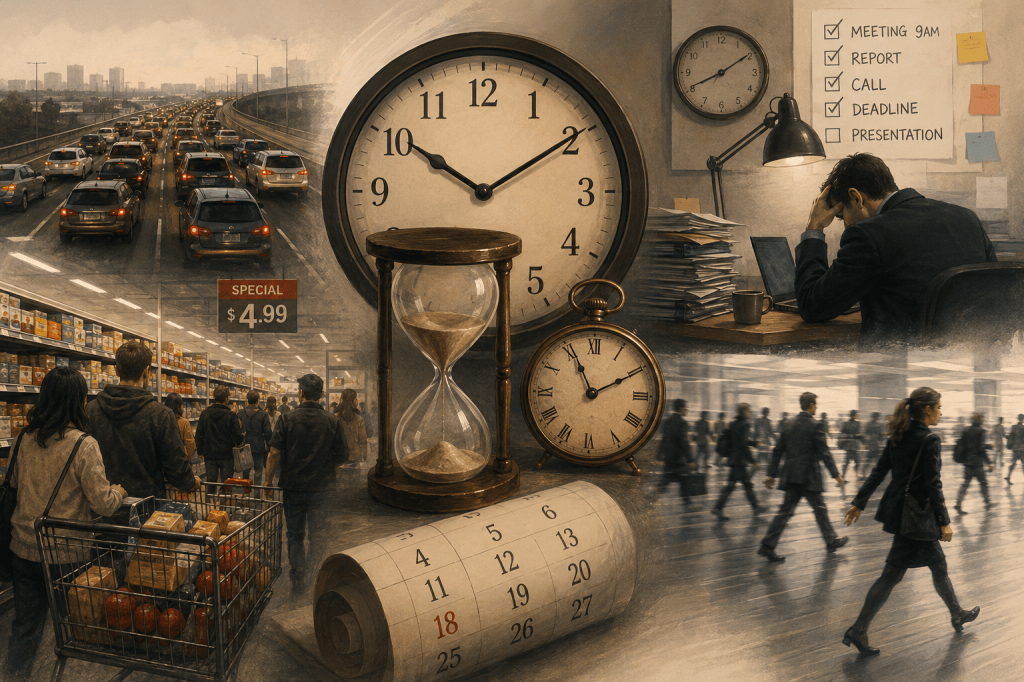
Late August, Saturday. A few more days and the electronic mailman will deliver my pension check. Traffic on the 101 moves forward two car lengths, then stops again. The driver of a black pickup keeps switching lanes, cutting people off and throwing himself around like a man personally betrayed by the highway, only to end up beside me again a few minutes later, looking even more irritated than before. A young woman behind the wheel of a silver Toyota is talking on the phone, touching up her makeup in the rearview mirror and loudly objecting to the existence of traffic. The driver behind me has pulled so close that I can see the color of his eyes in the mirror and what looks suspiciously like a cavity in one of his front teeth.
Everybody is in a hurry to get somewhere. I’m the only one with nowhere to be late to. That still feels strange. I quickly forgot the meetings with stern-faced bosses, deadlines that were due yesterday, children who had to be picked up from school, concerts my wife and I tried to reach straight from work through rush-hour traffic and clogged streets. For years I drove with the feeling that someone was waiting for me at the other end, already checking the time and wondering where the hell I was. Now I drive without worrying whether I’ll make it on time.
Back when I was working, I used to joke with my colleagues: “When I retire, I’m only going to drive during morning and afternoon rush hour. Slowly. Just to annoy all you working people trying to get to work.” We laughed. It didn’t take long for me to become that grumpy old bastard I used to complain about—the one I was convinced had left the house for no reason other than to make life miserable for decent, hardworking people. It turns out retirement doesn’t just change your daily schedule. It changes the color of traffic lights. Yellow is no longer your last chance to make it through the intersection. It is a perfectly reasonable suggestion that you might as well wait for the next green.
As the line begins moving again, I turn on the radio. Branimir Štulić’s voice comes through the speakers:
“Hard times for old men, my friend, our traces left upon the walls.
We circle like dogs, the girls no longer turn to look at us, their hair awakening longing.
The road to eternity is long, and we travel it silently and in peace.”
Some songs we listen to for decades without really hearing them until we finally reach the age they were written for. When the song came out, “old men” were somebody else. Men sitting on park benches, listening to transistor radios and gossiping about the neighbors. They had a past while I was busy racing toward the future. I used to think a person became old all at once, like crossing a border and having a customs officer stamp your passport. I didn’t know you crossed that border slowly. First you notice that professional soccer and basketball players are much younger than you. Then, somehow, the coaches start getting younger too. Eventually you realize you’re older than the commentators.
Johnny is singing, traffic is crawling, and for some reason I start thinking about Aristotle. Who else would come to mind in this heat? Another benefit of retirement, I suppose. When you’re working and stuck in traffic, you think about your quarterly performance review. Now I have the luxury of contemplating Greek philosophy. I have no idea what the pension system was like in ancient Greece, or whether Aristotle ever made it to retirement age, but more than two thousand years ago he was already asking a surprisingly troublesome question: What, exactly, is time?
While we are thinking about it, the past no longer exists. The future hasn’t arrived yet, so it doesn’t exist either. The present lasts for such a short time that before we can even call it by its proper name, it has already become the past. Aristotle wondered how time could exist if the things it is made of do not.
At first glance, this sounds like the sort of question people ask when they have far too much free time—or when they are determined to ruin their readers’ mood. But the more I think about it, the more I suspect Aristotle was merely trying to explain something every retiree eventually feels, even if we tend to use less intimidating vocabulary. Time, after all, isn’t money. You can’t borrow some from the neighbor or stuff it under the mattress for a rainy day. You can’t save it by driving faster, spending it at the office instead of in the park with your family, or eating lunch standing up while talking on the phone.
Aristotle connected time with movement and change. We recognize it, he argued, through what came before and what comes after. In other words, we never actually see time. We see the traces it leaves behind. A child outgrows last year’s shoes. A new crack appears in the wall. Photographs in an album begin to fade. We see change, and we call it time.
When you’re a child, summer vacation feels like a small eternity. June passes quickly because everything is still new. July is endless. By August you begin to sense that summer is running out, though September first still seems impossibly far away. You lie in the grass watching clouds drift overhead, and time simply refuses to move.
Later, we begin urging it along. We can’t wait to finish elementary school, turn eighteen, graduate from college, find a job, get married, have children. Once the children grow up, we race toward the next promotion, the bigger paycheck, the final mortgage payment. We are always convinced that real life will begin in the next chapter. We spend more than half our lives waiting for something to begin, and the rest trying to understand when it all ended.
Then one day there is no longer a major station ahead that you are waiting to reach. All that remains is the journey itself. And that is when the train seems to speed up. When you’re young and convinced you have all the time in the world, days move slowly. When you’re older and finally understand what time is worth, it begins slipping through your fingers. Maybe that’s why retirees are always checking their watches even though they have nowhere to be.
Traffic finally begins to thin. I leave the freeway and, after a few lights, pull into the supermarket parking lot. There I confront a question considerably more practical than Aristotle’s: Why the hell did I come here on a Saturday morning? I could shop Monday at nine. Tuesday at two. I could choose the day and hour when there isn’t a soul in sight, when every checkout lane is open and the parking lot looks like an abandoned airport. Instead, I have chosen the precise moment when everyone is here. Families with small children. People who work all week. Lost husbands clutching shopping lists…
Retirement arrives, but habits refuse to retire with you. For decades, Saturday was grocery day. The brain remembers that better than the calendar does. The car practically turns toward the store on its own, just as I still wake up in the morning at roughly the hour I once got up for work. There are no spaces near the entrance. I crawl between rows, watching people push overflowing carts toward their cars. The driver behind me honks. Once, I would have gotten angry. Now I wave and keep going. Maybe I am finally making good on that old promise: once retired, I would stop rushing and devote myself to irritating the employed.
Inside, I’m greeted by a blast of pleasant cold air, the smell of rotisserie chicken, and a crowd that makes it look as though some holiday has arrived without anybody bothering to announce it. A married couple is standing in the middle of an aisle debating whether they really need a thirty-six-roll package of toilet paper. The husband points out that it’s on sale. His wife reminds him that they already have enough toilet paper at home to last through the end of the year. “What if COVID comes back?” he says triumphantly, grabbing the package.
A little farther down, a mother is explaining to her daughter that she cannot have a doll simply because she happened to see it. The child, however, deploys the argument before which parental logic has been surrendering for centuries: “But Vanessa has one!” An older gentleman studies the nutrition label on a cereal box as if searching for a hidden clause in a mortgage agreement. A young man wearing headphones pushes a cart while answering work messages on his phone. Even here, somewhere between the canned beans and the laundry detergent, he is racing toward a brighter future.
And suddenly I remember my childhood. It isn’t that Serbia was one thing and America something entirely different. Today the differences are smaller than we like to imagine. Here and there, people hunt for bargains, buy more than they need, complain about prices and come home without the one thing they actually went out to buy. The real difference isn’t between “them” and “us.” It is between the time we remember and the time we live in now.
Back in the old neighborhood, Saturdays meant going to the open-air market, and not merely to buy food. You went there to be among people. My father would take a single shopping bag and announce in advance that we were buying only what we needed. My mother would come home with twice as much, every single item of which, according to her, had been absolutely essential.
At the watermelon stand, a special ritual began. My father would pick one up. Weigh it in his hands. Knock on it. Press an ear against the rind like a doctor listening to a patient’s lungs. The vendor watched solemnly, knowing better than to interrupt an expert at work. “This one’s good,” my father would say. “They’re all good,” the vendor would reply. “If it isn’t, I’m bringing it back.” We never did. Even when it was pale, watery and completely tasteless, we ate the whole thing, preserving both the dignity of the family and my father’s reputation as a connoisseur of watermelons.
Around us, people talked, bargained and traded gossip. Everybody knew who had gotten married, who had divorced, whose son had gone into the army, who had found a job—and, among the vendors, whose cow had gotten into whose cornfield. News didn’t arrive through Viber. It came with a kilo of tomatoes. I usually lingered near the newsstand across from the high school, studying the front pages of newspapers and comic books, calculating how much we would have to save on the new potatoes for there to be enough left over for the latest issue of Tex Willer.
Today I’m standing in an American supermarket surrounded by products from all over the world. I can buy seedless watermelon, cheese from France, coffee from Colombia, and plums that have traveled more miles than everyone I know put together. The choice is endless. Somehow, the flavors are different.
Maybe the market of my childhood wasn’t really so different from today’s supermarket. People went there with lists and came home with things they had never intended to buy. They argued about prices there too. Vendors insisted theirs was the finest produce in town; customers swore they had seen the same thing cheaper somewhere else. People haven’t changed that much. What has changed is the way we spend our time among them.
Shopping once took half a day, and nobody considered those hours wasted. Today we try to get everything done as quickly as possible, then become irritated because the line isn’t moving, the card reader is taking too long, or the man in front of us is counting out his change to the last penny.
I reach the checkout. Four customers ahead of me. I look at the next lane. Only three. I switch. Naturally, the woman at the front of my new line has coupons and a great many questions for the manager. The line I abandoned immediately begins moving at remarkable speed. Some things even retirement cannot change.
While I wait, I watch the young man in front of me. He holds his phone in one hand and unloads his cart with the other. He checks the time, sighs, and calculates with his eyes how much longer it will take him to reach the register. I know that expression. I wore it for years. The impatience of a man convinced that somebody is stealing ten minutes of his life. I want to tell him not to worry. He’ll finish his shopping. He’ll get to work. He’ll come home. He’ll raise his children, pay off his loans, and one day he’ll have enough time to stand in this very line without feeling the need to hurry the cashier. Of course I say nothing. He wouldn’t understand. I wouldn’t have understood some old man giving me the same lecture thirty years ago either.
I leave the store and push my cart toward the car. The heat hasn’t let up, and neither has the traffic in the parking lot. A car is waiting for my space. The driver has both hands on the steering wheel and follows my every movement. I could move a little faster. Instead, I slowly arrange the grocery bags in the trunk. Not out of spite. Simply because, for the first time in many years, I can.
As someone honks in the distance, I think again of Štulić’s lyrics, of Aristotle, and of all those stations in life I once couldn’t wait to reach and leave behind. The past no longer exists. The future hasn’t arrived yet. The present doesn’t last long. But sometimes it lasts just long enough for a retiree to return his shopping cart without hurrying.


Leave a comment