

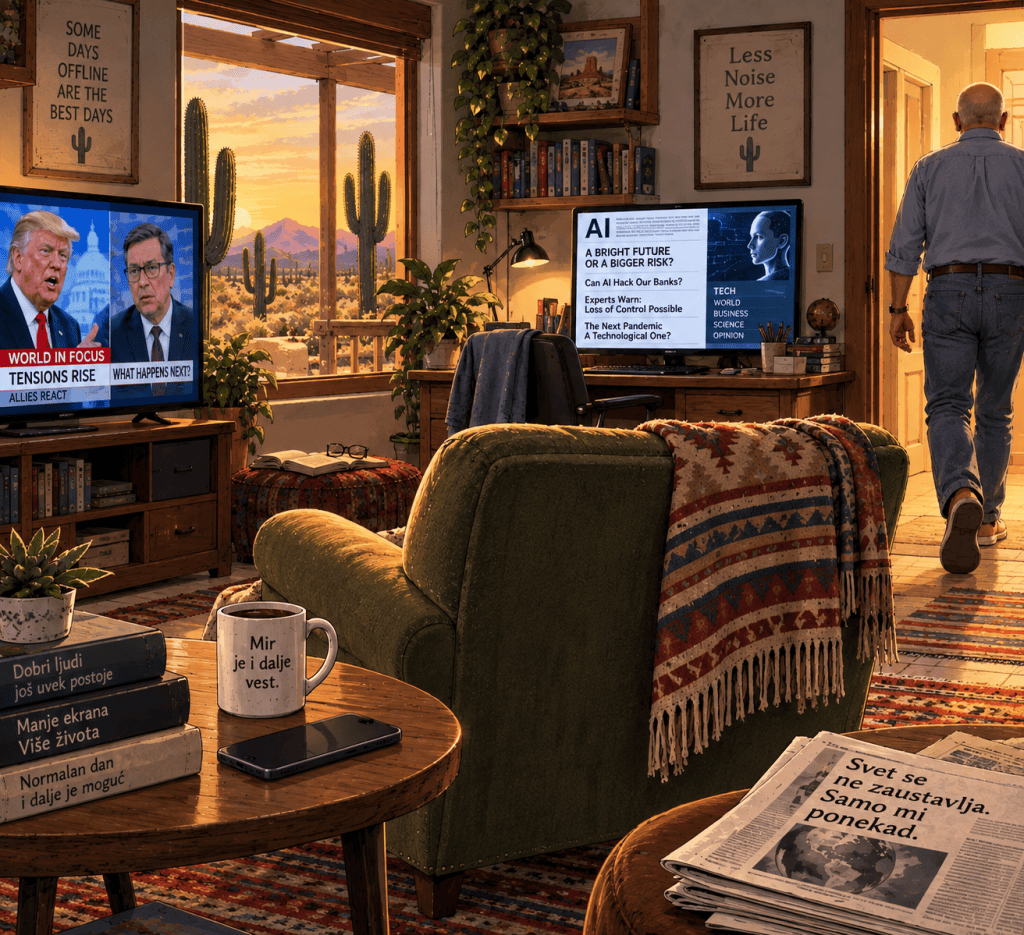
I decided to go an entire day without reading, listening to, or watching the news. Not for political reasons, but purely for health. At my age, a man has to keep an eye on his blood pressure, blood sugar, cholesterol, and the amount of political nonsense he allows into his system before breakfast. I can still manage the first three. It’s the fourth one that has been giving me serious trouble lately.
The experiment began at seven in the morning, with my first cup of coffee. I left my phone facedown on the table, like a syringe an addict has reluctantly set aside for later. The television stayed off, the laptop closed. That morning I was taking a break from America, Serbia, Europe, the Middle East, and artificial intelligence. If the world had chosen that particular day to fall apart, so be it. Or, to borrow the title of that wonderful film — Let It Fall, It Won’t Be Missed. At seven twenty, I felt terrific. Twenty minutes later, I was already wondering what on earth might be happening out there. By eight, it was time for my first minor violation: the weather forecast. That didn’t count, obviously. Weather isn’t news. It’s meteorology. Several notifications were waiting at the top of the screen. One began with “Trump…,” another with “Vučić…,” and a third with “Breaking news…” I opened none of them. I was genuinely proud of myself. When I was younger, I quit cigarettes. Later came alcohol and sweets. Apparently, I have now reached the age when a man tries to quit politicians.
By nine, I had already discovered how long a morning can be when you have no idea what happened overnight, especially when Arizona is a full nine hours behind Europe. After coffee, I tended to a few plants in the yard and then, for no particular reason, moved on to the refrigerator. Open it, look inside, close it. Five minutes later, come back, perhaps hoping something new might have appeared in the meantime. Nothing had. The refrigerator has long been the only source of information I trust completely. By nine thirty I had ended up at the grocery store, where I discovered that cutting yourself off from the news is much harder than it sounds. News is everywhere: on your phone, on screens, on the radio, in headlines that catch your eye while you’re trying to find coffee on sale. In the end, all it takes is the guy ahead of you at the checkout turning around and asking:
— Did you hear what he said this time?
— No. And I don’t want to. At least not today.
IGNORANCE IS NO EXCUSE
Only after you stop working do you discover freedoms you never gave much thought to before. You can open a book in the middle of the day and lose track of time, watch a movie at two in the afternoon, or spend hours researching something that serves absolutely no purpose beyond the fact that, at that particular moment, you happen to find it interesting. A call from the grandkids no longer has to be squeezed between two obligations, and you can change your plans without explaining yourself to the proper authorities. That morning I was trying out another one of those freedoms: spending a few hours without the slightest idea what the distinguished politicians of my two countries had said the night before. Once upon a time, that was called normal life. Today it qualifies as a political position. By noon, though, I was beginning to have doubts about my experiment. Missing a day of whatever Vučić or Trump has said isn’t really the problem. The problem is that these days you can never be sure whether something that sounded completely deranged yesterday will become government policy, a new law, or an economic measure tomorrow.
For years, I believed Serbia held a comfortable lead over the so-called democratic world in the competitive sport of political absurdity. We had perfected the culture of presidential addresses, emergency press conferences, historic decisions, and fateful days after which nothing would ever be the same — except, of course, that everything continued exactly as before. Whenever Vučić says something and half of Serbia thinks surely this is as far as it can go, Trump appears on another continent to demonstrate that it most certainly can go farther. I don’t know whether the two of them are competing, but if they are, we citizens have become referees who lost their cards a long time ago. Some say it’s because they have the same “advisers,” but that is another story altogether. The problem is no longer what politicians say. The trouble is that we have stopped being surprised. There was a time when a head of state could say something unimaginable and people would discuss it for days. Now one absurdity barely has time to shock us before the next one pushes it off the front page. Wisdom, sadly, has become a kind of political fossil. We know that decent people in presidential offices once possessed it; there are even written records to prove it. But no one seems to have encountered a living specimen in quite some time.
Things become particularly interesting when politics gets hold of money. In Serbia, we have long been accustomed to the government somehow becoming more generous as elections approach. Suddenly, money appears for retirees, young people, low-income families, one-time payments, and vouchers. The public treasury develops a sudden attack of philanthropy just as citizens begin wondering whom they might vote for. The money, of course, belongs to the state — which is to say, to the people — but somehow the gratitude always ends up at a private political address.
America, having perfected so many other things, apparently decided this particular discipline could use some improvement as well. Trump recently offered five thousand dollars to voting-age Americans if his party wins the November election. I have to admit that, as a retiree, I immediately became somewhat more politically flexible. Five thousand dollars is not pocket change. For that kind of money, a man can buy a new stove, fix his car, take a decent trip, or spend several months successfully convincing himself that his vote had absolutely nothing to do with the money. Still, a man’s honor is not for sale. That is one of those things we particularly enjoy saying before anyone has made us a specific offer. Mine, apparently, is five thousand dollars. I gave it some thought, added up my years, my principles, and my bank balance, and decided to decline. My honor remains intact.
In Serbia, we somehow do it with more romance. You receive the money, but no one explicitly tells you what is expected in return. It’s like an aunt slipping you an envelope before your wedding. There’s no contract, but everyone knows her child will be getting married soon enough. America is more practical: if we win, you get five thousand dollars. That’s no longer buying votes. It’s a loyalty program. Granted, it may be slightly illegal, but let’s not get hung up on technicalities. The next logical step is an app: collect ten Republican victories and the eleventh one is free.
By one in the afternoon, I was beginning to suspect that my news fast was doing me more harm than the news itself. When you don’t know what is happening, imagination begins filling in the blanks, and in recent years even the wildest imagination has lost its competitive advantage over reality. Who could have imagined the far right winning elections in Germany, the war in Ukraine still grinding on, and people in Gaza still dying beneath the rubble while the world, from a respectable distance, debates what their horror ought to be called? There was a time when the first of those sentences alone would have awakened uncomfortable historical memories, the second fear, and the third shame. Instead, the wealthy check the markets, politicians check their poll numbers, and everyone else keeps scrolling through Instagram and TikTok.
This is where the jokes stop. There are stories a person can laugh about, and others before which humor ceases to be a defense and becomes an escape. That morning in Arizona, I could turn my phone facedown and decide that for a few hours I simply didn’t want to know what was happening. Somewhere else, people were being awakened by sirens and explosions. They couldn’t switch off the war, mute it, or save it for later. All I had to do was look away from a screen. What I didn’t want to see was happening outside their windows.
A PRODUCT THAT KILLS THE “CUSTOMER”
Around two o’clock, I made a mistake and opened my laptop. I wasn’t planning to read the news. I wanted to do something completely different. Of course, a person always “just wants to do something completely different” a few seconds before ending up exactly where he promised himself he wouldn’t go. A story about artificial intelligence appeared on the screen. I allowed myself that one. Artificial intelligence isn’t politics, I decided. Three minutes later, it turned out I had found a subject even more cheerful than politics.
For several years now, the people developing the world’s most powerful artificial-intelligence systems have been sending us a rather unusual message. We have created something extraordinary. It will change the world. Invest as much money as possible. Our companies will be worth astronomical sums. Oh, and by the way, there is a chance that one day we may lose control of the thing. It is a fascinating business model. There was a time when a manufacturer who discovered that his product might kill the customer would recall it. Today he calls a press conference: “Our new model is twenty times more powerful than the previous one and can solve problems humans cannot. There is, incidentally, a possibility that one day it may conclude that humans are no longer necessary. Subscription: $29.99 a month.”
The richest people on the planet are pouring enormous sums into a technology whose dangers they simultaneously warn us about. It’s like a salesman handing you a chainsaw and casually mentioning:
— Just so you know, there is a possibility it may come looking for you at night.
— What’s the warranty?
— Two years.
— I’ll take it.
What worries me less, however, is the chainsaw itself than the people telling us what we should be afraid of. For years now, we have heard warnings that artificial intelligence might one day slip beyond our control, take down the electrical grid, attack the banking system, or trigger a crisis unlike anything the world has ever seen. Those dangers are not imaginary: today’s systems already possess cyber capabilities serious enough that the companies building them are strengthening their own defenses. But another possibility keeps nagging at me, one that may be even more unsettling. What if one day there really is a major technological crisis — but artificial intelligence didn’t cause it? What if someone takes down the grid, freezes the banks, or creates enough chaos, and then tells us that a rogue AI agent was responsible? The pandemic already taught us how quickly an emergency can redraw the boundaries of what governments are allowed to demand of their citizens. The next one may not come from a laboratory or a marketplace. It may come from a server.
I’m not saying this will happen. But when someone spends years preparing me for catastrophe, I begin thinking about what might follow it as well: emergency powers, surveillance, restrictions that were politically unthinkable yesterday and become acceptable tomorrow because, after all, we are in a state of emergency. A technological pandemic wouldn’t have to infect us. It would only have to frighten us.
At three in the afternoon, my experiment officially collapsed. I went back to the news the way a man breaks a diet: he doesn’t eat one scoop of ice cream, he eats three, then consoles himself with the thought that on Monday he will become a man of character again. Within twenty minutes I had caught up on everything I had missed. Politicians were arguing, wars were continuing, markets were reacting, and everyone, as usual, was on the right side of history. History, naturally, had not been consulted. The world had managed perfectly well for several hours without my supervision. I found that mildly insulting.
WISDOM AS BREAKING NEWS
By early evening, I realized I had designed the experiment badly. The real question isn’t whether a person can go twenty-four hours without the news. Of course he can. The much harder task is following it every day without allowing it to ruin your view of the world — or, worse, completely reshape it. So how do you stay informed without losing your mind? I still don’t have an answer. Perhaps news should come with a recommended daily dosage: one Trump with breakfast, half a Vučić before lunch, never consume wars on an empty stomach, and artificial intelligence only under adult supervision. Social media should be available by prescription only.
My phone was lying on the table again, this time faceup. The experiment had lasted less than eight hours. Not bad for a beginner. But perhaps the real problem isn’t that every day we read about political madness, wars, death, threats, and catastrophe. The problem begins when none of it surprises us anymore. Once the abnormal becomes normal, propaganda is no longer necessary. Habit will do the job.
I picked up the phone. Tomorrow I’ll try again, but not by ignoring the news. I’ll attempt something much harder.
I’ll try to find one story in which somebody said something intelligent.


Leave a comment