

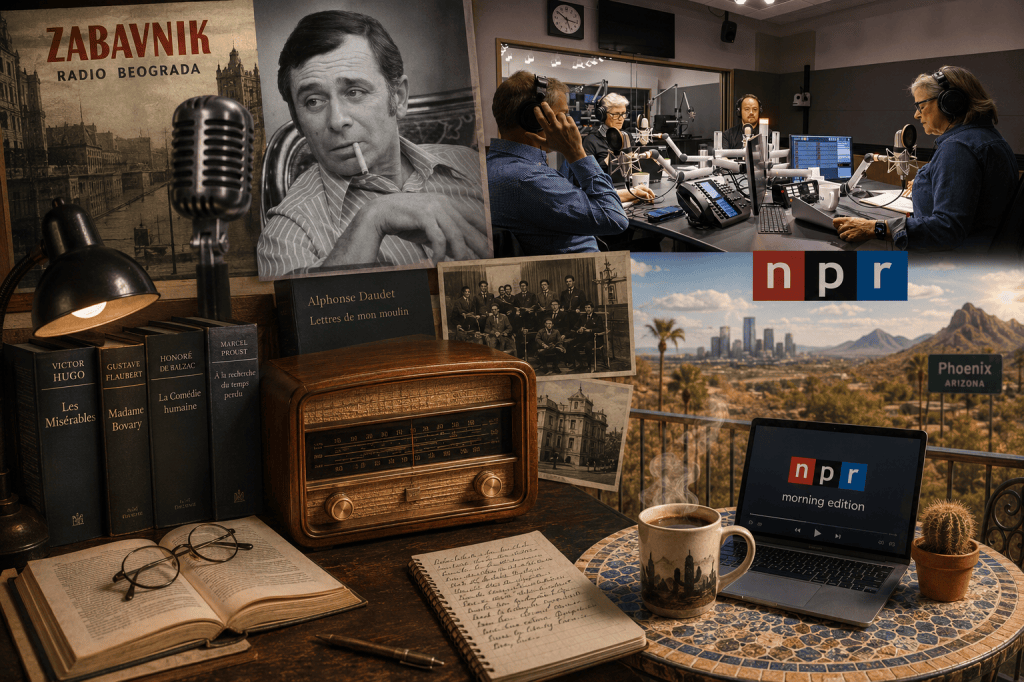
When I was a student, I thought books were where knowledge came from. It took me years to realize that all along, the radio had been studying right beside me. Studying was fairly straightforward in those days. You sat down at a desk, opened your notes and kept at it until the letters began swimming before your eyes. There were no shortcuts, no miraculous techniques for memorizing things in half the time. And when something had to be done, you somehow found a way to do it.
Books covered the desk. Beside them sat an ashtray, a ballpoint pen and a large mug of coffee. In the corner of the room was the radio. It stayed on almost all day, playing softly enough not to interfere with my studying but loudly enough to keep me from feeling alone. It was simply there, like a clock on the wall. You paid no attention to it, yet somehow you knew it was working.
RADIOSKOP
Around ten, when drowsiness slowly gave way to concentration, Radioskop would begin. It was a program about film, music, literature, theater, exhibitions and concerts—in short, about the entire world that, during exam season, would simply have to wait. While other people discussed Bergman, Wim Wenders or Haustor’s first album, I was busy trying to persuade Victor Hugo, Flaubert, Balzac and Proust to explain one more time what my professor had clearly failed to get across in class. The radio talked. I studied. Or so I thought.
In the evening, when we gathered at our usual bar, one friend would take over. There wasn’t a new movie he had missed, an album he hadn’t heard or a book he didn’t have an opinion about. He knew what the band Mizar was working on, why Tarkovsky had changed the art of filmmaking, who De Niro had fallen in love with, what was happening on the European theater scene and which exhibition simply could not be missed. He was our resident authority on culture, a walking encyclopedia, and we listened to him in awe.
There was no Google in those days. If there had been, our friend would probably have corrected it from time to time. Every now and then, though, I had the strange feeling that I had heard all this information somewhere before. Not word for word, perhaps, but the names were familiar, the stories vaguely recognizable—like trying to remember a dream that keeps slipping away the moment you open your eyes. I blamed it on exhaustion from studying, but a few days later the same thing would happen again. Eventually, the mystery of the things I had somehow “heard before” was solved. And this is how it happened.
One day, after passing a particularly difficult exam, I was too exhausted for either books or the bar. I stayed home, made some coffee, shoved my books under the table and, for the first time in months, decided to actually listen to Radioskop. The host introduced Azra’s new album. Then came a piece about Kurosawa. A story about Meryl Streep. Something about a new theater production. Finally, an exhibition by a young Portuguese painter.
I sat there stunned. It was as if I weren’t listening to the radio at all, but to my friend from the bar. Only then did it occur to me that I hadn’t dreamed those stories about art. I had heard them before without realizing I was listening. The radio had been telling its story while I read mine. We had spent all those hours in the same room, apparently ignoring each other.
That evening I went to our usual place, ordered a drink and waited. For the first time, I wasn’t curious about what our resident know-it-all was going to tell us. I already knew. I only wondered what order he would choose. Everyone was there, beers on the table, when the evening’s unofficial cultural briefing began.
“Have you heard the new Azra?” I nodded.
“They say you either love Kurosawa or you don’t understand him at all.” I nodded again.
Then came Meryl Streep. Then the theater. Finally, the Portuguese painter. He followed precisely the same order in which Radioskop had aired the stories a few hours earlier.
I didn’t have the heart to interrupt him. Quite the opposite. Suddenly I respected him much more. For months, I had let the program drift through my room like the hum of a refrigerator or the ticking of a clock. He had actually listened. I could almost picture him sitting beside his radio with a notebook on his lap, carefully writing down everything he would later turn into his own opinions. He may have been the first person I ever knew who had a podcast long before podcasts were invented.
From then on, I listened to radio differently, because I had begun to understand that behind all those voices were actual people. Every host had a different rhythm, different pauses, little habits that belonged to them alone. One spoke quickly, another slowly. One could say a great deal by remaining silent for a few seconds, while another read every piece of news as though he had just been handed confirmation that World War III had begun.
I realized that a radio wasn’t merely a box that dispensed information. It was a talkative companion that never demanded your attention. Being in the same room with you was enough. It stayed with me while I studied, prepared for exams, made coffee or wrestled with the great dilemmas of life in Yugoslavia—whether that summer we should vacation in Makarska or Poreč. It never imposed itself. It was patient. Perhaps that is why I never felt I was listening to it, even though those were the years when it taught me the most.
NPR
Years later, on another continent, I found my radio again. This time it was tuned to National Public Radio.
When I came to America, I spoke decent English. I could buy bread, open a bank account, explain to a police officer why I had taken the wrong turn, or tell a doctor where it hurt. But it still wasn’t a language I thought in. It was a language I managed in. You learn a foreign language when you can put together a correct sentence. You begin to understand a people when you know why someone laughed, or when you can hear irony in the tone of a voice rather than having to find it in the meaning of the words.
No language course taught me that. Radio did. More precisely, National Public Radio.
At first I listened every morning, usually while driving to work. I turned it on the moment I pulled out of the garage and switched it off only when I reached the office parking lot. I listened to NPR during my lunch break and occasionally, on the sly, during working hours when the bosses were in meetings. I never felt as though I were studying English. I was simply listening to people talk.
And they talked differently from what I was used to. They didn’t shout over one another. They didn’t finish each other’s sentences or interrupt someone just to give their own answer. They spoke calmly, clearly, with a kind of old-fashioned civility that had somehow survived the newer trends in broadcasting.
Over the years I changed jobs, addresses and countless everyday habits. Phones changed. Cars changed. Presidents changed. Only the radio remained tuned to the same station. I’m not claiming NPR was flawless—no news organization is—but it became the one I felt most at home with. Perhaps because I had grown up with radio that also knew how to listen to its guests.
Sometimes I think radio lost its battle not because of the internet, but because it got scared. At some point somebody calculated that it was cheaper to play fifty songs than to pay one good editor or host. That a playlist was safer than a program. That people would stay on the same frequency anyway. They were wrong.
People never stopped wanting to hear voices. They simply went wherever the voices had gone. Today we call it podcasting. Radio gradually surrendered the spoken word. The music stayed. The commercials stayed. The voices disappeared, and little by little, so did the listeners.
Now that I no longer have anywhere to rush to, I make coffee on Saturday mornings, step out onto the patio and turn on NPR, in the leisurely manner appropriate to a retiree. Once, I turned on the radio to keep me company while I studied. Today we keep each other company over my first cup of coffee. An entire lifetime fits between those two habits. Sometimes I listen carefully. Other times my thoughts wander. And every now and then, something unusual happens.
Between two serious news stories, a short jazz interlude and an interview with a librarian from some small town in Iowa, I hear a brief burst of static. The same kind I heard as a child while searching for Radio Belgrade. It lasts only a moment, just long enough to make me think the signal has somehow gone astray.
First, silence. That peculiar radio silence that makes you instinctively glance at the receiver.
Then static. The old kind, like a needle slowly moving across a dial in search of the right frequency. And then… A voice.
ZABAVNIK
“Good afternoon, dear listeners. Radio Belgrade’s Zabavnik is about to begin.” I put down my coffee.
I didn’t move, afraid that a single gesture might break the connection between two Saturdays separated by more than four decades. The voice was the same.Warm. Calm.
“Today is Saturday, December 5, 1982.”
A short theme played. Then, in the same composed voice, as though nothing unusual had happened:
“On this day… One hundred and seven years ago, Rainer Maria Rilke was born, the poet who believed that childhood is our only true homeland. Walt Disney was also born on this day, the man who proved that a mouse could become more famous than many kings. Tickets are still hard to come by for The Marathon Family, while around the world people are talking about a new film by a young American director named Steven Spielberg.”
I smiled. Everything was exactly as it should be. Then…
The voice paused for a moment, as though the announcer had discovered a sheet of paper in front of him that wasn’t supposed to be there.
“In Kragujevac, it is a cold December day. A seventeen-year-old boy is wondering whether to go out with his friends tonight or stay home and listen to the radio. He has no idea that forty-five years from now he will be sitting on a patio in Arizona with a cup of coffee in his hand, or that an entire life will somehow be packed between these two Saturdays.”
I didn’t know whether to smile or be frightened. But Đuza didn’t sound surprised in the slightest. He might just as well have been reading the weather forecast.
“And now, as we do every Saturday, we open the doors of our Opera Box…”
From the Opera Box came the familiar voices of Slavko Simić and Milutin Butković. The eternal argument—whether one should say “in the box” one way or another. Some questions, apparently, never grow old. Then the static returned. Brief. Barely audible.
And suddenly the familiar NPR host was back, as though nothing had happened.
I sat on the patio for a while longer. My coffee had gone cold. A neighbor was walking his dog. Someone was watering the lawn. Somewhere in the distance, a plane passed overhead. Arizona was slowly waking up. The radio kept playing.
People sometimes ask why, with the internet, podcasts and every imaginable app at my disposal, I still insist on listening to the radio. I never tell them the real reason. How do you explain that I don’t turn it on for the news? I turn it on for hope.
For that childish hope that somewhere between two frequencies I might once again hear the voice of someone who left the program long ago, but never quite left my life. As a child, I was convinced that people lived inside that wooden box. Later I learned that wasn’t true. Today I’m no longer so sure. Because every time I hear the old hiss of radio static, an old Saturday comes alive again: a student’s desk, a bar, a country that no longer exists, and a young man who has yet to discover how profoundly the voices coming out of an ordinary box will change his life.
I turned off the radio. The static disappeared. The voice remained.


Leave a comment