

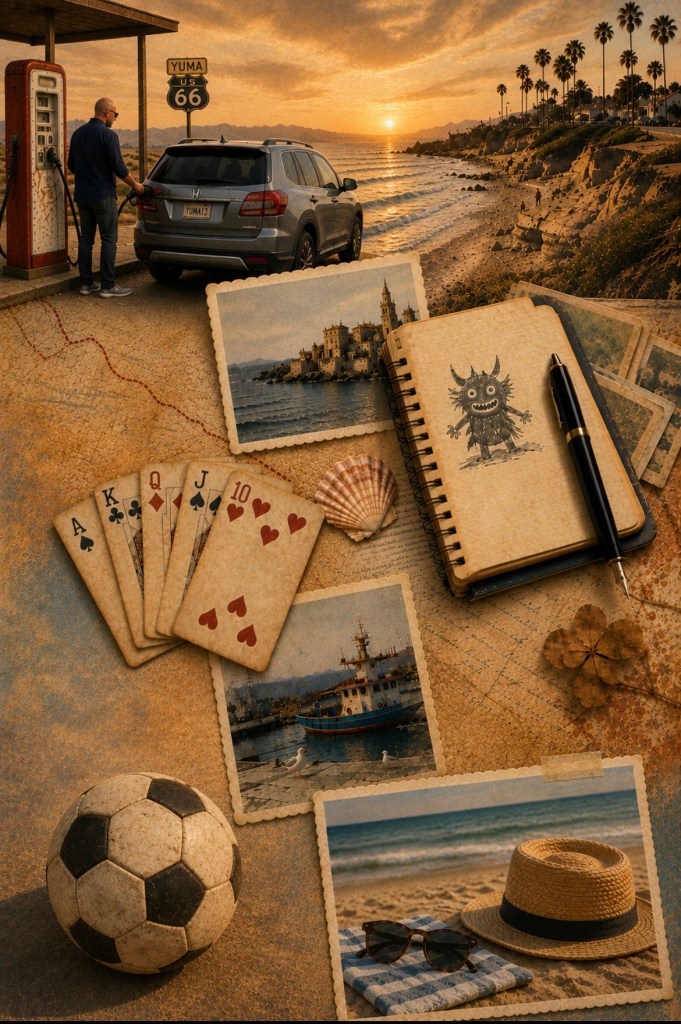
We spent our summer vacation in San Diego again this year. It was a Saturday. We left Phoenix in high spirits and reached Yuma right on schedule.
To anyone who loves Westerns, that may sound like destiny. To an Arizona retiree, however, it meant something much more practical.
It was time to fill up the tank.
Yuma is your last chance to enjoy Arizona gas prices before crossing into California, where gasoline is apparently refined from a far nobler grade of crude—possibly hand-crafted and aged in oak barrels.
As I stood by the pump, 3:10 to Yuma came to mind. I wasn’t expecting either Glenn Ford or Russell Crowe to walk out of the convenience store, but I checked my watch anyway.
It was 3:10.
A man my age learns to respect little signs like that, especially when they give him permission to polish reality ever so slightly in his diary.
I topped off the tank and headed west.
San Diego has long since become part of our family’s internal geography. It is one of those places we are always happy to visit and never quite ready to leave. Some cities greet you with monuments and museums. San Diego simply reminds you to slow down. The Pacific on one side. Palm trees on the other. Sailboats scattered across the bay. Seagulls behaving as if they hold the deed to the entire coastline. And weather that allows people from Phoenix, for ten glorious days each year, to discover that air can exist without first being preheated to one hundred degrees.
This time the whole family was there: three daughters, three sons-in-law, three grandchildren, and only one wife—though an exceptionally valuable one. Mine, naturally.
In a family gathering like that, a man quickly discovers where he stands in the chain of command. My official responsibilities included organizing beach soccer tournaments with my grandson, reading books, enjoying retirement, and—just to make sure leisure didn’t corrupt my character—taking out the trash. In a temporary household of eleven people, garbage accumulated at something very close to an industrial pace.
Morning walks. The beach. A little soccer. A good book. A boat ride around the bay. La Jolla. Lunch. Back to the beach.
Life suddenly became wonderfully uncomplicated.
Where’s the sunscreen?
Who brought the water?
Where are the kids?
Whose towel is this?
And, above all:
Who’s taking out the trash today?
The answer, remarkably, never seemed to change.
Grandpa.
One afternoon I was sitting on the patio with a book resting in my lap. A short distance away, three young men were playing cards. I’ve never been much of a gambler, and playing cards has never particularly appealed to me. But if I had been born with that weakness, I suspect I would have played Preferans, the old Balkan card game.
My regular partners would have been two formidable ladies—strict, relentless, and only occasionally fair.
Their names were Lethargy and Nostalgia.
Between one hand and the next, we would invariably be joined by a nervous gentleman called Regret. He had an irritating habit of reminding me how young I used to be.
I have no idea how the score would have been kept, but I suspect I would have spent most evenings losing.
As the three of them calmly bid for the trump cards of my destiny, I decided it was time to change the rules altogether. I rummaged through old memories, took inventory of a lifetime’s worth of recollections, and wandered back to the days when I was everything I no longer am—young, handsome, thick-haired, and brilliantly intelligent.
Well…
The last claim remains open to historical debate.
The Adriatic
I remember it as if it had happened yesterday. It was 1970. Our family’s first summer vacation. Budva. On Mogren Beach I swam in the sea for the first time and made one of the great scientific discoveries of my childhood.
Sea water really is salty.
Adults had been telling me that for years, but I belonged to a generation that preferred to verify important claims experimentally. I swallowed enough of the Adriatic to confirm the theory beyond any reasonable doubt.
What I remember from Budva has very little to do with what travel guides usually celebrate. I don’t remember the old town, its history, or its architecture. I remember the sea. The scorching pebbles beneath my feet. A towel that never quite managed to get rid of its sand. I remember Cockta. And Yupi. Especially Yupi.
One evening, after working my way through what must have been ten bottles of Yugoslavia’s proud contribution to the world of soft drinks, I thoroughly soaked the bed.
“Poor thing,” my mother said. “He wet the bed.”
Easy for them to laugh.
I was devastated. Frightened at first, then hopelessly embarrassed, I searched for an explanation that might save my dignity. I came up with a nightmare so terrifying that even I almost believed it. Monsters, ghosts, witches, and several assorted bogeywomen chased me through the darkness. I added a few extra creatures in the interest of my own defense.
My parents pretended to believe every word. My mother ran her hand gently through my hair while my father offered a piece of advice that quietly shaped the rest of my life.
“Whenever you have a bad dream, write it down. Every monster. Every ghost. Every witch. Fill a notebook with them. Then close it, press the covers together as hard as you can, and punch it three times. When you open it again, they’ll all have turned into words.”
I have no idea whether they understood what they had just set in motion. I’ve been writing ever since.
For more than half a century I’ve been trying to turn monsters into words. Some of those monsters were imaginary. Some were painfully real. Others merely changed their shape. I still like to believe that words possess a quiet kind of magic—that if we choose them carefully enough, they can make even our darkest fears a little less frightening.
That summer, though, life was wonderfully uncomplicated. My parents decided when we went to the beach and when we came back. They worried whether I was hungry, thirsty, sunburned, or swimming too far from shore. My only responsibility was to be a child. At the time, I had no idea what an extraordinary privilege that was.
The Black Sea
Twenty-eight years passed.
It was the summer of 1998. Once again we were heading for the sea, only this time I was behind the wheel. My wife sat beside me, and our three daughters occupied the back seat.
Somewhere along the way, one of life’s quietest transitions had taken place—the kind nobody announces. One summer you’re the child someone else takes to the seaside. Then, almost overnight, you’re the one packing the bags and making sure everyone remembered their passports.
The drive from Kragujevac to Burgas was just under seven hundred kilometers. We crossed half of Serbia and nearly all of Bulgaria at a time when GPS didn’t exist. Instead of a pleasant electronic voice telling us to turn right in two hundred meters, we had a map. A large paper map that unfolded to roughly the size of a dining-room table and demanded almost as much attention as the road itself.
Traveling seven hundred kilometers with three young children also teaches you something about the relativity of time. Einstein insisted that time depends on the observer. Any parent who has ever driven across two countries with small children could have explained the theory in much simpler terms.
“Dad, when are we going to get there?”
“In a few hours.”
Five minutes later:
“How about now?”
Eventually, we did.
Burgas. The Black Sea. And the home of our landlady, Zoya, and her husband.
The English word landlady doesn’t quite do her justice. Back home, a gazdarica was never just the person renting you a room. She was an institution. She knew where to buy the freshest bread, which fruit stand charged less than the others, the quickest path to the beach, the restaurant to avoid, and the one you absolutely had to try before going home.
We had a wonderful holiday. The girls spent every possible minute in the water. The sea was still salty, although by then I no longer felt the need to test the fact personally. Within days, Zoya and her husband stopped being the people we rented a room from.
They became our friends.
We returned home carrying swimsuits, photographs, and enough memories to last until the following summer. None of us imagined that only a few months later the world would begin rearranging itself.
By the next spring, we were no longer discussing where to spend our vacation.
We were trying to figure out where our children might be safe.
The bombing had begun.
The monsters from my childhood notebook had long ago been turned into words. Life, however, has an unsettling talent for inventing creatures far more frightening than anything a child could dream.
Then the phone rang.
It was Zoya.
“Come here,” she said. “Stay with us.”
There was nothing ideological about the invitation. They didn’t offer geopolitical analysis. They didn’t debate who was right, who was wrong, what politicians were saying, what television claimed, or what generals might decide next.
They had a house.
We had children.
As far as they were concerned, that settled the matter.
Only a year earlier we had crossed the same border carrying inflatable swim rings, plastic buckets, towels, children’s toys, and all the countless things families believe are essential for a successful vacation.
Now it was the same family.
The same children.
The same border.
Only the reason for crossing had changed.
They wouldn’t let us in.
Fearing a wave of refugees from Serbia and Kosovo, the Bulgarian authorities closed the border. Somewhere between government regulations, politics, fear, and the heavy thud of a passport stamp, our family’s quiet rescue plan came to an end.
Zoya and her husband waited on one side.
My family stood on the other.
Sometimes the distance between hope and disappointment is no more than a few yards of asphalt and a lowered barrier.
After that, I never remembered Burgas because of the Black Sea.
I remembered it because two ordinary people had been willing to open the door of their home when we needed one most.
Perhaps that’s why I become a little suspicious whenever someone starts dividing entire nations into friends and enemies, good people and bad people.
Nations are abstractions.
Zoya wasn’t.
She had a name.
A face.
A front door she was ready to open.
And a heart big enough to make politics seem very small.
The Pacific
“Grandpa!”
A child’s voice brought me back to San Diego.
The book was still resting in my lap. The three young men were still playing cards on the patio. Across from them, my own familiar trio seemed ready to resume our endless game. Nostalgia was dealing. Lethargy looked thoroughly bored. Regret tapped his fingers impatiently on the table.
I had no time for any of them.
The family beach soccer tournament was about to begin.
We marked the goals with flip-flops and divided into teams according to rules that seemed to change whenever the score became inconvenient. As one of the organizers—and by far the oldest registered player—it fell to me to guarantee the integrity of the competition.
The grandchildren quickly concluded that Grandpa was a highly unreliable referee.
The protests were frequent.
VAR, unfortunately, was out of service.
At one point the ball rolled toward the water, and my grandson ran after it.
“Don’t go too far!” I called.
Then I stopped.
I’d heard those words before.
On Mogren Beach.
More than half a century earlier.
Only back then, someone else had been standing on the shore.
Perhaps that’s how life works.
For years we imagine that growing up means becoming different from our parents. Then one day, on the opposite side of the world, we open our mouths and discover that their sentences have quietly become our own.
Once they watched me as I walked into the sea.
Later, my wife and I watched our daughters.
Now our daughters watch their children, and I have been promoted to grandfather—a position whose principal duties include organizing beach soccer tournaments and occasionally reminding everyone not to wander too far.
That evening we returned to the house. Towels everywhere. Children’s clothes on the floor. Half-empty glasses on the table. Someone was looking for a phone charger. Someone was hungry. Someone else was already in the shower. Another voice wanted to know what tomorrow’s plan was. From the kitchen came laughter, overlapping conversations, and the comfortable noise that only a house full of family can produce.
By the front door another full trash bag was waiting for me. I picked it up without complaint.
One day, I thought, I may actually miss this.
Not the trash itself, of course.
The reason it filled up so quickly.
A house overflowing with people.
On my way back from the dumpster, I glanced toward the patio. The three young men were still playing cards.
At the next imaginary table sat my own companions. Lethargy had finally lost her trump. Nostalgia was once again trying to convince me that the best games had already been played. Regret nodded in wholehearted agreement.
This time I didn’t sit down.
Because Nostalgia cheats.
She convinces us that Mogren was more beautiful simply because we were six years old. That Burgas was better because we were younger. That every then must somehow be superior to now.
I don’t believe that’s true.
Perhaps the places never changed as much as the people standing beside us.
On Mogren Beach, I had my parents.
In Burgas, I had my wife and our daughters.
In San Diego, I had those daughters, their husbands, their children…
…and that one exceptionally valuable wife from the beginning of the story.
Three seas.
The Adriatic.
The Black Sea.
The Pacific.
The water was salty in all three.
Everything else had changed.
From inside the house came the familiar call once again.
“Grandpa!”
I left the cards on the table—the cards I had never actually picked up—and walked back inside.
If life insists on being a long game of Preferans, then this summer I finally realized something.
I’ve been holding a remarkably good hand all along.


Leave a Reply