

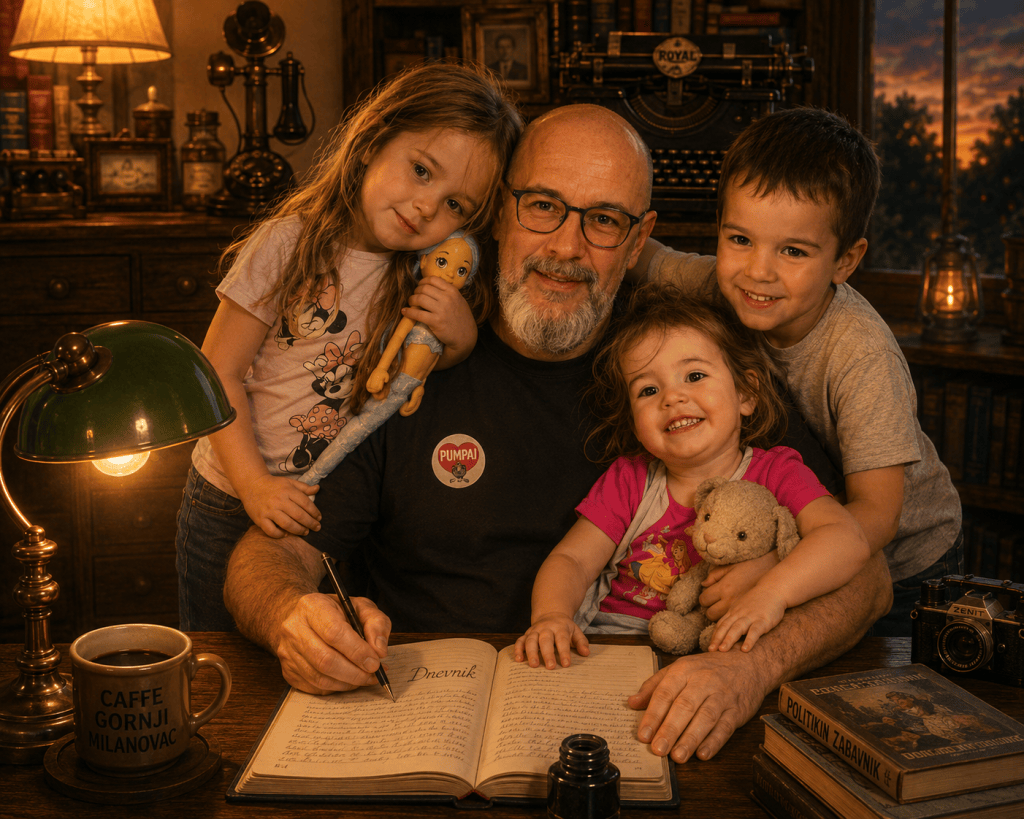
A TRILOGY OF OLD AGE
I have tried many times to keep a diary, only to give it up even faster. Naturally, I would quickly find a reason. Idleness is easy to justify; finding the motivation for its opposite is much harder. With time, a person learns that good writing does not require a great deal of philosophizing, because every journalistic and literary form rests, above all, on a good story. And good stories do occasionally happen even to ordinary mortals.
Today is Saturday. The right time to begin. Saturdays have always held a special place in my life, probably because Saturday was a day when one did not have to work. My situation is somewhat different now. Recently, every day has become Saturday for me—and Sunday too, for that matter. Since this newly minted Arizona retiree enjoys everyday life in a manner appropriate to his years, this diary should not be taken entirely at face value. As one reader of Kragujevačke once put it: “There may be some truth in there, but mostly he makes things up. He’s a writer. You can’t trust him!”
ONE SATURDAY IN AUGUST 2026
The day began on a lively note, with the loveliest noise a house can ever receive—the arrival of grandchildren. The siege of Grandma and Grandpa’s home involves soccer, with the doors serving as goalposts, dolls in strollers and, naturally, Barbie’s Dreamhouse. There are plastic knights as well, laying siege to a castle made of the very same material. And whenever our dearest guests have behaved themselves, we all sit down together to watch a Disney cartoon.
Once we have thoroughly spoiled them, we send them back to their parents—let them see what it’s like! After lunch, everyone departs for home, while Grandpa heads straight to the park to burn off the excess calories. I follow my usual route, avoiding the busier streets. Only one traffic light to cross—I should survive. Ready, steady, go…
At the entrance to the park, dog walkers exchange experiences, though none of them is listening to anyone else. Each talks exclusively about their own “baby.” An overweight woman, engaged in a gentle jog, is approaching a bench where her husband awaits her with hamburgers that are still steaming. On the playground, a group of boys is examining something. Their ball has been abandoned off to one side while they study a wooden object with great care.
“What have you got there, boys?” I ask, intrigued.
“An old clock, but it’s got some computer chips in it,” says a red-haired rascal.
“Be careful. It could be a bomb,” says the anxious Tito Pioneer within me, the one who was taught at school that the enemy never sleeps.
“Don’t worry. My grandpa made it. Crazy Scientist George. Interested in buying it? I’ll let you have it for forty dollars.”
“Twenty!” I fire back.
“Sold.”
I abandon my walk and hurry home at a half-run. I shut myself in my room as though I were about to do something forbidden, open the little door from which the cuckoo would ordinarily emerge—and discover an entirely different world.
CHILDHOOD
The clock carries me into the past, half a century and a little more… Back to the days when I kept my first diary.
Winter, 1969. In the corner of the dining room, the oil stove rattled and thumped. Milky coffee still steamed from a polka-dot cup on the table, while the whiteness of a porcelain plate was disturbed by slices of fried bread, yellow as lemons and made with eggs from our own hens. For a boy of my age, I handled letters rather skillfully, so, following the example of an older friend from the neighborhood, I decided to keep a diary. I respected words and sentences, but drawings and pictures were still closer to my heart. Lunov Magnus and The Golden Series somehow always managed to outplay the literary midfield of Mato Lovrak, Branko Ćopić, and Ferenc Molnár.
The days passed easily and without obligation. Life moved slowly; growing up was intense. Every Friday, however, the world around me began to turn much faster, while the entire household adapted itself to the state of emergency inside my head. It marked the beginning of the fulfillment of the age-old ambitions of the artistic side of my humble self, all embodied in a fascinating cultural project.
And so, from early morning, lunch would be simmering on the stove while Grandma and I hurried toward an institution that played no small part in shaping the carefree days of my earliest childhood.
“Stop dawdling or we’ll be late to the newsstand!” Grandma Mica would urge me.
The nearest kiosk stood beside Kolonska Gate. Bravely, we forced our way through snowdrifts and fearlessly broke a path past the snowbound kindergarten. Then we would turn sharply right and, passing Žika’s and Pućko’s houses, reach the magnificent linden trees in Laza Marinković Street, which led us directly to Andra, Laza’s namesake by surname, and to Kolonska Gate.
The kiosk stood proudly on the corner. A beautiful young woman worked there, always smiling, a colorful scarf draped casually around her shoulders. Silently, I stared at the rosy faces of strangers. Like us, they stood obediently in line, patiently nurturing the hope that this time they too would manage to secure a copy of the comic Never Enslaved. I am speaking, of course, of the illustrated literary adventures of Mirko and Slavko.
The exploits of our brave Partisans thrilled me far more than the nonsense involving some Zagor, Blek the Rock, or Commander Mark. I enjoyed all seven enemy offensives, marveling at the grand epic of our fighters in the National Liberation Struggle and the revolution. Occasionally, even Comrade Tito would ride at the head of the column, while Boško Buha, appearing as a special guest, blew up several enemy bunkers. Meanwhile, a young Partisan woman regularly “hurled her bombs” and, with her irresistible Young Communist beauty, wrapped both Mirko and Slavko around her little finger with equal success.
It was wonderful while it lasted. But the woman in the colorful scarf began more and more often to call through the kiosk window:
“Don’t bother waiting. The papers from Gornji Milanovac aren’t coming today. Difficult road conditions, and snow that has once again taken the road crews by surprise this January. Don’t you people listen to the radio? All right, break it up! I need my breakfast. My neighbor Milovan brought me some pork cracklings!”
The revolutionary spirit and anti-fascist fervor gradually subsided, and my parents promised that from then on they would buy me Politika’s Zabavnik regularly—but only if I continued writing my diary. And so, once again, every Friday became an exception with Politika’s Zabavnik, although my first boyhood diary soon disappeared into one of the drawers.
BOYHOOD
While I tried in vain to pull the cuckoo out of the clock, the time machine carried me into my teenage years. Those were the days of endlessly long summer vacations, when the internet was not mentioned even in science-fiction movies. We did not stare at cell phones, but we read much more. Friendship questionnaires were all the rage then, but after reading Tolstoy’s trilogy Childhood, Boyhood, Youth, I took a yellow, hardbound notebook and began a new diary instead. My first entry was a memory from the seaside. And what a memory it was.
Summer, 1981. It was a Saturday when I saw her for the first time. She appeared in the garden of the Riva pastry shop, radiant in all her glory. From the very first moment, she bewitched me with her girlish warmth and divine beauty. Even today, after all these years, as I sail the endless oceans of memory, I stand once again on the deck of my mind and replay the scene that unfolded on that summer afternoon in the very heart of Makarska.
At Riva, directly across from the amusement park, they made the best ice cream in the world. The owner, a cheerful Dalmatian named Ante Kalabura, had mastered the confectioner’s trade in the Italian town of Sorrento. The house specialty, the subject of legends on both sides of the Adriatic, was a dessert with the simple, gentle, and remarkably original name Čupavko. Vanilla ice cream covered in caramel and rolled in a perfectly balanced mixture of ground hazelnuts, almonds, and walnuts.
From the very beginning, it was obvious that some secret bond connected us. She spoke to me absently, indifferently, without a care in the world:
“Don’t stare at me like that, bolan. You’re glowing like radioactive waste. You’re heating up the air and melting my ice cream!”
At that very moment, I dropped my crisp cone, spilling its contents onto the ground. Two scoops of frozen Čupavko slowly dissolved on the burning pavement. Confused and crimson with embarrassment, I finally began singing a few lines hastily composed by one desperate boy:
“Ice cream, ice cream,
you’re sweeter than a pie.
I know you like your ice cream—
and so, of course, do I!”
For a moment, the beauty seemed bewildered. Then I noticed a small circle of natural blush on her face, which was suddenly glowing with delight. Carried away by the energy of youth, she fluttered toward the beach and then farther and farther away… all the way to the deck of my mind, floating on the ocean of memory.
The following day, the crew of the tent anchored on lot B-158141 at the Makarska Youth Camp launched a complex intelligence operation. My fellow campers gathered the latest reports from the field. One discovered that the girl whose image had not left the broad landscape of my fantasies for a single moment was named Jadranka. Another learned that the beauty had arrived from Sarajevo and was staying in a private room directly opposite the post office. A third informed me that my beloved ate lunch at the El Toro restaurant.
I devised a strategy and decided to follow her everywhere. Wherever beautiful Jadranka went, crazy me would follow. I gathered the scattered crumbs of my courage and repeatedly failed to approach her.
Every evening, the band Galija played in the garden of the Youth Center. At the time, they were neither famous in the media nor politically acceptable. Through sheer musicianship, they were slowly clearing a path toward the summit of Yugoslav rock. “Avanturista” followed immediately after “Decimen,” while I patiently drank wine and waited for my favorite songs. Fortunately, I never made it as far as “U suton,” because instead of hearing how “the first stars and city lamps began to shine,” I heard a familiar voice:
“Well, look at you—such a brave man. A real hero! First you send those fools to follow me, and now you’re hiding under the table. Come on, bolan, for heaven’s sake, pick your heart up from your heels and take me for a walk on the beach!” Jadranka snapped, sounding more than a little disappointed.
I tried to clear my head as quickly as possible of a whole collection of unpleasant feelings: shame, humiliation, embarrassment… With an invisible sponge, I unsuccessfully attempted to erase the sentence echoing in my mind: “Open up, black earth, and let me disappear inside you!” Finally, I told myself: Come on, Šumadinac. Don’t bring disgrace upon your homeland!
Those were the distant, carefree, slightly absurd days when everything our parents warned us against was fashionable: cigarettes, alcohol, women, and cheating at cards. Anyone strange enough to follow a healthy diet voluntarily, to exercise, run, or walk without being forced, was said to be “not quite right in the head.”
Lost somewhere inside that mental landscape, I followed her and wished the enchantment would never end. A wave suddenly splashed the barefoot countess from Sarajevo. She turned sharply and kissed me. I trembled and floated somewhere high between dreaming and waking. We lay on the beach for a long time. I interrupted her lengthy monologues with kisses, determined to make up for lost time. Just before dawn, Jadranka suddenly became serious and wrote her address on a cigarette pack. She asked me to write to her regularly—“long letters.”
YOUTH
The memory of that teenage diary page set the clockwork of my retiree’s time machine in motion, and I remembered what came next.
A little more than ten years later, during the siege of Sarajevo, I often thought of my first boyhood love. Guided by reason, humanity, and love, I wrote on the back of an imaginary postcard verses that had not yet been written, verses that scattered like sparks through the depths of a troubled conscience.
Once more, as in the days gone by,
we’ll walk down Haulikova and through the old bazaar.
Marked by the threads of friendship,
we’ll leave our traces
in wet snow and on cobblestone.
Had Arsen’s verses existed then, and had the postcard been real, the answer would probably have read:
Why do you ask how we are?
We are alive. We are alive.


Leave a Reply